

Updated on 1 November 2026.
When people ask about solar EV charging, they usually mean one of two things. Some want to charge their own car from panels on their roof. Others want to run a charging station on solar. The answers are quite different, and so is the support from the government. This guide covers both, plus housing societies, which sit somewhere in between and get a subsidy most people don't know about.
Quick summary
- In India, 1 kW of solar panels makes about 4 units of electricity a day on average. Most electric cars go roughly 6 to 8 km on a unit.
- Homes get a central subsidy under PM Surya Ghar: ₹30,000 per kW for the first 2 kW and ₹18,000 for the third, up to ₹78,000. The scheme runs until 31 March 2027.
- Housing societies get ₹18,000 per kW for solar that powers common facilities, and EV charging counts.
- Commercial charging stations get no central solar subsidy. Solar can still cut costs, but the case is weaker than at home, because EV tariffs are already cheaper during sunny hours.
- With net metering you don't need a battery to "charge on solar". The panels earn credits by day and the car uses them at night.
How solar charging actually works
Most solar setups in India are on-grid. The panels feed your building and send any extra to the grid. A net meter records what you send out and what you take in, and you pay only for the difference. So when you plug in your car at night, it runs on grid power, but you're using up credit your panels built during the day. Over a month, if your panels make as much as you use, your bill for that use is close to zero.
The only way panels charge a car directly, in real time, is with a battery or with the car plugged in while the sun is out. For most homes, that's not needed. For charging stations, we'll come to batteries further down.
How much solar do you need for a car?
The government's own figures say 1 kW of rooftop panels makes 4 to 5.5 units on a clear sunny day. Across a whole month, with cloudy days and the monsoon, about 4 units a day is a safer number to plan with.
Most electric cars in India go roughly 6 to 8 km on a unit. So if you drive 40 km a day, you need about 5 to 7 units a day for the car, which is around 1.5 kW of panels just for driving. Your home uses power too, so most families who want to cover both end up at 3 kW or more.
Space-wise, plan on 10 to 12 square metres of shade-free roof for every kW. Shade from a water tank, a neighbour's building or a tree cuts output a lot, so a good installer will check the roof at different times of day.
For homes: PM Surya Ghar
PM Surya Ghar Muft Bijli Yojana is the central scheme for rooftop solar on homes. Here's how it works:
- Subsidy: ₹30,000 per kW for the first 2 kW, then ₹18,000 for the third kW. The most you can get is ₹78,000, which is reached at 3 kW. Bigger systems are allowed, but nothing extra is paid above 3 kW. North-eastern and hill states and some island UTs get a little more.
- Who can apply: households with a residential electricity connection.
- Conditions: panels must be made in India, including the cells, and the system has to be installed by a registered vendor.
- How to apply: register on the official PM Surya Ghar portal (pmsuryaghar.gov.in) with your electricity consumer number, pick a registered vendor, get the system installed, and the DISCOM fits a net meter and inspects. The subsidy is then paid into your bank account. Systems up to 10 kW don't need a separate feasibility approval from the DISCOM.
- Loans: collateral-free loans are available under the scheme for the rest of the cost.
- Deadline: the scheme runs until 31 March 2027.
One practical point. Adding a 7 kW car charger can push a home past its sanctioned load, especially if the AC and geyser are running at the same time. Solar doesn't fix that at night. Read single-phase or three-phase and a separate meter for your EV charger before you buy.
For housing societies: the subsidy most people miss
Under the same scheme, housing societies and RWAs get ₹18,000 per kW for solar that powers common facilities, and EV charging is specifically included. The subsidy is worked out on the smallest of three numbers: the size of the plant, 3 kW for every house in the society, or 500 kW. The solar has to be on a connection that serves only the common areas, not individual flats.
The scheme's own example: a society with 20 houses puts up a 100 kW plant. It gets the subsidy on 60 kW (20 houses × 3 kW), which comes to ₹10.8 lakh. For a society setting up shared chargers in the parking, that can pay for a good part of the power side. See our page on charging for housing societies.
For charging stations: does solar make sense?
It can, but go in with clear eyes. Three things to know:
1. There's no central subsidy for commercial solar. PM Surya Ghar is only for homes and housing societies. A petrol pump, hotel, mall or charging station pays the full cost of its solar. PM E-DRIVE, the central scheme for charging stations, has no solar part either.
2. Daytime grid power is already cheaper for EV charging. Under the Ministry of Power's 2024 guidelines, the tariff for a charging station's own connection should be 0.7 times the DISCOM's average cost of supply between 9 am and 4 pm, and 1.3 times at other hours, until 31 March 2028. States set the actual tariffs, but the idea is that sunny-hour power is cheap. Solar saves you the difference between its own cost and that cheaper daytime rate, which is a smaller saving than at home.
3. A station needs a lot of solar to matter. Take a 60 kW charger in use about 2 hours a day, which is close to what a typical public DC charger in India sees. If cars take around 40 kW on average, that's about 80 units a day. Matching that with panels needs roughly 20 kW of solar, or 200 to 240 square metres of shade-free roof or canopy. A busy station needs several times more.
Where solar does work well at a station:
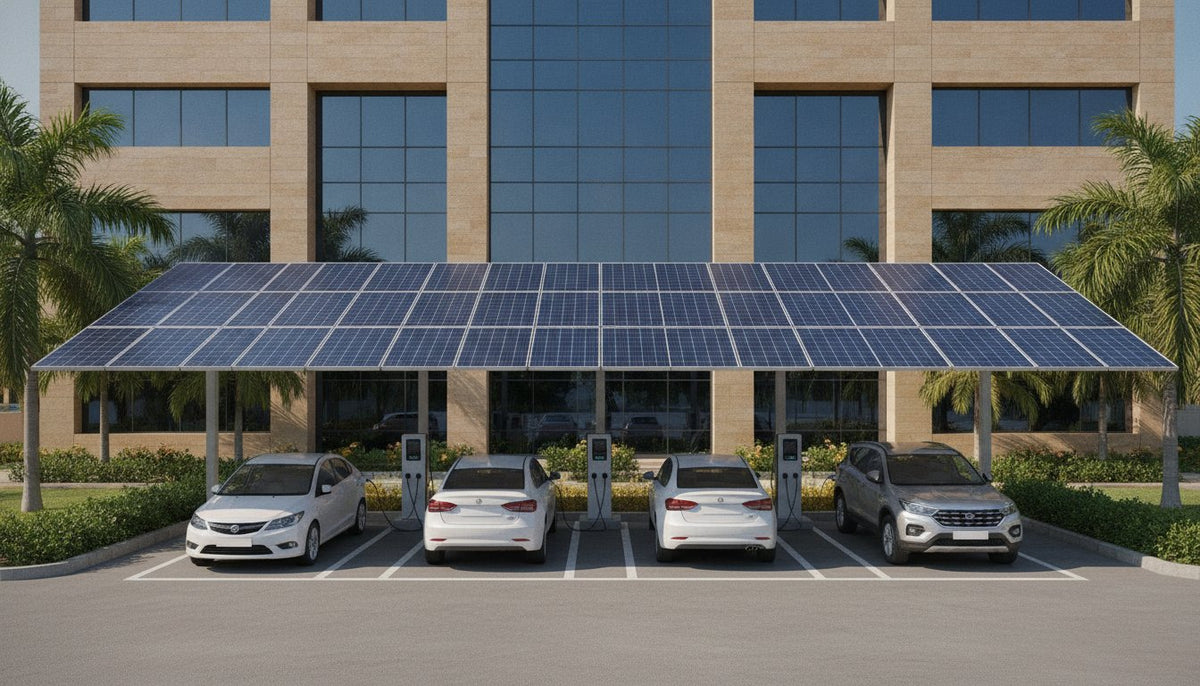
- When you have the roof or canopy space anyway. A solar carport over the bays is a natural fit, and the shade helps drivers too.
- When the site has other daytime load, like a shop, café or office, so all the solar gets used.
- Under net metering, where your state allows it for your connection size. The default national rule allows net metering up to 500 kW or your sanctioned load, whichever is lower, but states set their own limits.
Bigger users have another route. Under the Green Energy Open Access Rules, a consumer with 100 kW or more of contract demand can buy solar or wind power from elsewhere. Smaller users can ask their DISCOM for a green tariff instead.
What about batteries?
A battery lets you store daytime solar for the evening, run a fast charger on a weak supply, or cut the peak load that drives up demand charges. Those are real benefits at some sites. But batteries add a lot to the cost, and the central battery subsidies are for large grid-scale projects, not for a home or a single station. For most homes a battery isn't needed at all. For a station, it's worth working out only if your supply is weak or your demand charges are high.
Mistakes to avoid
- Not checking for shade across the day and across the year.
- Not checking whether the roof can take the weight of the panels and structure.
- Assuming every state's net metering rules are the same. Check yours before you size the system.
- Expecting panels to run a DC fast charger directly. They don't, unless there's a large battery in between.
- Buying a battery you don't need.
What we'd do
At home, size the solar for your family's use plus about 1.5 kW for every 40 km you drive a day, apply through PM Surya Ghar, and pick a home charger that suits your car and supply. In a housing society, look hard at the common-facility subsidy before planning shared chargers.
For a charging station, start with the chargers and the power connection, then add solar where you have the space. Our cost and earnings calculator can include solar in the estimate. For a site-specific answer, book a site survey.
Frequently asked questions
How much solar do I need to charge an electric car in India?
One kW of panels makes about 4 units a day on average, and most electric cars go roughly 6 to 8 km on a unit. Driving 40 km a day needs about 5 to 7 units, so around 1.5 kW of solar just for the car, on top of what your home uses.
Is there a subsidy for solar EV charging at home?
Yes, through PM Surya Ghar Muft Bijli Yojana: ₹30,000 per kW for the first 2 kW and ₹18,000 for the third kW, up to ₹78,000. It is for residential connections and runs until 31 March 2027.
Do housing societies get a solar subsidy for EV charging?
Yes. Societies and RWAs get ₹18,000 per kW for solar that powers common facilities, including EV charging, on the smallest of the plant size, 3 kW per house, or 500 kW.
Is there a subsidy for a solar-powered commercial charging station?
No central one. PM Surya Ghar covers only homes and housing societies, and PM E-DRIVE has no solar component. Check your state's solar policy for any local incentive.
Do I need a battery to charge my EV with solar?
Not with an on-grid system and net metering. The panels earn credits during the day and the car uses them at night. A battery is only worth it for backup, a weak supply, or cutting peak demand at a station.
Can solar panels run a DC fast charger directly?
Not on their own. A DC fast charger draws far more power than a typical rooftop or carport system makes at any moment, so the grid or a large battery supplies it. Solar lowers the bill by offsetting what the station buys.


