
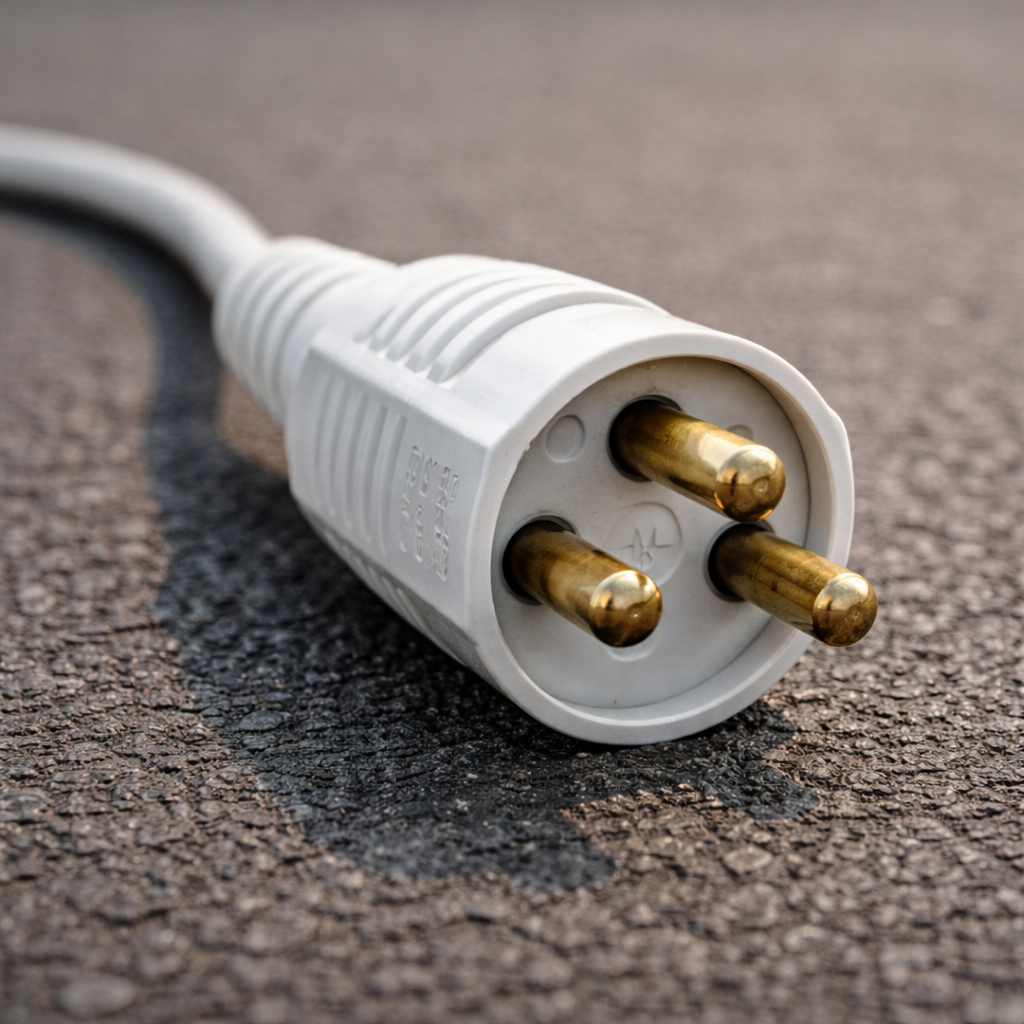

Yes, you can charge your electric car from a regular 15A socket in India. Most EVs sold here — Tata Nexon, MG Windsor, Tata Punch — come with a portable charger that plugs directly into a standard 15A wall socket. It delivers about 2.5 to 3.3 kW of power, which means a full charge takes anywhere from 12 to 15 hours depending on your battery size. It works, it’s safe (with the right precautions), and for many people it’s enough — especially when you’re charging overnight and not driving more than 30-40 km a day.
What Happens When You Plug Into a 15A Socket
When you connect your portable charger to a 15A socket, the charger draws about 2.5 to 3.3 kW of power (depending on the charger that came with your car). Your car’s onboard converter takes that AC power, converts it to DC, and feeds it into the battery.
The speed is limited by the socket’s capacity. A standard Indian 15A socket on a 230V supply can safely handle about 3.3 kW continuously. That’s not a lot when you’re filling a 38 kWh battery (like the MG Windsor) — it takes roughly 12 hours from near-empty to full.
But here’s the thing most people don’t consider: how often is your battery actually near-empty? If you’re commuting 30-40 km a day, you’re only using about 5-6 kWh of charge. Topping that up from a 15A socket takes just 2-3 hours. So in daily practice, the slow speed is rarely an issue if you plug in when you get home.
When a 15A Socket Is Perfectly Fine
A regular 15A socket works well in a few common situations.
If your daily driving is under 40-50 km, you’re using maybe 6-8 kWh per day. Plugging in overnight for 3-4 hours is enough to replenish that. You’ll wake up with more than enough charge for the next day.
If you’re renting and can’t install a permanent wall charger, the 15A socket is your best option. No installation, no electrician, no permissions needed. Just plug in and charge. A portable charger from ZEVpoint works exactly this way — it goes wherever you go.
If you have a second car or don’t drive daily, the slow charging speed genuinely doesn’t matter. Your car can sit plugged in during the day or overnight and be ready whenever you need it.
If you’re still evaluating whether an EV fits your lifestyle, start with the 15A socket. It costs nothing extra and gives you a real sense of how home charging works before you invest in a dedicated setup.
And if you want more control without upgrading your electrical setup, there’s an interesting middle ground — a smart 3.6 kW charger like the ZEVpoint Aveo Plus. It still runs on a 15A socket, but gives you app-based features like charging current control, scheduling, and consumption monitoring. These are features usually found only in higher-power wall chargers, but the Aveo Plus brings them to the 3.6 kW range. For low-distance daily drivers who want smart charging without a major installation, it’s a practical option.
When You Should Consider Upgrading
The 15A socket starts to feel limiting in certain scenarios.
If you drive more than 60-70 km daily — that’s roughly 10-12 kWh to replenish — you’d need 4-5 hours of charging every night. That still works if you have a predictable routine, but there’s less buffer. A day when you come home late or forget to plug in could leave you short the next morning.
If you need to charge quickly between trips — say you do multiple errands or have an unexpected drive — waiting 10+ hours for a meaningful charge is frustrating. A 7 kW charger cuts that to about 3-4 hours for the same amount of energy. And 7 kW is increasingly becoming the norm for home charging in India, so if you’re setting up a dedicated charger, this is the sweet spot most people go for.
If your home’s wiring is older or the 15A socket is shared with other heavy appliances (geyser, AC, microwave on the same circuit), drawing 3 kW continuously for hours can stress the wiring. You wouldn’t necessarily see a problem immediately, but it’s not ideal long-term.
An interesting option here is the ZEVpoint Dash AIO — it’s a charger that can work as both a 3 kW portable charger and a 7 kW wall charger. When you’re at home with a dedicated connection, you use it at 7 kW for faster charging. When you’re travelling or need to charge from a regular 15A socket somewhere else, the same unit works at 3 kW. It’s essentially two chargers in one, which means you don’t have to buy a separate portable charger as backup.
Charging Time: 15A Socket vs Dedicated Charger
Let’s compare real charging times using the MG Windsor EV (38 kWh battery) as an example:
| Charging Method | Power | Full Charge Time (10-100%) | Time to Add 40 km Range |
|---|---|---|---|
| Standard 15A socket (portable charger) | ~3.3 kW | ~12 hours | ~2 hours |
| Dedicated wall charger (7.4 kW) | 7.4 kW | ~7 hours | ~50 minutes |
| Higher-power wall charger (11 kW) | 11 kW | ~4.5 hours | ~35 minutes |
The “time to add 40 km range” column is the most practical number to look at. That’s roughly a day’s commute for most people. On a 15A socket, it’s about 2 hours. On a 7.4 kW charger, it’s under an hour. Both are perfectly manageable overnight, but the dedicated charger gives you a lot more flexibility during the day.
Safety Dos and Don’ts
Charging from a 15A socket is safe as long as you follow some basic precautions. These aren’t EV-specific rules — they apply to any high-draw appliance running for extended hours.
Make sure the socket is a proper 15A rated socket, not a 5A one. Indian homes have both — the 15A socket has larger pins and wider pin holes. Never use a 5A socket or an adapter to step down from 15A to 5A. The wiring can’t handle the sustained load and it’s a fire risk.
Use a dedicated circuit if possible. Ideally, the 15A socket you charge from shouldn’t be on the same circuit as your geyser, AC, or other heavy appliances. If multiple high-draw devices run on the same circuit simultaneously, the MCB may trip — or worse, the wiring can overheat if the MCB is oversized.
Check your earthing. A proper earth connection is non-negotiable for EV charging. The portable charger has built-in safety checks and will refuse to charge if it doesn’t detect earthing. If your socket doesn’t have functioning earthing, get an electrician to sort it out before you start charging — it’s a straightforward fix.
Don’t use extension cords or multi-plug adapters. The portable charger should go directly into the wall socket. Extension cords add resistance, generate heat at the connection points, and are not rated for sustained 3 kW loads over many hours. This is one of the most common mistakes people make.
Inspect the socket periodically. After a few months of daily charging, check if the socket or plug feels unusually warm, or if there’s any discolouration around the pins. These are signs of a loose connection that needs tightening or socket replacement.
The Portable Charger Advantage
The portable charger that works with a 15A socket isn’t just a starter option — it has genuine advantages even if you later install a wall charger at home.
It travels with you. If you’re visiting family, going on a holiday, or staying somewhere overnight, you can charge from any 15A socket. No need to hunt for a public charger. This is especially useful in smaller towns where public charging infrastructure is still catching up.
It works as a backup — and this is a point worth stressing. Even if you have a 7 kW or 11 kW wall charger at home, having a 3 kW portable charger is something every EV owner should have regardless. You’ll use it when visiting relatives, on holiday, in emergencies, or anytime you’re away from your main charger. Any 15A socket in the country becomes a charging point. It’s the kind of thing you don’t think about until you need it, and then you’re really glad you have it.
ZEVpoint portable chargers plug into any standard 15A socket and come with built-in safety features — earth detection, overcurrent protection, and temperature monitoring. They’re designed for the kind of daily, overnight use that Indian EV owners actually need.
Should You Start With a 15A Socket or Go Straight to a Wall Charger?
If you’re just getting your first EV, there’s nothing wrong with starting with the 15A socket and a portable charger. Use it for a few weeks, see how your actual driving and charging pattern works out, and then decide if you need something faster.
Many people find that the 15A socket handles their routine perfectly — they plug in after dinner, and the car is full by morning. If that’s your reality, you might not need to upgrade at all. And if you want smart features at this power level, the ZEVpoint Aveo Plus gives you app control, scheduling, and current adjustment — all while running on the same 15A socket.
If you already know your daily driving is on the higher side, or you just want the comfort of faster charging, going straight to a 7 kW wall charger makes sense. It requires a dedicated electrical circuit and proper installation, but once it’s in place, charging becomes noticeably quicker. And if you want the best of both worlds, something like the ZEVpoint Dash AIO lets you switch between 3 kW portable mode and 7 kW wall mode — so you get fast home charging and a travel charger in a single unit.
One thing to keep in mind regardless of what you choose: always have a 3 kW charging option available to you. Whether it’s a basic portable charger, an Aveo Plus, or a Dash AIO in portable mode — that 3 kW capability is your safety net. It works everywhere, needs no special setup, and ensures you’re never stuck without a way to charge. For a full walkthrough on setting up home charging, check out our home charging guide.
Browse ZEVpoint portable chargers and wall-mounted chargers to see what fits your needs.


