
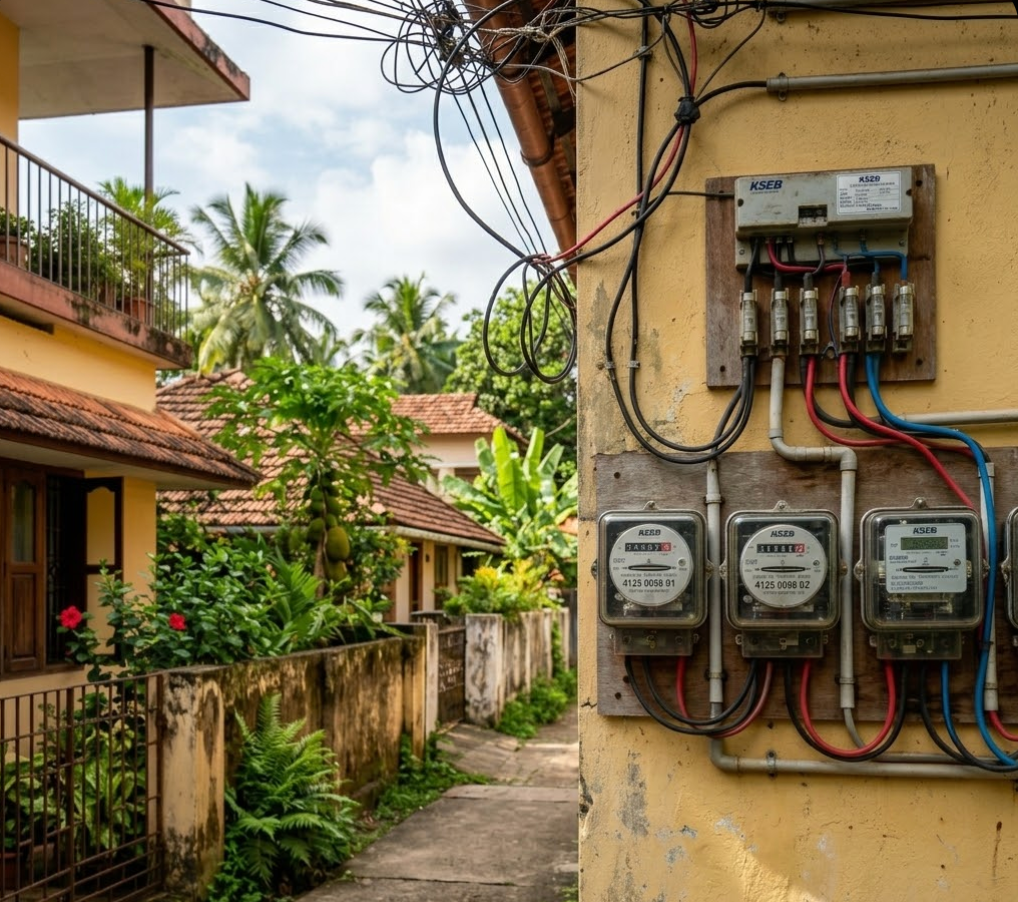

No, you do not need a separate electricity meter to charge your EV at home in India. Your charger draws power from your regular domestic meter, and the electricity consumed simply adds to your monthly bill. Most EV owners in India charge this way without any issues. However, some states offer discounted EV-specific tariffs if you install a dedicated meter for your charger — and in certain situations, that separate meter can save you money over time. Here's when it makes sense and when it doesn't.
The Default: Charging on Your Existing Home Meter
When you install an EV charger at home — whether it's a portable charger on a 15A socket or a wall-mounted 7 kW unit — it draws power from your existing domestic electricity connection. The units consumed by the charger get added to your regular monthly bill at your domestic tariff rate. No new meter, no separate connection, no DISCOM paperwork.
This is the simplest and most common setup for home charging in India. You buy a charger, get it installed (or simply plug it in for portable chargers), and start charging. Your DISCOM doesn't need to know or approve anything beyond what's already covered by your existing connection — as long as you stay within your sanctioned load.
The one thing to watch out for is your sanctioned load. Most Indian homes have a 5 kW sanctioned load, but some older or smaller connections may be as low as 2-3 kW. Whatever charger you're installing — even a basic 3 kW portable unit — check your sanctioned load first. If the charger pushes your total connected load beyond the sanctioned limit, you'll need to apply for a load enhancement (and for loads above 5 kW, likely upgrade to three-phase). But this is a load upgrade, not a separate meter — your billing still runs through the same meter. For a detailed look at how the sanctioned load works, read our single phase vs three phase guide.
When a Separate Meter Makes Sense
Some Indian states have introduced dedicated EV tariff categories — special electricity rates that are lower than standard domestic tariffs, specifically for EV charging. To access these rates, you typically need a separate meter dedicated to your EV charger. The charger runs on this dedicated meter, and you're billed at the lower EV tariff for that consumption, while the rest of your home continues on the regular domestic rate.
Whether this is worth it depends on three things: what EV tariff your state offers, how much you charge at home, and whether the cost and effort of getting a separate meter is justified by the savings.
State-Wise EV Tariff Rates
Here's what the major states currently offer for dedicated EV meter connections:
| State | EV Tariff (Dedicated Meter) | Regular Domestic Tariff (Higher Slabs) | Potential Saving per Unit |
|---|---|---|---|
| Delhi | ~₹4.50/kWh | ₹6-8/kWh (higher slabs) | ₹1.50-3.50 |
| Karnataka | ~₹4.50/kWh | ₹5-7/kWh (higher slabs) | ₹0.50-2.50 |
| Maharashtra | ~₹5-5.50/kWh (concessional) | ₹6-9/kWh (higher slabs) | ₹1-3.50 |
| Gujarat | Concessional (+ 100% duty exemption) | ₹4-6/kWh | Varies |
| Kerala | ToD-based: ₹5/kWh (solar hours), ₹9.30/kWh (non-solar) | ₹5-8/kWh (higher slabs) | Significant during solar hours |
The savings are most meaningful in states where the gap between the EV tariff and your domestic slab rate is large. In Delhi, for instance, if you're in the higher domestic slabs (₹7-8/kWh) and the EV tariff is ₹4.50/kWh, you save ₹2.50-3.50 per unit. At about 100-120 units of EV charging per month (typical for daily commuters), that's ₹250-420 saved per month, or ₹3,000-5,000 per year.
In states where domestic tariffs are already low (Gujarat, parts of Madhya Pradesh), the gap is smaller and a separate meter may not justify the effort. For a broader look at charging costs across states, read our EV charging cost breakdown.
The Slab Benefit: A Hidden Advantage
There's another reason a separate meter can help, and it's one most people overlook: electricity slab rates. In India, domestic tariffs are structured in slabs — the more units you consume, the higher the per-unit rate. If your home already consumes 300-400 units a month (AC, geyser, kitchen appliances), you're likely in a higher slab. Adding 100-120 units of EV charging pushes you even higher.
With a separate meter, your EV consumption is billed independently — either at a flat EV tariff or starting from the lowest domestic slab on a separate meter. Either way, it doesn't inflate your main home bill into higher slab territory. This slab separation alone can save money even in states that don't have a specific EV tariff category, simply because you're keeping your home consumption in a lower slab.
There's also the fixed charges angle. When you add EV charging load to your existing domestic connection, your sanctioned load increases — and with it, your monthly fixed charges go up on that domestic tariff. A dedicated EV connection with a subsidised EV tariff often has lower or waived fixed charges and demand charges (Maharashtra, for example, waives demand charges for EV connections). So the saving isn't just on the per-unit rate — it's on the fixed component of your bill too.
The math varies by state and by how much your household already consumes, so it's worth checking your current electricity bill, seeing which slab you're in, and estimating what 100+ additional units would cost in that slab versus on a separate meter.
How to Get a Separate EV Meter
The process is similar to getting any new electricity connection. Here's the general flow:
Contact your DISCOM (BSES/Tata Power in Delhi, MSEDCL/Adani in Maharashtra, BESCOM in Karnataka, etc.) and request a new metered connection for EV charging. Specify that you want the EV tariff category if your state offers one. In Karnataka, this is the LT-6(c) category. In Delhi, ask for the EV-specific subsidised rate.
The DISCOM will assess your premises, check the power availability, and install a separate meter — typically near your parking spot or at a location accessible for billing and reading. You'll pay a connection fee and possibly a security deposit (both vary by state and DISCOM).
The timeline is usually 2-4 weeks in urban areas, though it can stretch longer depending on the DISCOM's workload and whether any infrastructure work is needed.
Some DISCOMs allow sub-metering within your existing connection (a secondary meter downstream of your main meter), which is simpler and cheaper than a completely new service connection. Ask your DISCOM which option is available and appropriate for your setup. For information on government incentives that may offset some of these costs, check our government subsidies guide.
Apartment and Society Considerations
If you live in an apartment complex, the separate meter question has an additional layer. The Ministry of Power's guidelines and BEE's 2024 EV Charging Guidelines explicitly allow individual flat owners to install chargers at their parking spots and request separate metered connections from the DISCOM.
In practice, you have a few options depending on your building's layout:
You can pull wiring from your existing flat's electricity meter down to your parking spot. This is the simplest approach — no new connection, no DISCOM paperwork, your EV charging just adds to your regular bill. This works well if your meter is reasonably accessible and the wiring run isn't too long. However, for owners living on higher floors (say the 8th or 10th floor), running cable all the way down to basement or ground-floor parking can be impractical and expensive.
In many societies, especially newer ones, there's a common meter room on the ground floor or basement level where individual flat meters are located. If your meter is in such a common room close to the parking area, pulling a dedicated line to your parking spot becomes much more viable — shorter cable run, lower cost, and cleaner installation.
You can also get a completely separate dedicated EV meter at your parking spot from the DISCOM, billed directly to you and independent of the society's common meter. This is the cleanest approach for billing — no disputes with the RWA about how much electricity you're using, no complex cost-sharing calculations, and you get the EV tariff benefit if your state offers it.
Some societies prefer a fourth approach: a common EV charging setup with a shared meter, where individual usage is tracked through smart chargers and billed back to each car owner. All these models work. The right one depends on your building's meter layout, wiring feasibility, and how the RWA wants to handle things. For a detailed walkthrough of society-level charging setup, read our society/RWA charging guide.
Should You Get a Separate Meter? A Quick Decision Guide
Get a separate meter if: your state offers a dedicated EV tariff that's significantly lower than your domestic slab rate (Delhi and Karnataka are strong cases), you're already in a high domestic slab and adding EV charging would push you even higher, or you live in an apartment and want clean billing separation from the society's common meter.
Stick with your existing meter if: your state doesn't have a separate EV tariff category, your domestic tariff is already low (lower slabs in Gujarat, MP), your EV charging consumption is small (portable charger, short commute, 40-50 units/month), or the DISCOM process in your area is overly slow and complicated for the saving it would generate.
When in doubt, start with your existing meter. You can always add a separate meter later if your charging consumption grows or your state introduces better EV tariffs. There's no penalty for switching later — you're not locked into either approach.
Smart Charger Energy Tracking: The Practical Middle Ground
Even without a separate meter, a smart charger gives you session-wise and monthly energy tracking through the app. While this doesn't change your tariff, it does give you visibility into exactly how much your EV is consuming — useful for budgeting, for comparing against petrol costs, and for making an informed decision about whether a separate meter is worth pursuing. Keep in mind there can be a small accuracy difference between the charger's reading and the DISCOM meter, but it gives you a reliable ballpark to work with.
ZEVpoint's smart chargers across the Aveo and Polar series — portable and wall-mounted — all provide this energy tracking through the app, plus an on-device smart screen for quick visibility. If you decide later that a separate meter makes sense, you'll already have months of real usage data to base that decision on.
The Bottom Line
You don't need a separate meter to start charging your EV at home. Your existing domestic connection handles it just fine. A separate meter is an optimisation step — worth considering if your state offers a meaningful EV tariff discount or if your household consumption is high enough that slab separation saves money. Either way, it's a decision you can make after you've been charging for a few months and understand your actual consumption pattern.
Browse ZEVpoint chargers to find the right charger for your home — the meter question is independent of the charger you buy. And for a complete walkthrough on setting up home charging, read our home charging guide.


