
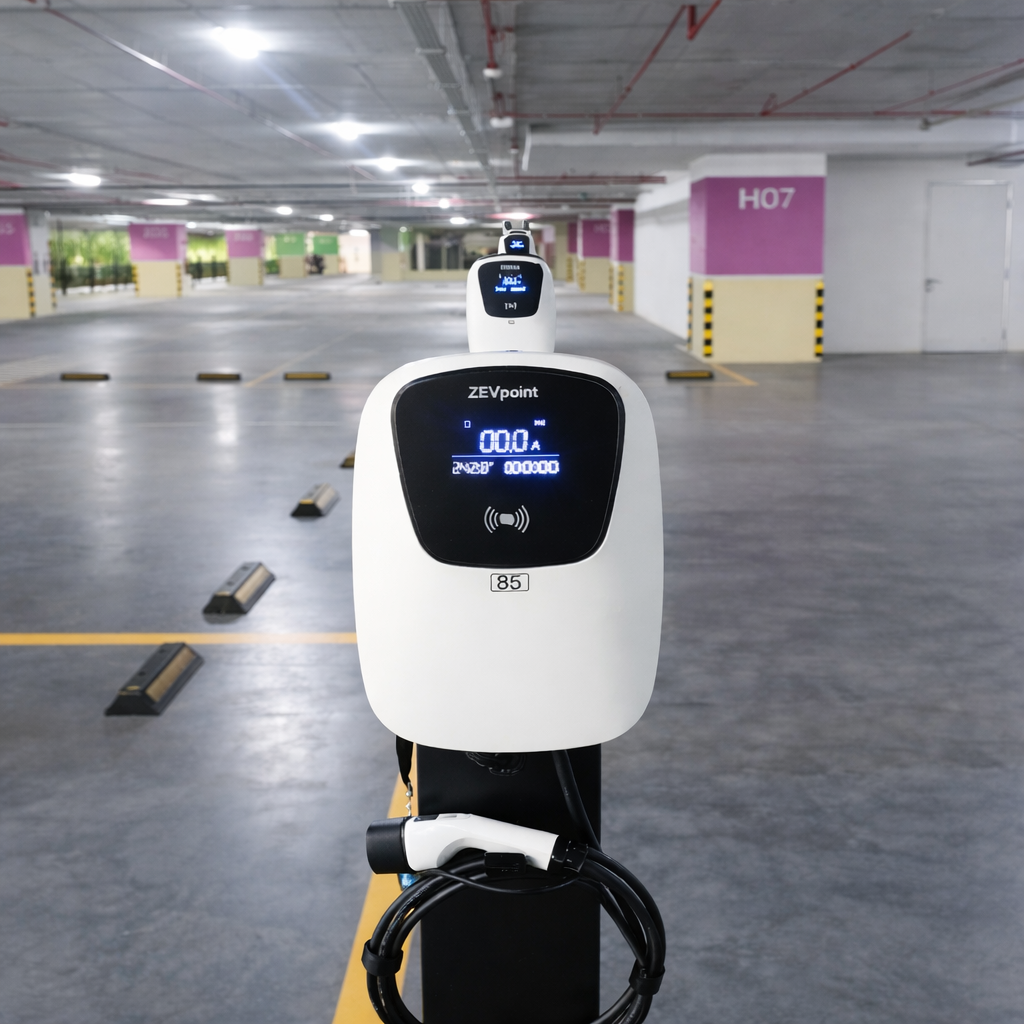

Setting up EV charging at your corporate office comes down to five steps: assess your building’s electrical capacity, choose the right chargers for your use case, get DISCOM approval for additional load if needed, install the chargers with proper safety infrastructure, and set up a management system for billing and access control. The whole process typically takes 4-8 weeks depending on your building’s existing electrical setup and DISCOM timelines. This guide walks you through each step with practical details relevant to Indian businesses.
Step 1: Assess Your Building’s Electrical Capacity
Before buying a single charger, you need to understand how much spare electrical capacity your building has. This is the most important step and the one most companies skip or rush through.
Start by talking to your building’s facility manager or electrical contractor. You need to know your total sanctioned load (in kW or kVA), your current peak usage, and the spare capacity available. The difference between sanctioned load and peak usage is what you have to work with for EV chargers.
For example, if your building has a sanctioned load of 200 kVA and your peak usage is around 150 kVA, you have roughly 50 kVA of headroom. That’s enough for about 6-7 chargers at 7 kW each, or more if you use smart load management (more on that later).
If your spare capacity is limited, you have two options: apply to your DISCOM for a load enhancement (Step 3), or use smart chargers with load balancing that dynamically adjust charging power based on available capacity. The second option is often faster and cheaper, and we’ll cover it in detail below.
Also check where your main distribution board is relative to the parking area. Long cable runs from the electrical panel to the parking lot add cost and can cause voltage drops. Ideally, you want the chargers within 30-50 metres of a sub-distribution board.
Step 2: Choose the Right Chargers
The type of chargers you need depends on how long vehicles typically stay parked at your office and who’s using them.
For employee parking — where cars sit for 8-10 hours during the work day — AC chargers in the 7 to 22 kW range are ideal. A 7 kW charger adds about 40-50 km of range per hour, which means even a 3-4 hour charging window during the workday gives most employees enough for their return commute and then some. There’s no need for fast charging when the car is parked all day anyway.
For visitor parking or client-facing spots — where cars might be parked for 1-2 hours — you might want a couple of higher-power AC chargers (11-22 kW) or even a DC fast charger (30 kW+) if you want to offer a premium experience. A 30 kW DC charger can add 150-200 km of range in an hour, which makes a noticeable difference for a short visitor stop.
For fleet vehicles — if your company operates EVs for deliveries, sales teams, or transport — overnight AC charging at 7-11 kW works well for vehicles that return to base daily. For mid-day top-ups, a DC charger at 30-60 kW can get a vehicle back on the road in 30-45 minutes.
Before deciding on numbers, check your local building norms. Some states and municipal authorities have already mandated that a certain percentage of parking in commercial buildings must be EV-charging-ready. If your building falls under such a regulation, that sets your minimum. Beyond compliance, look at your employee count and current EV adoption — for a larger office with strong EV uptake, you might need 15-20 chargers from the start, not just 4-5. The key is to size it based on your actual situation rather than a generic number.
Another decision to make early: will you offer charging free of cost as an employee perk, or will you charge employees for the electricity used? This affects your charger choice significantly. If you’re offering it free, you don’t necessarily need OCPP-enabled smart chargers with billing capabilities — non-OCPP chargers are simpler and more affordable, while still letting you monitor usage and control the chargers. OCPP adds value when you need user-level billing, access control, and detailed reporting, but it also adds cost. Having a clear charging policy in place before you buy hardware saves you from over-investing or under-investing.
Data privacy and collection is also worth thinking about upfront. If you’re tracking which employees charge, when, and how much — that’s usage data tied to individuals. Make sure your policy covers how this data is stored, who has access, and what it’s used for. This is especially relevant for companies with strict IT and compliance standards.
Companies like ZEVpoint have helped organisations like Amazon India, Merck, and Nvidia set up complete corporate charging hubs — from charger selection and electrical planning to management systems tailored to each company’s specific needs and policies.
Step 3: DISCOM Approval and Electrical Load
If your existing spare capacity is enough to handle the chargers you want to install, you may not need DISCOM approval at all — you’re operating within your already sanctioned load. But if you need additional power, you’ll have to apply for a load enhancement with your local DISCOM (electricity distribution company).
The process varies by state, but generally involves submitting an application with your required additional load, paying a connection charge or security deposit, and waiting for the DISCOM to upgrade your supply if needed (this can involve transformer upgrades in some cases).
Timelines range from 2-4 weeks for straightforward load enhancements to 2-3 months if transformer or infrastructure upgrades are involved. This is often the longest part of the process, so start early.
A few states — Delhi, Maharashtra, Karnataka, and others — have introduced dedicated EV charging tariffs for commercial establishments. These are typically lower than standard commercial rates and can significantly reduce your operating costs. Ask your DISCOM specifically about EV charging tariffs when you apply.
It’s also worth checking for government subsidies and incentives. Under various central and state schemes, businesses can get subsidies on charger installation or reduced electricity rates for EV charging.
Step 4: Installation and Safety Infrastructure
Once you have the electrical capacity sorted, the physical installation is relatively straightforward. Here’s what’s involved.
Cabling and distribution: Run dedicated circuits from your sub-distribution board to each charger location. Each charger should have its own MCB (miniature circuit breaker) and ideally an RCCB (residual current circuit breaker) for earth fault protection. Use cables rated for the charger’s power — your electrical contractor will size these based on the distance and load.
Earthing: Proper earthing is non-negotiable for EV chargers. Each charger point needs a reliable earth connection. In a commercial building, your existing earthing system is usually adequate, but it should be tested and verified before commissioning the chargers. Any charger worth installing will refuse to operate without proper earthing detected.
Mounting and placement: Wall-mounted chargers are the most space-efficient option for parking lots. Pedestal-mounted chargers work for open areas or islands between parking rows. Think about cable length — the charging cable needs to comfortably reach the car’s charging port regardless of which direction the car is parked.
Signage and markings: Mark the EV charging spots clearly with floor paint and signage. This prevents non-EV vehicles from occupying charging spots and makes the facility visible and usable for employees. It’s a small detail that makes a big practical difference.
The installation itself — for a set of 4-8 AC chargers — typically takes 2-5 days once the electrical preparation is done.
Step 5: Management, Billing, and Access Control
This is where most office charging setups either succeed or become a headache. Without a management system, you’ll end up with disputes over charger access, no way to track usage, and no way to bill employees if you choose to charge for electricity.
Smart chargers with OCPP (Open Charge Point Protocol) support connect to a central management platform that handles everything. Here’s what a good management system gives you:
Access control — restrict charger use to registered employees via RFID cards or an app. This prevents unauthorised use and lets you manage who has access to which chargers.
Usage tracking — see exactly how much energy each charger has delivered, to which user, and when. This data is essential for billing and for planning future expansion.
Billing options — you can offer charging as a free employee perk (common in companies trying to encourage EV adoption), charge at cost (just the electricity rate), or charge a small premium. The management platform handles the billing automatically.
Load management — this is a big one, and it works at two levels. The simpler approach is static load management, where you fix the maximum output of each charger at a set level. If your building can only spare 30 kW for charging, you set each of your 6 chargers to 5 kW max. You can change this limit anytime — bump it up at night when the building load is low, or dial it down during peak office hours. It’s straightforward and gives you full control without needing any complex setup.
The more advanced approach is dynamic load management (DLM), where the system automatically adjusts charging power in real-time based on the building’s available capacity. If the building’s power usage spikes (say, everyone turns on the AC at 2 PM), the system automatically reduces charging power to avoid overloading your supply. When the building load drops, charging power goes back up. DLM lets you install more chargers than your spare capacity would otherwise allow, because not all chargers need to run at full power simultaneously.
Scheduling — some systems let employees book charging slots, which prevents conflicts when you have more EV-driving employees than charger points. This becomes important as adoption grows.
How Many Chargers Do You Actually Need?
A common question, and the answer depends on how many employees currently drive EVs and your expected growth.
Right now, in most Indian offices, EV adoption among employees is still in single digits — maybe 5% of the workforce. But this number is growing rapidly. If you’re setting up infrastructure today, plan for where you’ll be in 2-3 years, not just today.
A practical approach: start with 1 charger for every 3-4 EV-driving employees. One charger can comfortably serve multiple users per day, since most employees don’t need a full 8-hour charge — a 3-4 hour top-up is usually enough for the commute home.
For a 200-person office with 10 EV owners today, start with 4-5 chargers. Build the electrical infrastructure (cabling, distribution board capacity) to support an additional 8-10 chargers so you can expand without re-doing the electrical work. This “build the backbone, add chargers gradually” approach is the most cost-effective.
Costs: What to Budget
Here’s a rough breakdown for a typical corporate setup of 4-6 AC chargers at 7 kW:
| Component | Approximate Cost |
|---|---|
| Chargers (4-6 units, 7 kW AC smart chargers) | ₹60,000 – ₹1,50,000 |
| Electrical infrastructure (cabling, DBs, MCBs, earthing) | ₹50,000 – ₹1,50,000 |
| Civil work (trenching, conduit, mounting, signage) | ₹20,000 – ₹60,000 |
| DISCOM load enhancement (if needed) | ₹20,000 – ₹1,00,000 |
| Management platform (annual, if cloud-based) | ₹10,000 – ₹50,000/year |
Total upfront cost for a 4-6 charger setup typically falls between ₹1.5 lakh and ₹5 lakh, depending on the building’s existing infrastructure and how much electrical work is needed. Costs scale roughly linearly as you add more chargers, though the per-charger cost drops since infrastructure is already in place.
If you offer paid charging to employees (even at cost), the electricity revenue offsets operating costs. And if you’re eligible for government subsidies, the effective cost can drop significantly.
Why Bother? The Business Case
Setting up office EV charging isn’t just a feel-good sustainability initiative. There are practical business reasons.
Employee retention and recruitment — in a competitive hiring market, workplace amenities matter. EV charging is increasingly seen as a modern, forward-thinking perk, especially by younger employees and senior professionals who are early EV adopters.
ESG and sustainability reporting — if your company tracks environmental metrics, workplace EV charging directly contributes to Scope 3 emission reductions (employee commuting). This is relevant for companies with ESG commitments, B Corp aspirations, or clients who care about supply chain sustainability.
Future-proofing — EV adoption in India is on a clear upward trajectory. Setting up charging infrastructure now, when demand is still manageable, is cheaper and less disruptive than retrofitting when half your parking lot needs chargers.
Cost is modest — compared to other workplace amenities (gym, cafeteria, parking itself), EV charging infrastructure is relatively inexpensive. The chargers themselves are a one-time cost, electricity is cheap (₹7-10/kWh on commercial tariff), and maintenance is minimal.
Getting Started
The first step is the electrical assessment. Get your facility team or an electrician to check your building’s spare capacity and the distance from the distribution board to the parking area. Once you have those two numbers, you can size the installation and get accurate quotes.
ZEVpoint offers commercial-grade smart chargers with tailored solutions to your use case — whether it’s app-based management, load balancing, or access control. If you’re exploring options, reach out to us and we can help you plan the right configuration for your office.
For related guides, check out our hotel EV charging guide and society/RWA charging guide for similar setups in different contexts.


