
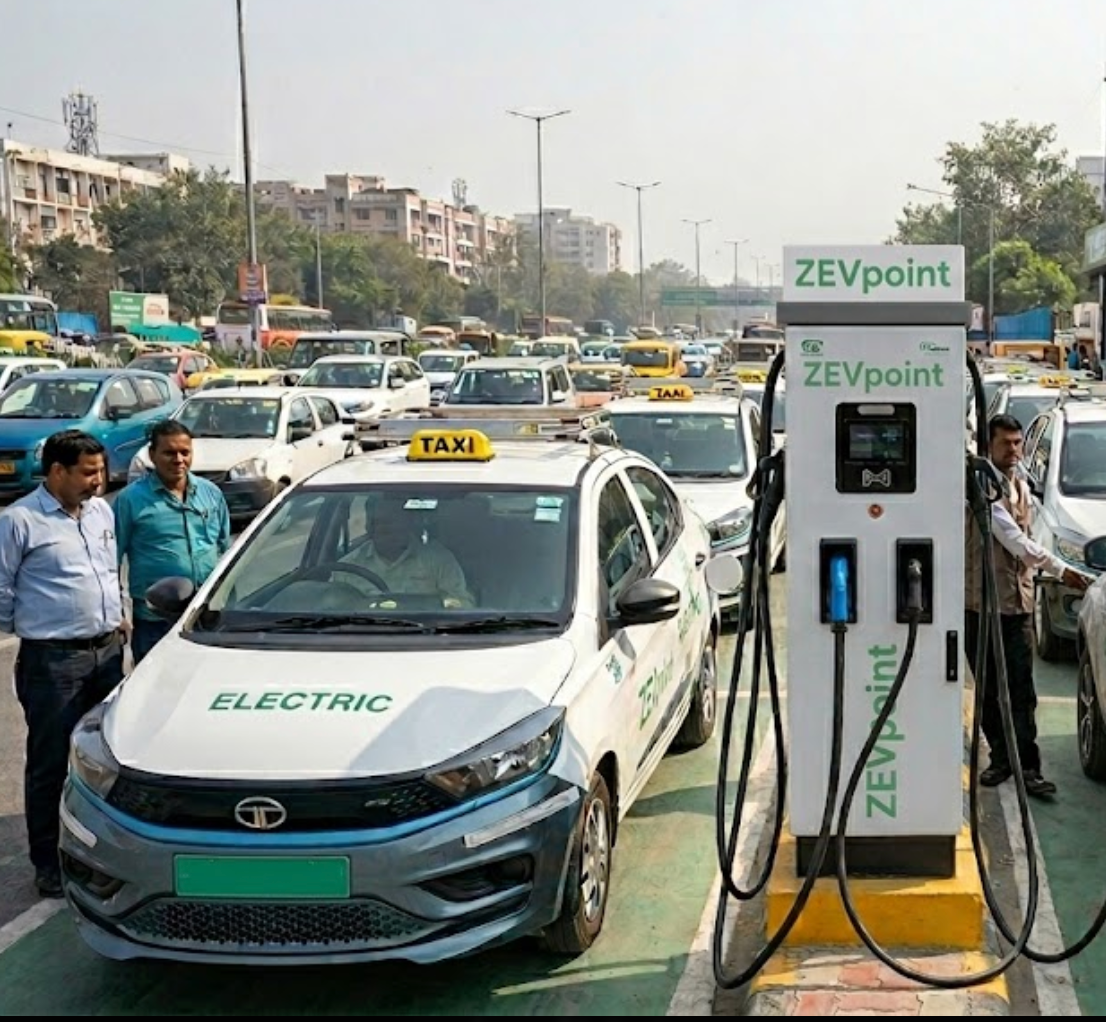

Electric taxi and cab fleets in India charge their vehicles using depot-based Type 2 AC chargers (7-22 kW) overnight and DC fast chargers (CCS2) for mid-shift top-ups. On depot charging, the running cost works out to roughly ₹1-1.5 per km — compare that to ₹6-8 per km on diesel or ₹7-10 per km on petrol in city driving conditions. Even when fleet cars charge at outside stations with tie-up rates, the cost stays around ₹2-4 per km. Uber is deploying 25,000 Tata XPRES-T EVs across 7 Indian cities, Everest Fleet operates 2,000+ EVs, and Lithium Urban runs electric corporate shuttle fleets in multiple metros. If you're running a taxi fleet, a cab aggregator service, or a corporate car pool — here's how fleet charging works and how to set it up.
The Scope of Fleet Electrification in India
Fleet electrification in India is happening across two broad segments, and it's worth understanding the distinction because the charging infrastructure is completely different for each.
The two-wheeler and three-wheeler delivery segment — companies like Amazon, Flipkart, Zomato, Swiggy, and fleet aggregators like Zypp Electric and Magenta Mobility — is the larger volume play. These fleets use proprietary chargers, battery swapping stations, and specialised connectors that are specific to their vehicle platforms. This segment is growing rapidly, with operators like Zypp running 22,000+ EVs and Amazon crossing 10,000 electric delivery vehicles. But the charging infrastructure here is very different from what we're discussing in this article.
The car-based taxi and cab segment is where standard Type 2 AC chargers and CCS2 DC fast chargers come in — the same infrastructure that charges personal EVs. This is the segment we're focusing on, because it's directly relevant if you're operating a taxi fleet, considering setting up fleet charging at your depot, or running a charging station that serves commercial cab operators.
Who's Running Electric Taxi Fleets in India
The electric taxi space in India has seen some dramatic shifts recently. The biggest players today:
Uber and Tata Motors signed a deal to deploy 25,000 Tata XPRES-T EVs across Delhi NCR, Mumbai, Kolkata, Chennai, Hyderabad, Bengaluru, and Ahmedabad. This is currently the largest single EV fleet deployment commitment in India's ride-hailing space. Uber is partnering with fleet operators like Everest Fleet and Lithium Urban to manage the vehicles and charging infrastructure on the ground.
Everest Fleet, based in Mumbai, manages 2,000+ electric cars across 7 major cities. They received $20 million in funding led by Uber in 2023 and are targeting 10,000 EVs by 2026. Their model is to own and manage the vehicles, provide them to drivers, and handle the depot charging infrastructure themselves.
Lithium Urban Technologies operates electric corporate shuttle and mobility services, partnering with both Uber and corporate clients for employee transport and business travel fleets.
What Cars Are Taxi Fleets Using
The most common electric cars in Indian taxi fleets today include the Tata XPRES-T EV (the primary fleet vehicle, designed specifically for commercial taxi use), BYD e6 (popular with premium fleet operators and airport transfer services), Tata Nexon EV, MG ZS EV, and Mahindra XUV400. The vehicle lineup keeps expanding as more manufacturers launch fleet-friendly EV options.
One important thing to note — virtually all electric cars available in India today come with a minimum 7 kW onboard charger (most are 6.6-7.2 kW). This means a 7 kW Type 2 AC charger at your depot will charge them at full AC speed. For overnight depot charging where you have 7-8 hours, this is perfectly adequate. For understanding how onboard charger ratings affect charging speed, read our 7kW vs 11kW vs 22kW guide.
How Fleet Depot Charging Works
Fleet depot charging follows a predictable pattern that makes it very different from public charging or individual home charging. You're managing a known number of vehicles, with known battery sizes and known daily utilisation. This predictability is actually your biggest advantage.
The overnight AC charging model is the backbone. Cars come back to the depot after the day's shifts (typically by 10-11 PM), drivers plug them into Type 2 AC chargers, and the cars charge overnight for 6-8 hours. By 5-6 AM, every car has a full battery and is ready for morning dispatch. A 7 kW charger adds roughly 35-45 km of range per hour, so in 7 hours you're adding 250-300+ km — more than enough for a full day's taxi operations. For a fleet of 20 cars, you need 20 Type 2 AC charging points at the depot. At ₹35,000-50,000 per charger, that's ₹7-10 lakh for the charger hardware alone, plus electrical infrastructure.
Mid-shift DC fast charging is the supplement for high-utilisation fleets. If a car does two shifts — morning and afternoon — and comes back with low battery between shifts, a 30-60 kW CCS2 DC fast charger can add 100-150 km range in about 30 minutes. This keeps the car operational without waiting for a full overnight charge. You don't need many DC chargers — typically 2-3 for a fleet of 20 cars, since not every car needs a mid-shift top-up every day. But the ones that do get turned around fast. For a deeper understanding of the difference, read our AC vs DC charging explained guide.
The charging cost is where the fleet model wins. At concessional EV tariffs of ₹5-6.50/kWh, charging a car with a 30 kWh battery costs roughly ₹150-200 per full charge — that's good for 250-300 km. Compare that to ₹2,000-3,000 worth of petrol for the same distance in city driving. Even when drivers occasionally need to charge at outside stations (where rates are ₹15-20/kWh with fleet tie-ups), the cost per km stays well below what petrol or diesel costs.
The Running Cost Comparison
The reason fleet operators are switching isn't environmental sentiment — it's the numbers. Here's the actual cost per kilometre for a taxi doing 150-200 km daily in city driving conditions (with AC on, stop-and-go traffic, which is the reality for taxis):
A petrol taxi in city driving gets roughly 10-12 km per litre with AC running. At ₹100-105 per litre, that's ₹8-10 per km. A diesel taxi does slightly better at 12-15 km per litre, but at ₹87-93 per litre, it still works out to ₹6-8 per km. An electric taxi charged at the depot on concessional EV tariffs (₹5-6.50/kWh) costs roughly ₹1-1.5 per km. Even when charging at outside stations with fleet tie-up rates (₹15-20/kWh), the cost is around ₹2-4 per km. That's a saving of ₹4-8 per km compared to petrol or diesel. For a car doing 200 km per day, that's ₹800-1,600 saved daily, or ₹24,000-48,000 per month per vehicle on fuel alone.
Maintenance savings add to this substantially. Electric cars have far fewer moving parts — no engine oil, no clutch, no exhaust system, no timing belt, no gearbox oil. Fleet operators consistently report 30-40% lower maintenance costs on EVs compared to their petrol or diesel equivalents. For a 20-car fleet, the combined fuel and maintenance savings are significant enough to make the business case self-evident.
The total cost of ownership (TCO) works out clearly in favour of electric for any fleet doing 100+ km per vehicle per day. The higher upfront cost of the vehicle is offset by the running cost savings within 2-3 years, and from that point on, every kilometre driven is dramatically cheaper than on a petrol or diesel vehicle.
Setting Up Fleet Charging Infrastructure
If you're setting up charging infrastructure for your own fleet, here's the practical approach:
Start with a fleet assessment. How many cars? What's the daily distance per car? Do all cars return to one depot or multiple locations? What are the shift patterns — single shift or double? For a single-shift taxi fleet doing 150-200 km per day, overnight AC charging at the depot handles everything. Double-shift operations need a few DC fast chargers for mid-shift top-ups.
For the electrical setup, calculate the total load. If you have 20 cars and install 7 kW AC chargers for each, that's 140 kW total if all charge simultaneously. But smart charging software can stagger start times — say 5 cars at 9 PM, 5 at 10:30 PM, 5 at midnight, 5 at 1:30 AM. This brings your peak demand down significantly, which directly reduces your DISCOM demand charges. A three-phase commercial connection is essential for any depot with more than 3-4 chargers. Apply for a commercial EV charging connection and specifically ask for the concessional EV tariff category.
For charger selection, plan for a mix of AC and DC. 7 kW Type 2 AC chargers are the workhorse for overnight charging — affordable, reliable, and they match the onboard charger rating of most fleet cars. But don't skip DC entirely. Having a few 30-60 kW CCS2 DC fast chargers at the depot means you can turn cars around in 30 minutes during the day — less idle time, more trips, more revenue. The ideal mix for most depots is AC chargers for every car (overnight) plus DC chargers at a ratio of about 1 per 8-10 vehicles (for daytime turnarounds).
Software and fleet management is where the operation scales. You need to track which cars are charging, current battery levels, energy consumption per vehicle, charging costs, and dispatch readiness. OCPP-enabled chargers allow you to manage all of this from a single dashboard — set charging schedules, stagger loads, monitor energy usage per charger, and get alerts if a car isn't charging properly or if a charger has faulted. ZEVpoint commercial solutions come with OCPP support, app-based monitoring, and smart scheduling features that work well for fleet deployments of this kind.
Smart Charging: Not Optional for Fleets
When you're charging 15, 20, or 50 cars at a single depot, smart charging isn't a nice-to-have — it's a necessity. Without it, you're dealing with simultaneous charging loads that spike your electricity demand and your DISCOM bill, no visibility into which cars are ready for dispatch and which aren't, and no way to optimise for the cheapest electricity hours.
Smart chargers with scheduling and load management solve this. Stagger charging across vehicles — start one batch at 9 PM, the next at 11 PM, the next at 1 AM. The total energy consumed is the same, but the peak demand is one-third, which directly reduces your demand charges. In states with time-of-day tariffs, the software can automatically push charging to the cheapest hours. Over a 20-car fleet, this kind of optimisation can save ₹15,000-25,000 per month on electricity bills alone.
Energy monitoring per vehicle also doubles as fleet health management. If a car is consistently consuming more energy per km than others in the fleet, it could indicate tyre issues, aggressive driving patterns, or early signs of battery degradation. The data from your charging system helps you spot problems before they turn into expensive repairs or range complaints from drivers.
Location Strategy for Fleet Charging
The depot isn't the only place where fleet vehicles need charging. Here's how smart fleet operators think about charging locations:
Primary depot: This is where 80-90% of charging happens. Overnight AC charging for the full fleet. This should be close to the area your cars operate in, ideally with affordable rent and a DISCOM connection that supports the load you need.
Secondary charging hubs: For fleets operating across a large city, having 1-2 satellite charging locations (a few chargers at a second depot or partnering with an existing public charging station) reduces the dead kilometres drivers accumulate travelling back to the main depot for mid-shift charges.
Public charging network as backup: Your drivers should know the public charging stations along their regular routes. For the occasional situation where a car runs lower than expected, having Google Maps, PlugShare, ZEVpoint, and other discovery apps on the driver's phone ensures they can find a nearby charger rather than getting stranded. For those interested in setting up their own public station alongside fleet charging, read our guide to starting a charging station business.
Government Support and Financing
The government's push supports fleet electrification through multiple channels. State-level concessional EV tariffs (₹5-6.50/kWh in most states, versus ₹8-10/kWh commercial rates) are the biggest ongoing benefit — this is what makes the per-km economics work. Several states also offer registration fee waivers, road tax exemptions, and permit fee reductions for electric commercial vehicles.
For charging infrastructure, PM E-DRIVE subsidies on charging stations are primarily available to government entities and their CPO partners — not directly to individual fleet operators. However, state-level incentives vary. Delhi has offered subsidies for charging point installation, and Maharashtra provides viability gap funding for DC fast chargers. Check what's available in your state through our government subsidies guide.
For financing the vehicles and charging infrastructure, options like SBI EV Mitra and other bank schemes offer structured loans for commercial EV purchases. Several fleet leasing companies also offer EV-as-a-Service models where you don't buy the cars — you lease them with charging infrastructure included, converting the entire operation into a predictable monthly cost.
Getting the AC-DC Mix Right
The best fleet depots run a healthy mix of AC and DC chargers. AC handles your predictable overnight charging at low cost, while DC is what maximises vehicle output during the day — less idle time, faster turnarounds between shifts, and more revenue-generating hours per car. A fleet that only has AC chargers is leaving money on the table during peak demand hours when a car could be back on the road in 30 minutes instead of sitting at the depot for hours.
A practical ratio for most depots: about 1 AC charger for every 1.5-2 cars — by rotating vehicles through chargers during the night, you don't necessarily need a 1:1 ratio if you have smart scheduling in place. For DC, about 1 fast charger for every 8-10 cars handles daytime turnarounds comfortably. As your fleet grows and shift intensity increases, you can add more capacity on both sides without overhauling the entire setup.
A few things to watch out for — don't skip OCPP-enabled smart chargers. Without scheduling and load management, 20 cars starting to charge at the same time will spike your peak demand charges unnecessarily. Smart chargers stagger loads automatically and the monthly savings on demand charges alone justify the investment. Also, start your DISCOM connection application well before your fleet arrives — getting a new commercial EV connection can take 2-8 weeks depending on your city. DISCOMs are mandated to prioritise EV connections, but the paperwork still takes time. For understanding connector types used in fleet charging, read our connector guide.
The Bottom Line
Electric taxi fleets are already operational at scale in India — the running cost advantage of ₹1-1.5/km on depot charging versus ₹6-10/km on petrol or diesel is too significant for any fleet operator to ignore. Even charging at outside stations with fleet tie-ups keeps the cost at ₹2-4/km. The right mix of AC for overnight and DC for daytime turnarounds keeps your vehicles productive and your costs low.
Setting up fleet charging infrastructure isn't just about buying chargers — it's about the complete ecosystem. ZEVpoint has been actively contributing to India's growing EV fleet space by helping operators set up end-to-end charging hubs — from the charging hardware itself (AC and DC) to the OCPP-based software for scheduling, load management, energy monitoring, and remote diagnostics. Companies like Amazon India, Merck, and Nvidia, along with hospitality brands like Hyatt, Wyndham, ITC, and Echor, already rely on ZEVpoint's infrastructure for their fleet and guest charging needs. Whether you're starting with 5 cars or scaling to 50, the approach is the same — get the infrastructure right from day one, and the operational savings take care of the rest. Also see our corporate EV charging guide and hotel EV charging guide for related setups.


