
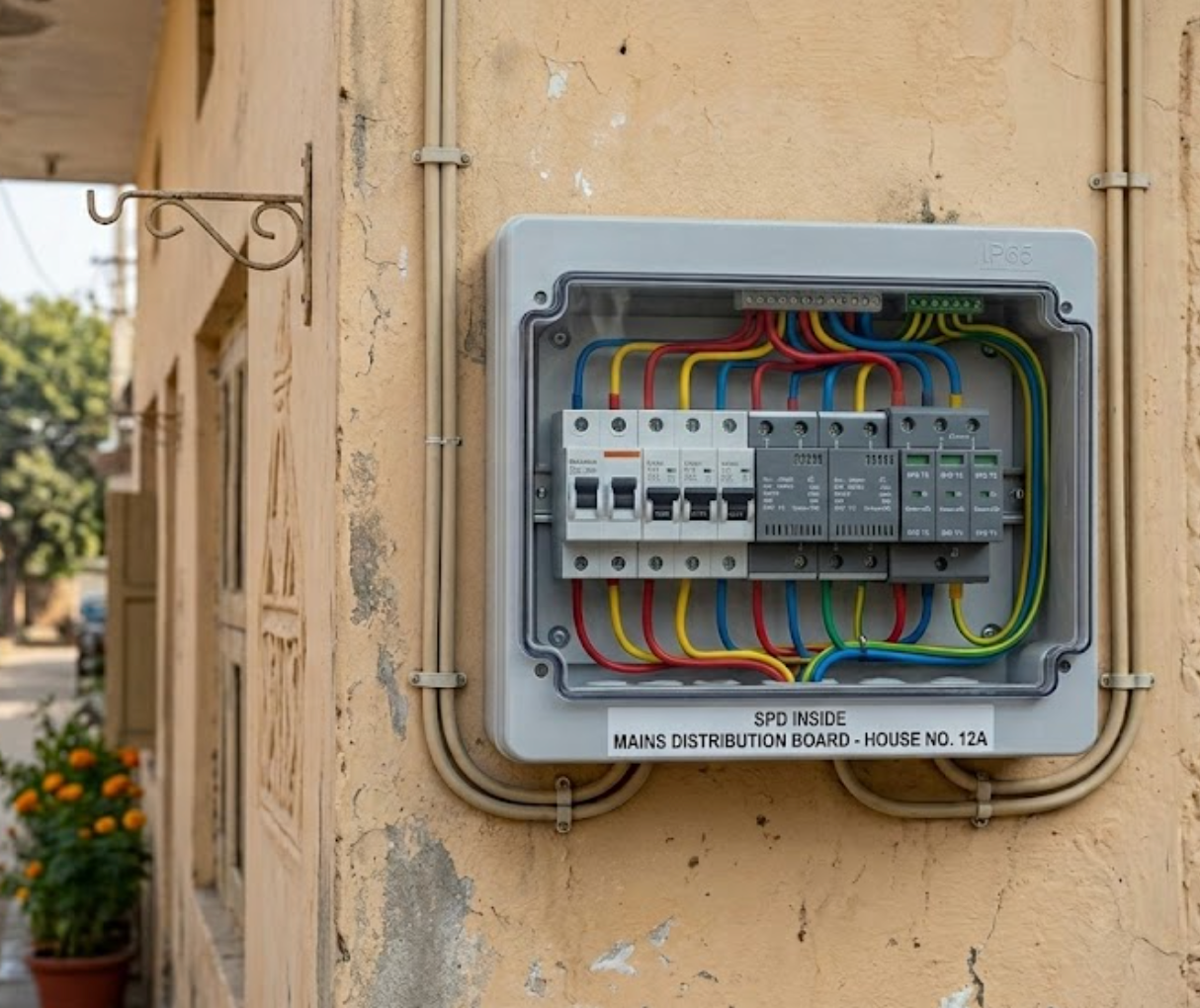

Every EV charger installation needs a set of electrical safety devices — MCB (Miniature Circuit Breaker), RCD (Residual Current Device), SPD (Surge Protection Device), and proper earthing. These are the devices that protect you from electric shock, protect your charger and car from power surges, and prevent electrical fires. Here's what each device does, what rating you need for your charger, and why your electrician should never install a charger without them.
Why This Matters More Than You Think
An EV charger pulls significant power — a 7 kW charger draws about 30-32 amps continuously for 5-8 hours every night. That's a heavy electrical load, sustained for long periods, often while you're asleep. Compare that to your AC which cycles on and off, or your geyser which runs for 20-30 minutes. The sustained high current means the wiring, connections, and protective devices need to be right. A loose connection or faulty wire under sustained 30A+ load can overheat and cause a fire. A ground fault without an RCD can electrocute someone touching the car or charger. A lightning-induced surge without an SPD can fry the charger's electronics.
MCB: Overcurrent and Short-Circuit Protection
An MCB (Miniature Circuit Breaker) is the most basic safety device — it cuts off power when the current flowing through the circuit exceeds its rated capacity, or when a short circuit occurs. Think of it as the gatekeeper that prevents your wiring from overheating and catching fire.
You already have MCBs in your home for your AC, geyser, and other circuits. The EV charger needs its own dedicated MCB, and the rating needs to be chosen carefully. Here's something many people get wrong — for a 7 kW charger that draws about 30-32A, you might think a 32A MCB is the right match. It's not. MCBs are designed for continuous duty at roughly 80% of their rated capacity. A 32A MCB running at 30-32A continuously for 5-8 hours will heat up and nuisance-trip because it's operating right at its limit. We recommend a 40A MCB for a 7 kW charger — this gives the thermal headroom for sustained charging without false tripping. For three-phase chargers, the current splits across three phases so the per-phase amperage is much lower — an 11 kW charger draws about 16A per phase, so a 20A 4-pole MCB is the right choice. For 22 kW, it draws about 32A per phase, so a 40A 4-pole MCB works (same 80% logic as the 7 kW single-phase setup). Make sure it's a Type C MCB — this type can handle the small inrush current that occurs when charging starts without false-tripping. For help choosing the right charger power rating, see our 7kW vs 11kW vs 22kW guide.
MCBs typically cost ₹800-1,200 depending on brand and rating. Havells, Schneider Electric, Legrand, and ABB are the common choices in India.
RCD: Protection Against Electric Shock
An RCD (Residual Current Device, also called RCCB in India) is what protects you and your family from electrocution. It continuously monitors the current flowing through the live and neutral wires. If there's a mismatch — meaning some current is leaking through a fault path (like through a person's body, or through damaged insulation to the car's metal body) — the RCD trips within milliseconds and cuts off power.
For EV chargers, the standard requirement is 30mA sensitivity — meaning the RCD trips if it detects even 30 milliamps of leakage current. That's well below the threshold that can cause serious harm to a person.
Here's where it gets important for EV charging specifically. Normal household RCDs are Type A — they detect AC leakage currents and pulsating DC currents. But EV chargers, because of the electronics inside the car's onboard charger, can produce smooth DC fault currents. A Type A RCD alone cannot detect smooth DC faults. This is why IEC 61851 (the international standard for EV charging) mandates either a Type B RCD (which detects all types of fault currents including smooth DC), or a Type A RCD combined with a 6mA DC fault detection device built into the charger.
Many quality EV chargers, including ZEVpoint's wall-mounted and portable charger range, come with Type A RCD plus 6mA DC detection built into the charger itself. In such cases, an external Type A RCD at the distribution board provides additional backup protection, and the charger handles the DC fault detection internally. If your charger doesn't have built-in DC fault protection, you need a Type B RCD externally. Always check your charger's specifications or ask the manufacturer.
RCBO: An Optional All-in-One
An RCBO (Residual Current Circuit Breaker with Overcurrent protection) combines the MCB and RCD into a single device — overcurrent protection, short-circuit protection, and residual current protection all in one unit. If your distribution board is tight on space, or if you want a cleaner setup with better fault isolation (only the EV circuit trips during a fault, leaving other home circuits intact), an RCBO is a convenient option.
That said, an RCBO is not mandatory. If you already have a properly rated MCB and your charger has built-in RCD protection (as most quality chargers do), the RCBO is an optional upgrade rather than a necessity. It's nice to have, not need to have.
SPD: Surge Protection
An SPD (Surge Protection Device) protects your EV charger from voltage spikes — sudden, brief surges of high voltage caused by lightning strikes (even indirect ones nearby), grid switching events, or faults in the power supply. Now, chargers do come with built-in protection for voltage and current — but they have a working range. A charger might handle voltage fluctuations within its specified operating range (say 170-270V), but a proper power surge from a lightning strike or grid fault can spike well beyond that range and damage the charger's electronics permanently. The SPD catches those extreme spikes before they reach the charger.
For EV charger circuits, a Type 2 SPD is the standard recommendation. It can be installed in the distribution board on the circuit feeding your charger — either before or after the MCB, since an SPD is a parallel (shunt) device that diverts surge energy to earth rather than sitting in series with the load. If you already have a whole-house SPD at the main distribution board, the circuit-level SPD adds a second layer of protection.
This is especially important in India where power quality varies significantly across regions and voltage fluctuations are common in many areas. If you're in an area prone to thunderstorms or frequent power cuts (where the resumption of power can cause voltage spikes), an SPD is not optional — it's essential.
Earthing: The Foundation of It All
None of the devices above work properly without good earthing (grounding). The RCD needs a proper earth path to detect fault currents. The SPD needs earth to divert surge energy safely. Without proper earthing, these devices are just boxes that won't protect you when it matters.
The good news is that you don't necessarily need to install a completely new earthing setup for your EV charger. If your building already has proper earthing — and most modern buildings do — you can use the existing earth on the condition that it's in good condition and the earthing resistance values are within the workable range for your charger. Get your electrician to test the existing earthing before the charger installation. If the values are good, you're set. If not, or if your building is older and the earthing is questionable, you'll need a new earth connection.
For a new earthing setup, chemical-based earthing (which provides more consistent and long-lasting earthing resistance compared to traditional pipe or plate earthing) typically costs ₹8,000-10,000 installed. It's a one-time investment that serves not just the EV charger but improves your building's overall electrical safety. Most quality EV chargers, including ZEVpoint's range, have built-in earth continuity monitoring that checks the earth connection before allowing charging to start — so even if earthing degrades over time, the charger will detect it and refuse to charge until it's fixed.
Where Each Device Sits in the Circuit
The typical setup for an EV charger installation goes: DISCOM meter → main distribution board → SPD and dedicated MCB on the EV circuit → EV charger → earth connection. The key point is that the EV charger should be on its own dedicated circuit from the distribution board — not sharing a circuit with other heavy appliances. This ensures that if a fault occurs, only the EV circuit trips, and your home's other circuits continue functioning normally. If you're considering a separate meter for your EV charger, the safety device requirements remain the same.
For cable sizes and specific wiring details, always refer to the installation guidelines provided by your charger manufacturer. Different charger brands and models may have specific requirements for cable gauge, connector types, and wiring configuration. Your charger's installation manual is the definitive reference for these details — follow it carefully, and use a qualified electrician who has experience with EV charger installations.
"My Charger Already Has Safety Features — Why Do I Need External Devices?"
This is probably the most common question, and it's a fair one. Quality chargers like ZEVpoint's wall-mounted and portable range do come with serious built-in safety — overcurrent protection, overvoltage and undervoltage protection, overheat prevention, earth continuity monitoring, Type A RCD with 6mA DC detection, IP65/IP66 water and dust resistance, and intelligent power adjustment. These are not token features — they genuinely protect the charger, the charging session, and indirectly, your car as well. The charger communicates with your car through the control pilot signal, checks earth continuity before allowing current to flow, and ensures that power is delivered safely within the parameters your car's battery can handle. So the charger is essentially the gatekeeper between your home's electrical supply and your car's battery — it makes sure only safe, controlled power gets through.
But here's the thing — the charger's internal protections protect the charger and what happens at the charger. They don't protect the wiring between your distribution board and the charger. A fault in that cable — a rodent bite, insulation damage, a loose connection — is upstream of the charger. The charger can't see it or protect against it. That's what the external MCB does. Similarly, a massive power surge from a lightning strike or grid event can spike beyond the charger's operating voltage range and damage it before the charger's internal protection can respond — that's what the external SPD catches. Think of it as layers — the charger protects itself, and the distribution board devices protect the circuit and wiring that feeds the charger. You need both layers for complete safety. For understanding how AC vs DC charging works and why the safety requirements differ, read our detailed guide.
Choosing the Right Charger: Safety Starts at the Product
Before we talk about installation checklists, let's talk about the charger itself — because not all chargers are equal when it comes to safety. Don't always go for the cheapest option. A charger that costs significantly less than the market average might be cutting corners on internal safety components, build quality, or certifications. Make sure the charger you buy is properly certified and compliant with Indian standards — this ensures the internal safety features actually meet the required specifications.
Equally important is service availability. EV chargers are long-term installations — you'll use them daily for years. If the brand doesn't have a service network or responsive support in your area, you'll be stuck if something goes wrong. Check whether the brand offers installation support, warranty service, and after-sales support in your city before you buy. A good charger with accessible service beats a slightly better charger with no service support every time.
Your Pre-Installation Checklist
Before your electrician starts work, make sure these are part of the installation plan:
Dedicated circuit from the distribution board to the charger — no sharing with other appliances. A properly rated MCB — 40A for a 7 kW single-phase charger (not 32A — the sustained load will cause nuisance tripping at 32A), 20A 4-pole for 11 kW three-phase, 40A 4-pole for 22 kW three-phase, Type C curve. RCD protection — either built into the charger (check with manufacturer) or an external RCD at the distribution board. An SPD — Type 2 surge protection device on the EV circuit. Proper earthing — test existing building earthing first; if values are not workable, install chemical-based earthing. Correct cable sizing — refer to your charger manufacturer's installation guidelines for specific cable requirements. A certified, compliant charger — ensure it meets Indian safety and performance standards, and that the brand has service availability in your area.
Any electrician who suggests skipping any of these to save money doesn't understand EV charging loads, and you should find a different electrician.
The Bottom Line
An EV charger pulls heavy, sustained current for hours at a time — this isn't like plugging in a kitchen appliance. The protective devices — MCB, RCD (either built into charger or external), SPD, and proper earthing — protect against overcurrent, electrical shock, power surges, and ground faults. The charger's own safety features handle protection at the charger level, but the external devices protect the circuit and wiring that feeds it. Both layers together give you complete safety. Get the installation right, choose a quality charger from a brand with good service support, and your setup will run safely for years without any issues. Browse ZEVpoint chargers to find one that matches your needs.


