
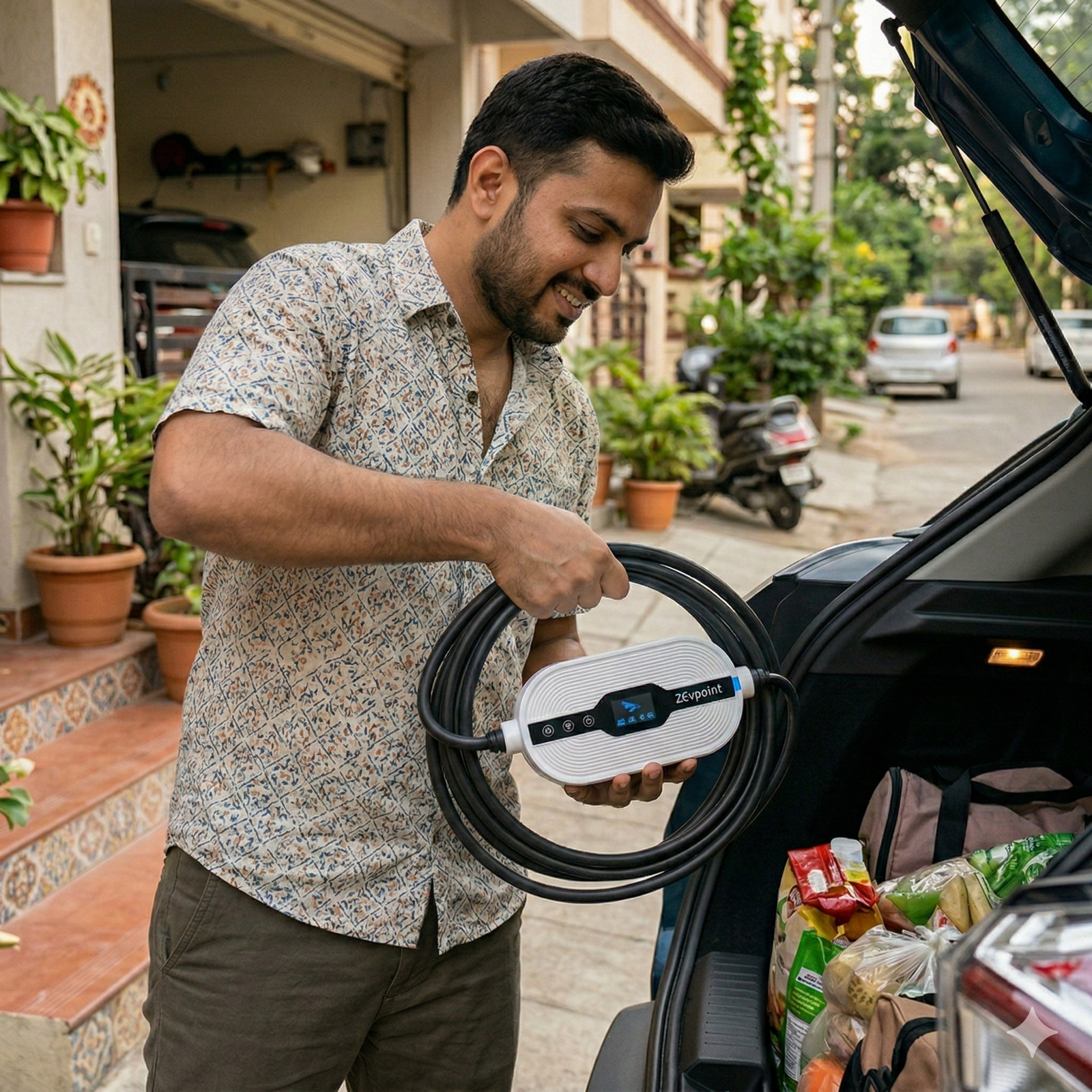

If you park in the same spot every day and have a dedicated parking space, go with a wall-mounted charger — it's faster, neater, and a one-time setup you won't think about again. If you rent your home, park in different spots, or travel frequently, a portable charger gives you the flexibility to charge from any 15A socket anywhere in the country. And if you want both, there are chargers that do both. Here's how to think through the decision.
The Quick Comparison
| Portable Charger | Wall-Mounted Charger | |
|---|---|---|
| Power | 3.6-11 kW | 7 – 22 kW |
| Full charge time (38 kWh battery) | ~4-15 hours | ~3-6 hours |
| Installation needed | Yes, Plugs in 16A socket for 3.6kW, for 7.5 ,11kW require dedicated circuit, MCB, Earthing | Yes — dedicated circuit, MCB, earthing |
| Portability | Carry it anywhere | Fixed to one location |
| Price range | ₹14,000 – ₹18,000 | ₹15,000 – ₹30,000 |
| Best for | Renters, travellers, Multi-Property setup, low daily km, backup | Homeowners, daily commuters, faster charging |
That's the summary. Now let's dig into the details of each so you can see which fits your situation better.
The Case for a Portable Charger
A portable charger is exactly what it sounds like — a compact unit you can carry with you and plug into any standard 16A wall socket in case of a 3.6kW powered charger. It typically delivers about 15-20 km of range added per hour of charging.
Then come the portable chargers with higher power options of 7.5kW or 11kW which require dedicated plug of 32A (1-Phase) or 16A (3-Phase) respectively. These chargers can delivery up to 70-80 km of range per hour and are suitable for people who own multiple properties and want to setup fast charging at those locations without investing in multiple chargers for each location. Portable chargers generally have fewer features than wallmount but can delivery equally good performance. However, overall power losses in wallmount are lower as compared to the portable.
If you drive less, 20-30 km a day, you only need about 2-3 hours of charging to top up what you used, which can be managed with a 3.6kW basic portable charger. Plug in when you get home, and by the time you've had dinner and watched something, the car has enough for tomorrow. But for higher distances and larger batteries 7.5kW has become the new norm. You can get portable chargers as well with app support and other features.
The real strength of a portable charger is flexibility. You're not tied to one location. Visiting your parents for the weekend? Plug into their 15A socket. Staying at a hotel that doesn't have EV charging? Any socket works. Moved to a new apartment? set the power point easily if needed — just plug in and go.
For renters, this is especially important. If you're in a rented flat or your housing society is being difficult about permanent installations, a portable charger lets you charge without asking anyone's permission. For 3.6kW portable charger you require almost No electrical work, no NOC, no committee meetings. You're completely self-sufficient. For higher powered chargers also you are required to setup only power points without any worry of tampering with the charger when installed in a common area.
Portable chargers also make sense as a backup even if you already have a wall-mounted charger at home. Think of it as your emergency charging kit — it lives in your boot, and any 15A socket in the country becomes a charging point when you need one. This is the kind of thing you don't think about until you're stuck somewhere with a low battery and no public charger in sight.
If you want smart features at this power level, the ZEVpoint Aveo Plus is worth looking at. It's a 3.6 kW smart charger that plugs into a 15A socket but gives you app-based control . These features are typically found only in higher-power chargers commonly in 7.5kW and above category in both portable or wallmount.
The Case for a Wall-Mounted Charger
A wall-mounted charger is a permanently installed unit, fixed to the wall or pillar next to your parking spot. It connects to a dedicated electrical circuit and delivers 7 to 22 kW of power.
With a 7.5 kW wall charger, the MG Windsor EV (38 kWh battery) charges fully in about 7 hours. At 11 kW, Hyundai Creta (42 kWh) charges under 5 hours. For most people, a 7 kW charger is the sweet spot — it comfortably charges any current Indian EV overnight, requiring power on a single-phase connection.
The main advantage is speed and convenience combined. You pull into your parking spot, plug in, and walk away. The charger is always there, always ready. There's no cable to pull out of the boot, no hunting for a socket, no setup each time. It becomes as natural as plugging in your phone at night.
Wall-mounted chargers also tend to be more robust and weather-resistant than portable units. They're designed to be permanently exposed to the elements — dust, rain, heat — while a portable charger is meant to be stored when not in use. If your parking is outdoors or in a semi-covered area, a properly rated wall-mounted unit is the safer long-term choice.
For homeowners with a dedicated parking spot — whether in an independent house, villa, or a fixed spot in a housing society — a wall-mounted charger is the natural choice. The one-time installation cost (charger + electrical work) typically runs ₹30,000 to ₹50,000, and after that it's zero hassle for years.
Smart wall chargers from ZEVpoint come with multiple control options like RFID, app control, Plug & Charge mode. Features like power adjustment, scheduling, and consumption monitoring allow more control over experience. You can set different charging schedules for weekdays and weekends, cap the charging current to match your home's wiring capacity, and track exactly how much you're spending on charging each month.
When the Answer Is Both
For a lot of EV owners, the ideal setup isn't one or the other — it's a charger at home and sometimes a charger in the boot. Its just about selecting the one which suits your user case the best.
But buying two separate chargers means spending twice. This is where something like the ZEVpoint Dash AIO makes a lot of sense. It's a single charger that works as both a 7 kW wall-mounted unit when installed at home with a dedicated circuit, and as a 3 kW portable charger when you unplug it and take it with you. Same unit, two modes. You get fast home charging and portable backup without buying two devices.
This is particularly useful if you're someone who does a lot of weekend trips or visits family regularly. During the week, the Dash AIO sits on your wall charging at 7 kW. On Friday evening, you unplug it, toss it in the boot, and you have a portable charger for the entire trip.
Decision Guide: Which One Fits You?
Here's a simple way to think through it based on your situation:
Go portable if you rent your home and might move in the next year or two. If your housing society hasn't approved wall charger installations yet. If you mainly need a charger for travel and emergencies then go for 3.6kW charger. Or if you want to go for faster charging but still need flexibility for plugging into different locations then go for 7.5kW or 11kW chargers before committing to a permanent setup.
Go wall-mounted if you own your home or have a long-term parking spot. If you want faster charging with higher convenience and more features. If you value the convenience of a permanent, always-ready setup. If your parking spot has access to a dedicated electrical circuit (or you can get one installed). Or if you want a clean, professional-looking setup.
Go for both (or a dual-mode charger) if you want fast daily charging at home plus backup for travel. If you frequently stay at places without public EV charging. Or if you just want the peace of mind that you can charge anywhere, anytime.
A Few Things People Overlook
Your car's onboard charger matters. Even if you buy a 22 kW wall charger, your car will only charge at the speed its onboard charger supports. If your car's onboard charger is 3.3, 7.2 kW, it'll charge at 3.3 or 7.2kW regardless of whether you use a 11kW or a 22kW EV charger.
Electrical readiness is key. A wall charger or a high powered portable charger needs a dedicated circuit — a separate MCB, proper earthing, and appropriately rated wiring from your distribution board to the parking spot. If your home's electrical setup is old or the DB is far from your parking spot, the installation cost goes up. Get an electrician to assess this before you commit — it could be ₹5,000 or ₹20,000 depending on the cable run.
At the same time, There's no harm in starting with what came in the box and upgrading later if you feel the need.
Browse ZEVpoint portable chargers and wall-mounted chargers to find the right fit.


