
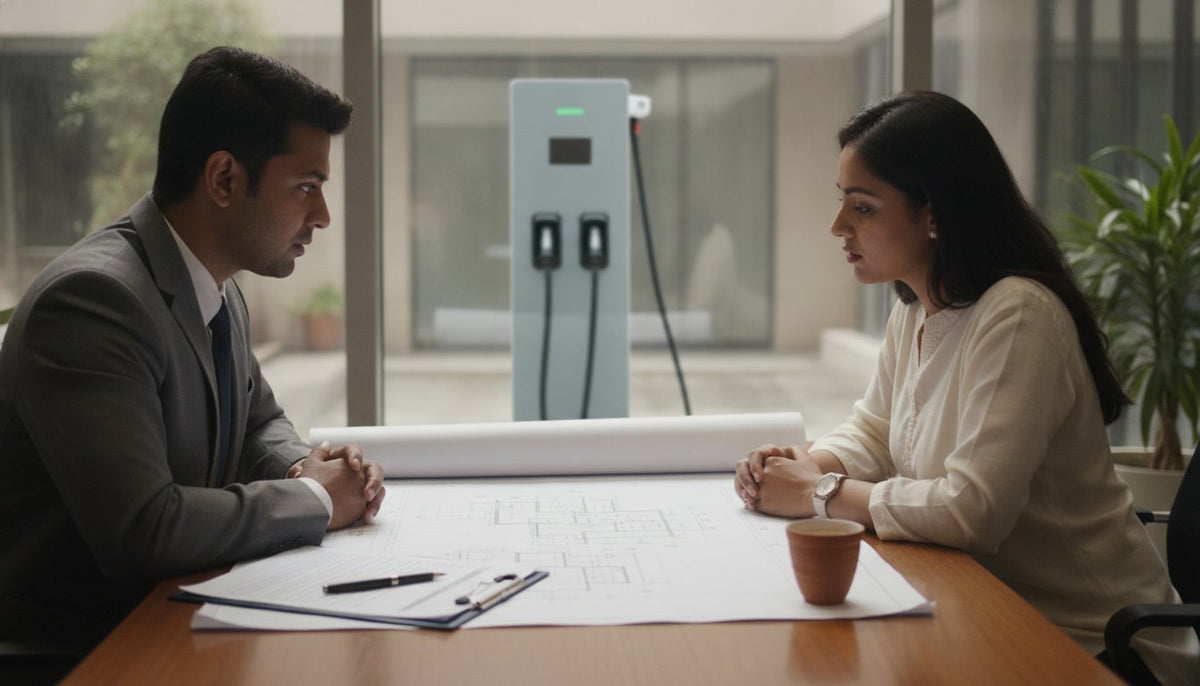

Short answer: a charging station is a ten-year decision, and most regrets come from questions nobody asked at the start. Before you sign with any charging company, including us, get written answers on six things: who owns what, how money reaches you, what the software does and whether you can leave it, how much power the site can really get, how faults are fixed, and what happens when the contract ends. The twenty questions below cover all six. A good company will be glad you asked.
Ownership and control
- Who will own the chargers once I have paid for them? The answer should be you, outright, with an invoice in your name.
- Who sets the price per unit, and can I change it myself?
- Do I pay a joining fee, or a share of each session, to anyone? If yes, for how many years, and what does it add up to?
- Whose name will drivers see on the charger, the payment page and the receipt?
Payments
- Can a driver pay without downloading an app? UPI by QR should be standard. See how UPI charging works.
- Is the driver's money held and only the used amount taken, or taken up front and refunded later? Refunds become your support calls.
- Whose bank account does the money land in, and how soon? Get the settlement time in writing.
- Are GST receipts issued for every session automatically?
Software
- Do the chargers run on OCPP, and which version? This decides whether you can ever change software.
- If I leave your software, do my chargers keep working with another?
- Will I see every charger, session and rupee live, from my own login?
- Can I set different prices for different groups, times of day, and idle fees?
- Will my chargers appear on maps and apps drivers already use? Read what charging software should do.
Power and site
- How much power can my site get from the DISCOM on LT supply, and when does it need HT? See LT or HT.
- Has someone actually visited and measured the site, or is the proposal from a template?
- If two cars charge at once, how is the power shared? See one dual-gun charger or two chargers.
Support
- Who sees a fault first, me or you, and how?
- How quickly does someone arrive when a remote fix is not enough, and which parts are kept in stock?
- What does the warranty cover, for how long, and what does maintenance cost after that? See keeping a DC charger running.
The exit
- When the contract ends, what do I keep? The chargers, the electricity connection, the drivers' data, the brand? Get it in writing before you start, not at the end.
How to read the answers
Vague answers are answers too. "Best effort", "as per policy" and "we will discuss later" usually mean the company has not decided, and the contract will decide for them. Ask for each answer in the proposal or the contract, not in a call. And compare like with like: a lower charger price with a share of every session for ten years may cost far more than it seems.
If you are weighing a franchise against owning, read do you need a franchise? If you own land and want to host instead, read hosting a charger on your land.
Our own answers
We would rather you ask us these than not. In short: you own the chargers outright; you set the price; there is no franchise fee or share of sessions to us; drivers pay by UPI with no app, only what they use is taken, and the money is credited to your bank the same day; our DC chargers run on OCPP, so you are never locked in; and every DC charger carries a 2-year warranty, with a maintenance contract after that. The rest is in your site's proposal: book a site study.
Frequently asked questions
What should I ask before buying an EV charging station?
Who owns the chargers, who sets the price, how and when money reaches you, whether the chargers run on OCPP, how much power the site can get, how faults are fixed, and what you keep when the contract ends.
Why does OCPP matter when choosing a charger?
OCPP is an open standard. Chargers that use it can work with other software, so you are not locked to one company for the life of the station.
How fast should a charging station owner get paid?
Get the settlement time in writing. On our system, UPI session payments are credited to the owner's bank account the same day.
Is a cheaper charger with revenue sharing a good deal?
Not always. Add up the share of every session over the full contract term and compare it with owning outright before deciding.


