

Your EV has a battery.
But what kind and does it matter?
If you've ever heard "LFP" or "NMC" and just nodded along this one's for you. You've bought an EV or you're about to. Someone mentions “LFP battery” or “NMC” and suddenly it feels like a chemistry lecture you didn’t sign up for.
Relax. You don’t need the science.
You just need to know two things:
Which battery your car has, and how to charge it right.
First what even is a battery type?
Think of your EV battery like a pressure cooker.
Different materials inside change how it behaves how hot it gets, how long it lasts, and how you should use it.
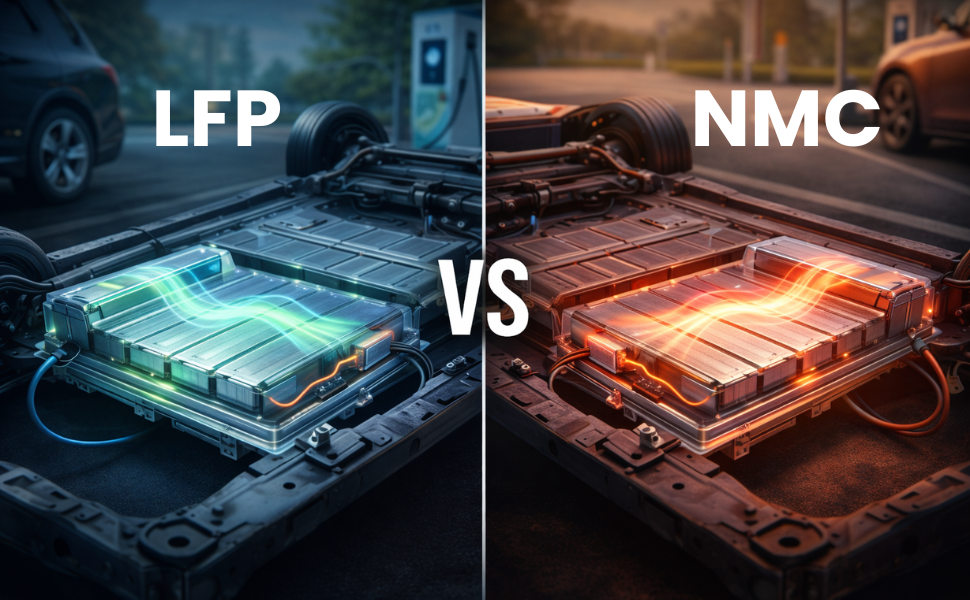
The two most common types are LFP and NMC.
- LFP is like a cast iron tawa-tough, stable, low maintenance
- NMC is like a premium non-stick-better performance, but needs a bit more care
That’s the core difference. Now let’s make it practical.
LFP vs NMC the simple version
LFP Battery (The Tough One)
Cheaper, safer, longer lifespan. Slightly less range, but handles heat better.
NMC Battery (The Long-Range One)
More energy-dense, gives higher range. But more sensitive to heat and charging habits.
In real-world terms, NMC can give about 20–30% more range, while LFP can last almost 2x more charge cycles over its lifetime.
How to check which one you have
Open your car's manual or settings app and look for "battery type." It will say either LFP (also written as Lithium Iron Phosphate) or NMC (Nickel Manganese Cobalt). If you bought an affordable EV in India recently, there's a good chance it's LFP.
How to charge an LFP battery
LFP is simple but here’s where most people get confused.
For daily driving, you don’t need to charge your LFP battery to 100% every time. Keeping it around 80–90% is usually more than enough for regular commutes and can slightly reduce long-term wear. That said, it’s still important to let the battery reach 100% occasionally about once every 1–2 weeks because your car’s Battery Management System (BMS) relies on full charges to stay accurate. Apart from that, LFP batteries are quite flexible, so you can plug in whenever convenient whether the battery is at 60%, 40%, or even 70%. Partial top-ups don’t harm it at all. The only thing to be mindful of is frequent fast charging. While it’s useful for long trips, relying on DC fast charging every day generates excess heat, which can speed up battery ageing over time.
In short:
LFP is flexible 100% is allowed, but not always necessary.
How to charge an NMC battery
NMC needs a bit more discipline mainly because it doesn’t like being full for too long.
For daily use, try to keep it in the 20–80% zone. This reduces stress and slows degradation over time. Charging to 100% is absolutely fine when you need it like before a long trip.
The real issue is letting the car sit at 100% for hours or days, especially in heat.
Also, instead of deep discharging and then charging fully, it’s better to top up more frequently in smaller amounts.
And in Indian summers, heat becomes a bigger factor so combining high temperature with fast charging should be avoided when possible.
What matters more than battery type
Across both LFP and NMC, the biggest enemy is heat, not charging percentage.
Especially in India:
- Parking in direct sun
- Charging right after a long, hot drive
- Frequent fast charging in peak summer
These things matter more than whether you stopped at 80% or 90%.
India-specific charging habits that actually help
Instead of over-optimizing percentages, focus on usage habits.
Home charging makes the biggest difference controlled charging is always better for battery health. If your car supports only 3.6kW, installing a 7.5kW charger won’t make it faster just more expensive. Scheduling your charge to finish in the morning helps avoid the battery sitting at 100% for too long, and also uses cooler temperatures.
And simple things like parking in shade or avoiding charging in extreme heat can quietly add years to battery life.
The one thing to remember
Modern EVs are smart.
They already protect the battery in the background.
You don’t need to micromanage every percentage.
Just remember:
- Don’t leave the car sitting at 100% for days (especially NMC)
- Avoid excessive heat
- Use fast charging when needed, not daily
That’s it.

