
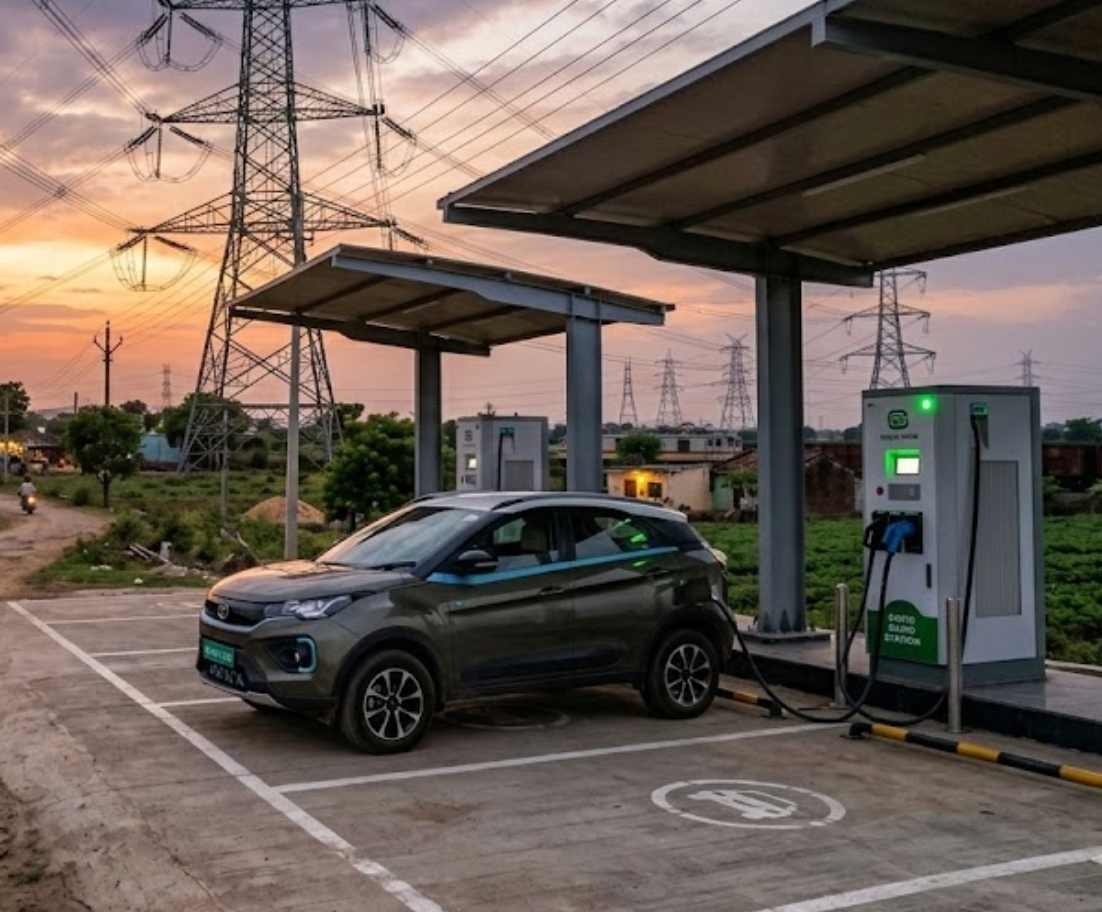

EV charging in India is surrounded by advice that sounds reasonable but doesn’t hold up once you look at the actual numbers and the technology behind it. Some of these myths come from early EV days when batteries and chargers were different. Others come from international content that doesn’t apply to Indian cars and conditions. Here are the most common charging myths Indian EV owners believe — and what’s actually true.
Myth 1: You Should Only Charge Your EV to 80%
This is probably the most widely repeated piece of EV advice, and for most Indian EV owners, it’s unnecessary. The 80% rule comes from NMC (Nickel Manganese Cobalt) battery chemistry, where holding a full charge for extended periods can cause slightly faster degradation over years of use. But here’s what most people miss — the majority of affordable Indian EVs today use LFP (Lithium Iron Phosphate) batteries.
The Tata Nexon EV, Tata Punch EV, MG Windsor — all LFP. And LFP batteries handle 100% charge perfectly well. In fact, Tesla, which uses LFP in its standard-range models, recommends charging to 100% regularly because it helps the Battery Management System (BMS) calibrate properly. Stopping at 80% on an LFP battery doesn’t protect anything — it just means you’re driving around with 20% less range for no reason.
If your car has an LFP battery (check your owner’s manual or the manufacturer’s specs), charge to 100% without worry. That’s what the battery is designed for. The 80% advice applies to older NMC chemistry, and even there, the difference over a battery’s 8-10 year lifespan is minimal with modern BMS systems managing the cell health.
Myth 2: DC Fast Charging Damages Your Battery
You’ll hear this one a lot — that DC fast charging is bad for battery health and you should avoid it as much as possible. The reality is more nuanced than that.
Does faster charging have some impact on a battery compared to slow AC charging? Yes, it does — the higher power and heat involved in DC charging do put marginally more stress on the cells over time. That’s just physics. But modern EVs come with sophisticated thermal management and BMS systems that regulate charging speed, voltage, and temperature in real time. The car itself slows down charging when the battery gets too warm or too full. You’re not manually pushing high voltage into the cells — the car’s software is in complete control, and today’s batteries are built to handle regular DC charging without any meaningful degradation over their lifespan.
The smart approach is to balance both. Use AC home charging as your daily routine — it’s slower, gentler on the cells, and cheaper. And use DC fast charging when it makes sense: road trips, days when you’ve driven more than usual, emergencies, or simply when you need a quick 30-minute top-up. This mix of slow daily charging and occasional fast charging is the ideal way to get the best out of your battery over the long run.
The myth isn’t that DC charging has zero impact — it’s that you should avoid it altogether. That’s like buying a car with a turbo engine and never going above 60 km/h. DC charging exists for a reason, modern batteries handle it well, and your car’s BMS is designed to manage the mix safely.
Myth 3: You Need a Special Setup to Charge at Home
Many first-time EV buyers assume home charging requires expensive electrical upgrades, special wiring, or a dedicated charging station before they can plug in. Not true. Every EV sold in India comes with a portable charger that plugs into a standard 15A power socket — the same socket your AC, geyser, or microwave uses. All you need is a basic MCB (miniature circuit breaker) on that circuit, which is the same protection you already have for your AC, geyser, and other high-power appliances at home. No special wiring, no electrician visit — just plug in and charge.
A 15A socket delivers about 2.5-3 kW, which translates to roughly 12-15 km of range per hour of charging. For someone driving 30-40 km a day (which is the average for most urban commuters), that’s about 3 hours of charging to replenish your daily use. Plug in when you get home, and you’re topped up well before morning.
Now, is a 15A socket the fastest option? No. A dedicated 7 kW wall charger is significantly quicker. But the point is — you can start charging your EV from day one with zero additional investment. Many EV owners drive happily on 15A socket charging for months before deciding if they want to upgrade. And even after upgrading to a higher-power charger, keeping a portable 3 kW charger (like the ZEVpoint Aveo Plus) is always smart — it’s your safety net for travel, emergencies, or charging at places that don’t have a wall-mounted unit.
Myth 4: EV Charging Is Expensive
This one is easy to bust with simple math. Let’s take the MG Windsor EV — 38 kWh battery, roughly 250 km of real-world range. A full charge from 0-100% consumes about 40-42 units of electricity (accounting for charging losses).
At an average domestic tariff of ₹6-7 per unit in most Indian states, that’s about ₹240-290 for a full charge. That gives you 250 km of driving. Your per-kilometre cost? Roughly ₹1-1.2.
Now compare that with a petrol car doing 15 km/litre at ₹105/litre — that’s ₹7 per kilometre. Even a diesel car at 20 km/litre and ₹90/litre comes to ₹4.5 per kilometre. EV charging at home is 4-6 times cheaper than petrol, depending on your state’s electricity tariff.
It gets even better if you charge during off-peak hours. Several states now offer Time-of-Day (ToD) tariffs where late-night electricity is cheaper. With a smart charger from ZEVpoint, you can schedule your charging to start at midnight and stop before morning — automatically catching the cheapest rates without you having to stay awake for it. You can even set multiple schedules for different days of the week based on your routine.
For a detailed cost breakdown by state and car, check our EV charging cost breakdown.
Myth 5: A Higher kW Charger Always Means Faster Charging
This trips up a lot of buyers. Someone sees a 22 kW charger and assumes it will charge their car three times faster than a 7 kW. But your car’s onboard charger — the built-in AC-to-DC converter inside the vehicle — sets the speed ceiling. A 22 kW charger connected to a car with a 7.2 kW onboard charger will still charge at 7.2 kW. The extra capacity sits unused.
Before buying a charger, check your car’s onboard charger rating. Most Indian EVs (Tata Nexon, Punch, MG Windsor upper variants, XUV400, BYD Atto 3) support 7-7.4 kW. Newer models like the Mahindra BE 6, Hyundai Creta EV, and Ioniq 5 support 11 kW. Match your charger to your car’s onboard rating — that’s how you get the speed you’re paying for.
That said, there’s a solid case for buying a charger rated above your current car’s onboard capacity. Onboard charger ratings have been moving up steadily — from 3.3 kW to 7 kW to 11 kW in just a few years — so a higher-rated charger today future-proofs you for your next car. Just don’t expect it to charge your current car any faster. For the full picture, read our 7kW vs 11kW vs 22kW guide.
Myth 6: You Can’t Install an EV Charger in an Apartment or Society
This was a genuine problem a few years ago. RWAs would refuse permission, cite fire safety concerns, or simply stall applications indefinitely. But the legal landscape has changed significantly.
In January 2025, the Bombay High Court ruled in the Amit Dholakia vs State of Maharashtra case that housing societies cannot deny EV charger installations. The court held that EV charging is part of a resident’s right to use common electrical infrastructure, and the society’s role is limited to ensuring safe installation — not blocking it.
Maharashtra’s 2022 circular already mandated that societies must issue a No Objection Certificate (NOC) within 7 working days of receiving a proper application. And in February 2026, the Supreme Court took up a PIL seeking nationwide implementation of similar rules across all states.
If your RWA is still pushing back, you have clear legal backing. You can install a charger in your designated parking spot using your own electricity meter, with proper earthing and safety measures. The society cannot charge you extra for this or deny permission without legitimate safety grounds. For a step-by-step guide on handling the RWA process, read our society/RWA charging guide.
Myth 7: Overnight Charging Is Unsafe
This comes from the same anxiety people had about leaving phones charging overnight — and it’s equally unfounded for EVs. Modern electric vehicles have multiple layers of safety built into the charging system.
The car’s BMS continuously monitors cell voltage, temperature, and current flow. If anything goes out of range, it stops charging automatically. The charger itself (if it’s a quality product from a reputable brand) has overload protection, short-circuit protection, and temperature monitoring. And your home’s MCB provides a third layer — it trips if the circuit draws more current than it should.
Overnight charging is actually the most practical way to own an EV. Plug in at 10 PM, the car charges at a steady, gentle rate (which is easier on the battery than fast charging), and by 5-6 AM you have a full battery. Most EVs in India take 5-8 hours for a full charge at 7 kW — perfectly aligned with sleeping hours. With smart chargers from ZEVpoint, you can even schedule it to start later at night to catch off-peak electricity rates, and set a target time for completion.
Millions of EV owners worldwide charge overnight, every single night. It’s not just safe — it’s the recommended way to charge.
The Bottom Line
Most EV charging myths come from a time when the technology was newer and less refined. Today’s batteries are tougher, BMS systems are smarter, chargers have more safety features, and the legal framework supports home installation. The best thing you can do as an EV owner is understand your specific car and charging setup rather than following generic advice that may not apply to your battery chemistry, your charger type, or your driving pattern.
If you’re looking for a charger that gives you full control over your charging experience — power adjustment, scheduling, and monitoring — browse ZEVpoint chargers to find the right fit.


