
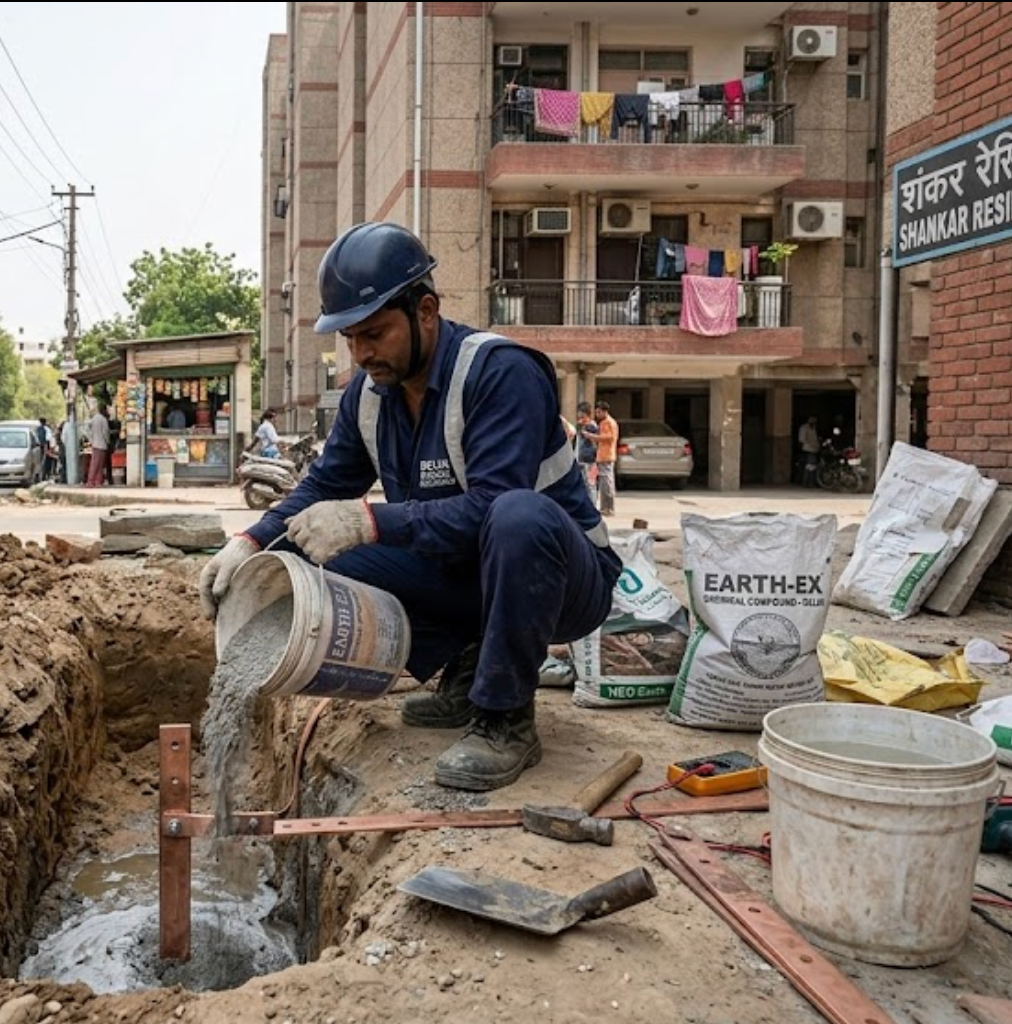

Proper earthing (grounding) is the single most important safety requirement for any EV charger installation — and it's the one that gets ignored or done poorly most often. Without good earthing, your RCD can't detect fault currents, your SPD can't divert surge energy safely, and a single insulation fault can put dangerous voltage on the metal body of your car while you or your family is touching it.
What Does Earthing Do for Your EV Charger?
Earthing provides a low-resistance path for fault currents to flow safely into the ground instead of through you. If a wire inside your charger develops a fault and live voltage touches the metal casing, the earth connection gives that current an easy path to flow into the ground — rather than waiting for you to touch the charger and become the path yourself.
But earthing doesn't just protect you directly — it's what makes your other safety devices work. Your RCD detects the difference between current flowing out through the live wire and current returning through the neutral. When there's a fault to earth, some current flows through the earth path instead of the neutral — and the RCD detects that imbalance and trips within milliseconds.
Without a proper earth connection, the fault current has nowhere to go. The RCD sees no imbalance. It doesn't trip. You could have the best RCD in the world, and it's useless without earthing. Same with your SPD — it diverts surge energy to earth. No earth, nowhere to divert. For a complete overview of all the safety devices your EV charger needs, read our MCB, SPD, RCD safety guide.
Why Is Earthing More Critical for EV Chargers Than Other Appliances?
EV charging creates higher earthing risk than typical household appliances for three specific reasons:
- Sustained high current — a 7 kW charger draws 30-32 amps continuously for 5-8 hours. Faults under sustained high current are more dangerous than faults under intermittent loads like ACs or geysers that cycle on and off.
- Physical contact — you touch the charger and the car every time you plug in and unplug. Your hand is on the connector, your body is next to the car's metal body. If there's a fault and earthing isn't right, you're directly in the current path.
- Weather exposure — many chargers are installed outdoors or in semi-covered parking. Rain, humidity, and moisture increase insulation fault risk and reduce your body's resistance to electric shock, making poor earthing consequences significantly worse.
Does the Charger Check Earthing Before Charging?
Yes. A properly built EV charger doesn't blindly send power to your car — it goes through a safety handshake first. Under IEC 61851 (the international standard for EV charging), the charger communicates with the car through a signal called the Control Pilot (CP). Before any current flows, the charger verifies that the earth connection is intact.
If it detects that the protective earth (PE) conductor is broken, degraded, or missing, it refuses to start charging. No earth, no power — it's a hard safety interlock.
Quality chargers like Zevpoint's wall-mounted and portable range have built-in earth continuity monitoring that runs this check before every charging session. If earthing degrades over time — maybe the soil dried out, or a connection came loose — the charger catches it and stops charging before it becomes a safety risk. But it relies on earthing being present in the first place. The charger can tell you earthing has failed; it can't create an earth path that doesn't exist.
What Earth Resistance Values Do You Need?
When electricians talk about earthing being "good" or "bad," they're talking about earth resistance — how easily current can flow from the earth electrode into the ground. Lower resistance is better. Here's what the numbers mean:
- Below 10 ohms — this is your target. Fault currents flow freely, the RCD responds quickly, and the voltage on exposed metalwork during a fault stays within safer limits.
- 50-100 ohms — the fault current is lower, RCD may be slower to respond, and "touch voltage" on the charger's metalwork during a fault can be dangerously high.
- Above 200 ohms — your earthing is essentially not doing its job for EV charging purposes.
Earth resistance depends on the type of earthing system (chemical, pipe, plate), soil type and moisture content, electrode depth and size, and even the season — dry summer soil has higher resistance than wet monsoon soil. This is why testing is important, and why some earthing types are more reliable than others.
Can You Use Your Building's Existing Earthing?
Yes — and in many cases, you should start here. If your building has proper earthing already in place (and most modern apartments and houses built to code do), your electrician can connect the EV charger circuit to the existing earth. This avoids the cost of a new earthing setup entirely.
The key is testing. Before the charger is installed, get your electrician to measure existing earthing resistance using an earth resistance tester. If values are within the workable range specified in your charger's installation manual, you're good to go. If resistance is too high, you have two options: improve existing earthing (sometimes adding a second electrode in parallel brings resistance down), or install new earthing specifically for the EV circuit.
In older buildings — especially those 15-20+ years old — earthing may have degraded significantly. GI pipe earthing corrodes over time, connections loosen, and soil conditions change. What was adequate when the building was built might not be adequate today. Always test, don't assume.
Which Type of Earthing Is Best for EV Chargers?
If you need new earthing, you'll hear about three types. Here's how they compare for EV charger use:
Pipe earthing is the traditional method — a galvanized iron (GI) pipe driven into the ground, surrounded by charcoal and salt to improve soil conductivity. It's the cheapest upfront, but has significant drawbacks: the GI pipe corrodes over time (increasing resistance), needs periodic watering to maintain soil moisture, and becomes unreliable in dry summers when you need it most. Lifespan is typically 10-15 years.
Plate earthing uses a copper or GI plate buried in the ground. Better contact area than pipe earthing, but still depends on soil moisture and seasonal variation. Requires more space, which is a constraint in urban settings.
Chemical earthing uses a specially designed electrode (copper-bonded or stainless steel rod) surrounded by a chemical compound that maintains consistent low resistance regardless of soil moisture. The compound absorbs and retains moisture, so it works even when soil dries out in summer. Key advantages for EV charger installations:
- Consistent, predictable earth resistance year-round — no seasonal variation
- Compact installation — works in space-constrained urban parking
- 20-30 year lifespan with minimal maintenance
- Works in difficult soil (rocky, sandy, dry regions)
- Cost: ₹8,000-10,000 installed — a one-time investment
For EV charger installations, chemical earthing is the most reliable option. If you're in a region with dry or rocky soil, or if seasonal resistance variation is a concern, it's strongly recommended.
What Happens When Earthing Fails?
Let's walk through real fault scenarios so the importance isn't abstract.
Insulation fault in the charger — a live conductor touches the metal casing. With good earthing: fault current flows through earth, RCD detects the imbalance and trips in under 30 milliseconds — before you can even touch it. Without earthing: the metal casing sits at 230V, waiting. When you touch the charger, your body becomes the path to ground. Even 30 milliamps through the body — which is well within possibility at 230V — can cause respiratory paralysis.
Cable fault between charger and car — current leaks to the car's metal body through the connector. With earthing: the car's chassis is earthed through the charger's PE conductor, fault current flows to ground, RCD trips. Without earthing: the car's metal body becomes live. Anyone touching the car while it's charging is at risk.
Lightning surge — your SPD activates and tries to divert surge energy to earth. With earthing: energy dissipates safely into the ground. Without earthing: SPD can't divert the energy, and the surge reaches your charger's electronics.
Every single safety device in your installation depends on earthing to do its job.
How Do You Check Your Earthing?
You can't check earthing quality with a regular multimeter — you need an earth resistance tester, and an electrician who knows how to use it. Here's what to do:
- At installation — ask your electrician to test earth resistance as part of charger installation. This should be standard practice, not optional. The test takes about 15 minutes and gives a clear reading in ohms.
- Ongoing monitoring — quality chargers handle this automatically. Zevpoint's range checks earth continuity before every charging session. If earthing degrades, the charger refuses to charge and displays a fault code. If this happens, call your electrician — don't just reset and retry.
- Annual testing — get your electrician to test earthing once a year, preferably before monsoon season (highest fault risk period). If you have traditional pipe or plate earthing, also test at end of summer when dry soil means highest resistance.
Earthing in Different Indian Housing Situations
The earthing situation varies depending on your housing type:
Newer apartments (built in last 10-15 years) — earthing is usually decent. The building has a common earthing system connected to each flat's distribution board. Your electrician can typically connect the EV circuit to existing earth. Get resistance tested to confirm.
Older apartments and independent houses — earthing may be outdated or degraded. Pipe earthing without maintenance (no watering, corroded electrodes) can have resistance well above safe limits. Chemical earthing is the most practical solution here.
Independent houses/villas with dedicated parking — most flexibility. You can install a dedicated chemical earthing electrode near the charger, giving the shortest earth path and most reliable setup. This is the ideal scenario.
Basement parking in apartment complexes — earthing connection point might be some distance from your parking spot. Longer earth conductor runs mean slightly higher impedance, but this is usually within limits if building's main earthing is good. Use correct cable size (refer to charger installation guidelines) and ensure tight, corrosion-free connections. For more on the electrical supply setup in different housing situations, read our single phase vs three phase guide.
What Are the Most Common Earthing Mistakes?
These are the mistakes electricians make with EV charger earthing, especially without specific EV installation experience:
- Using neutral as earth — dangerous and unfortunately still common in parts of India. The neutral can carry voltage during load imbalances and faults. Your EV charger needs a dedicated protective earth conductor. Any electrician suggesting neutral-to-earth connection should not be working on your EV installation.
- Skipping the earth conductor — some electricians run only live and neutral to save cable cost on long runs. The charger may turn on, but it's operating without earth protection. Built-in earth monitoring will likely throw a fault and refuse to charge.
- Connecting to water pipes or structural steel — this used to be acceptable decades ago, but water pipes are increasingly plastic (PVC/CPVC), and structural connections may not provide reliable low-resistance paths. Use a proper earthing electrode.
- Not testing after installation — the installation might look perfect, but without a resistance test, you don't know if it's actually working within the required range. Always test, always verify.
The Bottom Line
Earthing is what makes every other safety device in your EV charger installation work. Without it, your RCD can't trip, your SPD can't divert surges, and a fault can put dangerous voltage on your charger and car.
Getting earthing right is straightforward: test your existing building earthing first (it might be perfectly adequate), and if it's not, chemical earthing gives you consistent, low-maintenance protection for ₹8,000-10,000. Get it tested during installation, let your charger's earth continuity monitoring handle ongoing checks, and schedule an annual test before monsoon season. This is one part of the installation you never want to cut corners on. Browse Zevpoint chargers — all models come with built-in earth continuity monitoring for your safety.
Charging on a jugaad setup and the switch is melting
A melting extension board switch or a burning smell means the circuit is overheating and cannot handle the load. Stop charging, disconnect the charger and call a qualified electrician. Discoloured switches and lights flickering while the car charges are warning signs too. Ask the electrician to check your earthing thoroughly while they are there.
An EV charger, even a 3.3 kW one, draws a large current for hours. It should not run through an extension board or old, shared wiring just because the car seems to charge fine. A safe setup has:
- A dedicated circuit from the main meter box, not a shared power socket.
- A dedicated MCB and an RCCB of the type your charger maker recommends (Type A or Type B), in a weatherproof enclosure if installed outdoors.
- Installation by a certified electrician who understands EV charging.
The MCB and RCCB do different jobs. An MCB trips on overcurrent and short circuits. It is not designed to detect leakage, so on its own it may trip only after overheating and damage have already happened. The RCCB catches small leakage currents to earth, and it relies on proper earthing to do that.


