
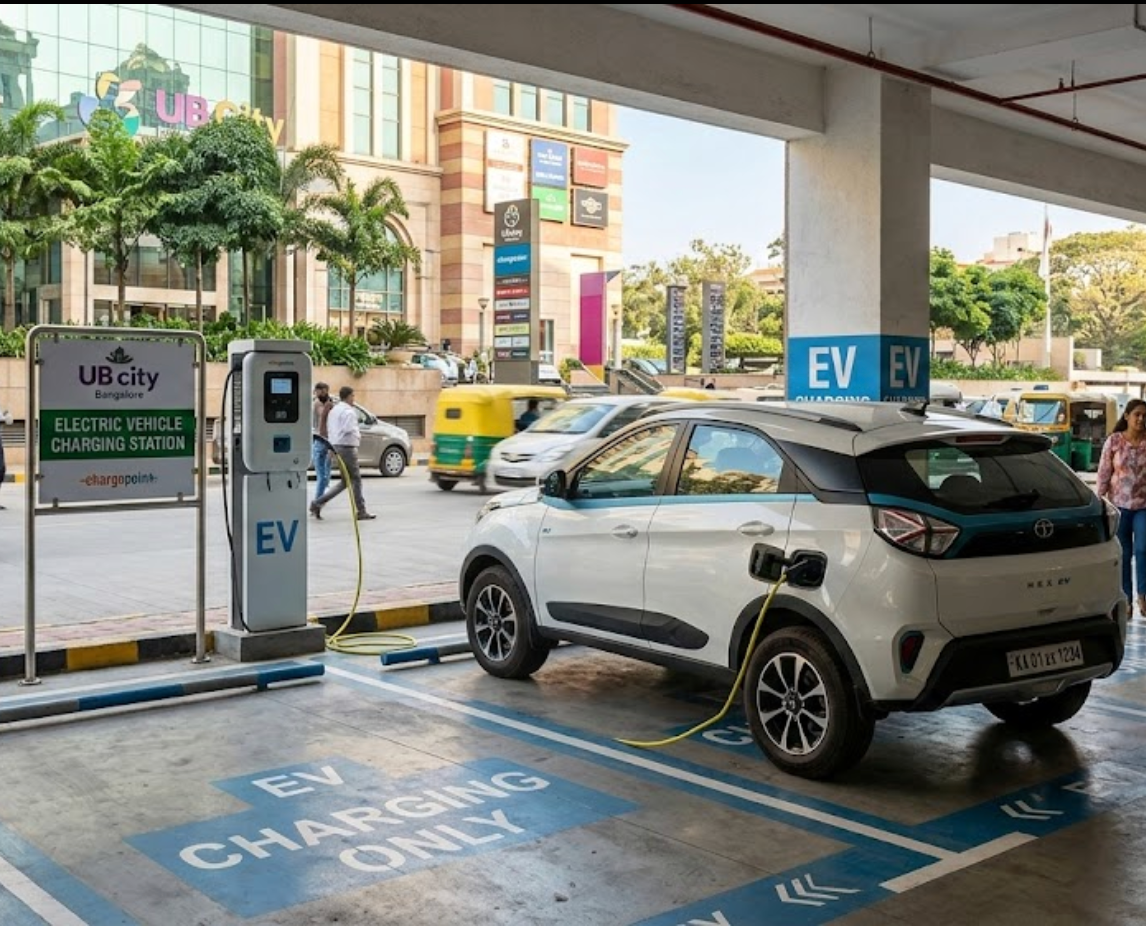

Shopping malls have a natural advantage as EV charging locations that most other venues don't — time. A typical mall visit lasts one to three hours. That's almost exactly how long an AC charger takes to add meaningful range to an EV. The visitor parks, shops or eats, and comes back to a car with more charge than when they arrived. No waiting, no wasted time.
With over 56 lakh EVs already on Indian roads and the number growing fast, mall operators who install charging infrastructure now aren't just offering a convenience — they're making a business decision with measurable returns. This guide covers what that decision actually involves: charger types, costs, revenue models, operational considerations, and the mistakes to avoid.
Why Are Shopping Malls Ideal for EV Charging?
The alignment between mall visits and charging sessions is the core reason this works. Most EV owners in cities drive 30–40 km daily. That's roughly 5–8 kWh of energy. A 7kW AC charger replenishes that in about 45 minutes to just over an hour — well within a typical shopping trip. The driver doesn't need to make a separate stop to charge; they simply plug in on arrival and unplug when they leave.
Beyond the time alignment, malls offer three things that matter for charger operations: existing electrical infrastructure with high sanctioned loads, covered parking that protects chargers from weather, and a steady stream of visitors with predictable parking patterns. Most malls already have the three-phase power supply needed for higher-capacity chargers without requiring a new connection.
What Types of Chargers Should a Mall Install?
This depends on what the mall wants to offer and how the parking works.
AC chargers (7kW to 22kW) are the natural fit for mall parking. They're significantly cheaper to buy and install, they match the typical mall dwell time of one to three hours, and they don't require heavy electrical upgrades. A 7kW charger on a single-phase supply adds roughly 35–40 km of range per hour. A 22kW three-phase charger can deliver over 100 km of range per hour. Most malls prefer installing 22kW units — since different cars support different charging speeds, a higher-capacity charger future-proofs the setup and serves the widest range of vehicles.
DC fast chargers (15kW to 60kW+) make sense if the mall wants to attract visitors who are specifically coming to charge — not just adding a charge while they shop. DC chargers deliver 50–80% charge in 30–60 minutes depending on the car and charger power. They cost significantly more (₹3–15 lakh per unit versus ₹30,000–50,000 for AC), draw much more power, and require dedicated electrical infrastructure. But they also command higher per-kWh pricing.
Most malls benefit from a mixed approach: a combination of AC and DC chargers based on available electrical load and parking space. Several AC chargers spread across the parking area serve regular shoppers, while one or two DC fast chargers in a prominently signed location attract visitors who need a quick top-up. The exact ratio depends on footfall, load availability, and local EV adoption.
What Does It Cost to Set Up EV Charging at a Mall?
The costs break down into hardware, installation, and ongoing operations.
For AC chargers, the unit cost ranges from ₹30,000 to ₹50,000 depending on the power rating and whether it's a smart charger with app control, RFID, and OCPP support. Installation — including wiring from the distribution panel, earthing, MCB, and mounting — adds ₹15,000 to ₹40,000 per charger depending on cable run distance. A mall installing 10 AC chargers might spend ₹5–9 lakh total.
DC fast chargers are a different scale. Units range from ₹3 lakh for a basic 15–30kW charger to ₹15 lakh for a higher-capacity 60kW+ unit. Installation with the required electrical upgrades can add another ₹2–5 lakh per unit. A single DC fast charger installation can cross ₹5–20 lakh all-in depending on capacity.
Ongoing costs are relatively modest. Electricity is the primary expense — at ₹4–8 per kWh depending on your commercial tariff and state. Maintenance for AC chargers is minimal; DC chargers may need annual servicing. If using a cloud-based management system (CMS), there's a monthly software fee, typically ₹500–2,000 per charger.
How Do Malls Make Money from EV Charging?
The revenue model goes beyond selling electricity. In fact, for many malls, the direct charging revenue is the smallest part of the return.
Direct charging fees. AC charging in India typically costs ₹12–18 per kWh, while DC fast charging commands ₹18–25 per kWh. If a 7kW AC charger runs for 3 hours, that's roughly 21 kWh — generating ₹250–375 per session at the user end. After electricity costs, the margin is ₹100–250 per session. A well-utilized AC charger serving 4–6 sessions per day generates ₹12,000–45,000 per month in gross margin. Not transformational by itself, but steady. Operators can also run time-based discounts to boost utilization during off-peak hours or offer specialized tariffs for regular visitors.
Increased dwell time and spend. This is where the real value lies. Research shows that retailers offering EV charging see customer dwell time increase by roughly 50 minutes on average, with a corresponding increase in in-store spending. For a mall, even a modest increase in time spent translates directly into higher food court revenue, more impulse purchases, and better anchor tenant satisfaction. The charger pays for itself through the register, not the electricity bill.
Advertising and brand visibility. Smart chargers with screens can display ads, promotions, or mall directory information during charging sessions. This is a captive audience — the driver is already at the charger, often checking session status. Some mall operators sell this ad space to tenants or external brands.
Differentiation and tenant value. As more urban Indians drive EVs, malls without charging will lose visitors to malls with it. It's becoming a baseline amenity like Wi-Fi or valet parking — you don't directly profit from it, but not having it costs you footfall. Premium tenants increasingly ask about EV charging availability when evaluating retail space.
Should the Mall Own the Chargers or Partner with an Operator?
There are three common models in India right now, each with trade-offs.
Mall-owned and operated. The mall buys the chargers, handles installation, and manages operations — either through its own facilities team or by subscribing to a CMS platform. The mall keeps all revenue and controls pricing, branding, and user experience. This requires upfront investment and some operational bandwidth, but the economics are straightforward and the mall retains full control.
Revenue-sharing with a charging operator. A charging network operator installs and manages the chargers at the mall's premises. The mall provides space, electricity, and parking access; the operator handles hardware, software, and user payments. Revenue is split — typically 15–30% to the mall. Lower investment, but the mall gives up control over pricing and user experience.
Charger-as-amenity (mall-funded, free to users). Some malls offer free AC charging as a visitor perk — similar to free Wi-Fi. The cost of electricity per session (₹50–150 for a typical AC session) is treated as a marketing expense, offset by increased dwell time and spend. This works especially well for premium malls where the target demographic overlaps heavily with EV ownership.
For most malls just starting out, the mall-owned model with a per-kWh charging fee offers the best balance — you invest in the infrastructure, control the experience, and generate revenue from day one. As utilization grows, you can add more chargers or upgrade to DC.
Regardless of which model you choose, working with a charger provider that understands commercial setups helps. Zevpoint, for instance, has helped several malls and retail spaces set up custom charging hubs — configuring the right mix of AC and DC based on the property's load capacity, parking layout, and visitor profile. The CMS can be configured to run promotional discounts during specific hours or offer specialized tariffs for loyalty members and repeat visitors.
What Operational Systems Do You Need?
If you're installing more than two or three chargers, a cloud-based charger management system (CMS) connected via OCPP becomes essential. Without it, you're managing each charger individually with no visibility into sessions, revenue, utilization, or faults.
A CMS gives the mall operator a dashboard showing real-time status of every charger — which ones are in use, which are idle, which have faults. It handles user authentication (RFID cards, app-based, or QR scan), payment processing, session logging, and energy metering. It also enables remote diagnostics and firmware updates, which saves the operations team from physically checking each unit.
OCPP (Open Charge Point Protocol) is what connects the charger hardware to the CMS software. Choosing OCPP-compliant chargers means you're not locked into one software vendor — you can switch CMS providers without replacing hardware. India's 2024 Ministry of Power guidelines advise open protocol adoption for exactly this reason.
For user convenience, the chargers should support multiple access methods. Not every EV driver will have a specific app. QR code payment (via UPI), RFID cards for regular visitors, and app-based start/stop cover the broadest range of users.
Where Should Chargers Be Placed in the Mall?
Placement matters more than most operators realize. Chargers buried in the farthest corner of basement level 3 will get low utilization no matter how good the hardware is.
The best placements share three characteristics: visibility, convenience, and signage. Install chargers on the level closest to the mall entrance — ideally basement 1 or ground floor parking. Mark the spots clearly with floor paint and overhead signage, just like handicapped or valet spots. Add directional signage from the parking entry so drivers know EV charging is available before they pick a spot.
Avoid placing chargers in spots that are naturally popular even without charging — you'll create friction with non-EV drivers who want those spots. Instead, convert less-desirable parking spots (further from elevators or entrances) into EV spots. The charging benefit gives EV drivers a reason to use those spots willingly.
Also consider cable routing. AC chargers need a cable run from the nearest electrical panel. Longer runs mean higher installation costs and potential voltage drop. Grouping chargers near an electrical riser or sub-panel keeps costs down and makes future expansion easier.
What Are the Common Mistakes Malls Make?
Having worked with commercial clients across retail and hospitality, a few recurring mistakes stand out:
- Installing only one or two chargers as a "test" but placing them in a hidden corner with no signage. Low visibility leads to low utilization, which is then used to justify not expanding. The test fails not because demand is low, but because nobody knows the chargers exist.
- Choosing the cheapest charger without CMS or OCPP support. Without remote management, the mall has no way to track utilization, collect payments, or diagnose issues remotely. Staff ends up manually managing charger complaints, which is unsustainable.
- Not planning for expansion. Install conduit and cable trays for more chargers than you need today. Adding infrastructure later — breaking concrete, pulling new cable — costs three to five times more than doing it during initial installation.
- Ignoring earthing and electrical safety. Mall parking areas often have different earthing conditions than the main building. Each charger installation should have proper earthing verified by a qualified electrician. Skipping this step saves a few thousand rupees and creates a safety liability.
- Not communicating the charging facility to visitors. Add it to Google Maps, your mall's website, and the charging apps that EV drivers actually use — Google Maps, PlugShare, and the charger network's own app. If drivers can't find your charger digitally, it doesn't exist for most of them.
How Does This Compare to Hotels and Corporate Offices?
Malls, hotels, and corporate offices are the three main commercial use cases for EV charging as a business in India, and each works slightly differently.
Hotels typically need overnight AC charging (guests park for 8–12 hours) and the charging is often complimentary or bundled with the room rate. Corporate offices need daytime AC charging for employees who park for 8–10 hours. In both cases, slower AC chargers are perfectly adequate because of the long parking duration.
Malls sit in between — dwell time is shorter (1–3 hours), so there's a case for slightly higher power AC chargers (11kW or 22kW) and a supplementary DC fast charger. Malls also need to handle a higher turnover of unique users versus the repeat-visitor pattern of offices and hotels. This makes the payment and authentication system more important — walk-in users need a frictionless way to start a session without downloading a specific app.
Is Now the Right Time to Install?
India has over 56 lakh registered EVs as of early 2025, and four-wheeler EV sales are accelerating. Most new EV buyers are urban, higher-income consumers — exactly the demographic that frequents malls. The charger-to-EV ratio is still extremely lopsided, with roughly one public charger for every 235 EVs. Demand is there; supply isn't.
The cost of installing AC chargers has come down significantly over the past two years, and the technology is mature. A mall that installs 10 AC chargers today is likely to see utilization climb steadily as the EV population grows. Waiting another year or two doesn't reduce cost — it just means your competitor mall across the road gets the EV-driving shoppers first.
For mall operators, this isn't a speculative technology investment. It's a parking amenity with a revenue model, and the demand curve is pointing in one direction.


