
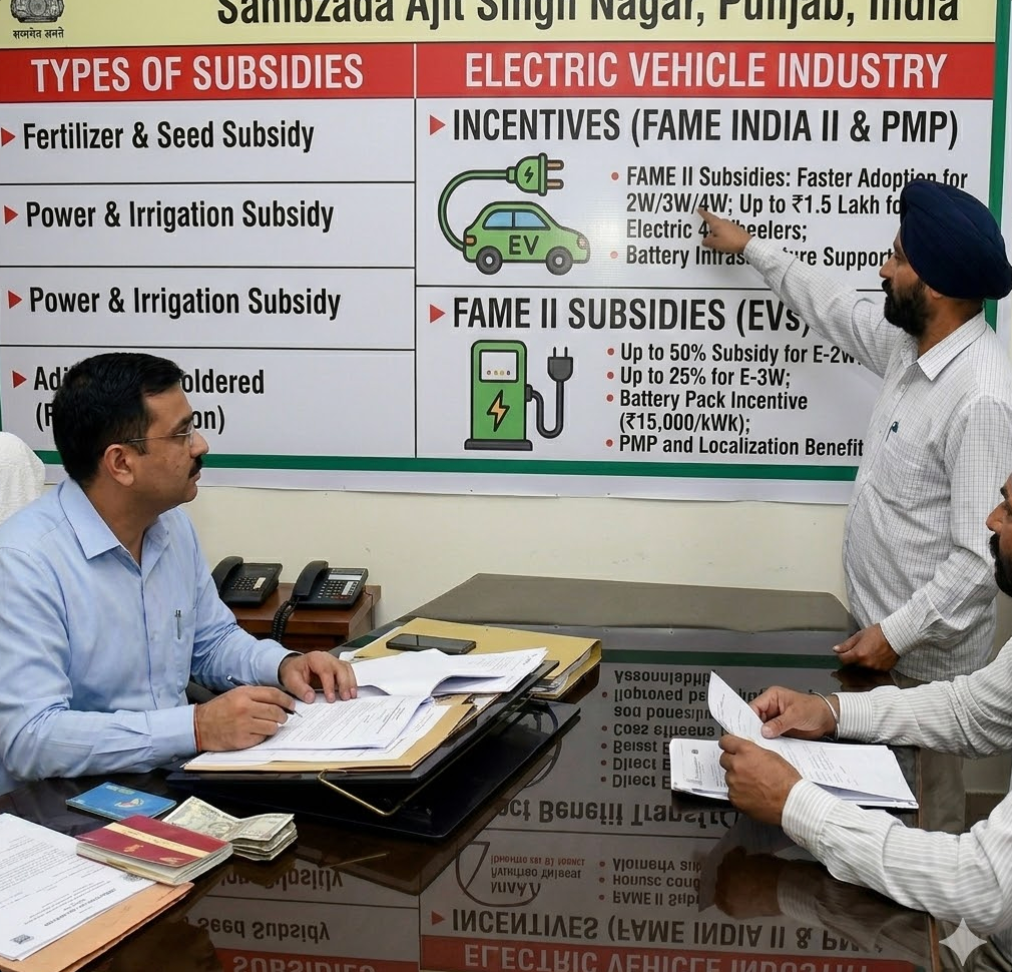

India currently has multiple government schemes — both central and state-level — that subsidise the installation of EV chargers, offer concessional electricity tariffs for EV charging, and mandate charging infrastructure in new buildings. If you're setting up a charger at home, at your office, or as a commercial charging business, there's a good chance you qualify for some form of financial support. Here's a practical breakdown of what's available and how to actually benefit from it.
PM E-DRIVE: The Central Government's Flagship Scheme
PM E-DRIVE (Electric Drive Revolution in Innovative Vehicle Enhancement) replaced the FAME II scheme in October 2024 and runs through March 2026, with certain segments extended till March 2028. The total outlay is ₹10,900 crore, of which ₹2,000 crore is specifically earmarked for EV charging infrastructure — targeting the installation of approximately 72,000 new chargers across the country by FY 2025-26.
The charger rollout under PM E-DRIVE includes roughly 22,100 fast chargers for four-wheelers, 48,400 fast chargers for two-wheelers and three-wheelers, and 1,800 fast chargers for e-buses. These are being strategically placed along 50 national highway corridors and at high-footfall locations like metro stations, airports, bus depots, and fuel stations.
What matters for you as a business or property owner is the subsidy structure for charger installation:
If you're a government office, residential colony, hospital, or educational institution and you allow free public access to the charger, you can get up to 100% subsidy on upstream infrastructure (cabling, transformer upgrades, civil work) and the charging equipment itself. This is the highest tier of support under the scheme.
If you're installing at a high-traffic public location — railway station, airport, bus terminal, metro station, municipal parking, retail outlet of a state-run oil company, or toll plaza — the subsidy covers 80% of upstream infrastructure costs and 70% of the charging equipment cost.
Battery swapping or charging stations at any location are eligible for 80% support on upstream costs.
These subsidies are significant, especially for organisations looking to set up multiple chargers. The application process goes through the PM E-DRIVE portal (pmedrive.heavyindustries.gov.in), and BHEL has been appointed as the nodal agency to aggregate demand and streamline deployment.
What About Home Charger Subsidies?
This is the question most individual EV owners ask, and the honest answer is: central government schemes like PM E-DRIVE are primarily designed for public and semi-public charging infrastructure, not for private home installations. If you're putting a charger in your own parking spot for your own car, you won't directly benefit from PM E-DRIVE subsidies.
However, some state policies do offer direct support for home charging. Delhi, for instance, offers a 100% subsidy of up to ₹6,000 per charging point for the first 30,000 slow/medium chargers installed at homes, apartments, and shops. If you live in Delhi and haven't claimed this yet, it's worth checking with your DISCOM (BSES or Tata Power Delhi).
Even where direct home charger subsidies don't exist, you still benefit indirectly through concessional EV electricity tariffs (more on that below) and through building mandates that make charger installation easier in apartments and societies.
State-by-State: What's Available Where You Live
EV charging incentives vary significantly across states. Here's what the major states currently offer:
Maharashtra
Maharashtra's EV Policy 2025 (running April 2025 to March 2030) is one of the most comprehensive in the country, with a budget of nearly ₹2,000 crore. For charging infrastructure specifically, the state offers a Viability Gap Funding (VGF) scheme — Charge Point Operators (CPOs) can get 15% of the charger cost reimbursed, up to ₹10 lakh per DC fast charger, particularly along highways and in cities like Mumbai and Pune.
Maharashtra also offers a concessional EV tariff of around ₹5-5.5 per kWh (approved by MERC), with waived demand charges for the initial years. This means if you're running a commercial charging station, you pay only for the energy consumed — no hefty fixed charges eating into your margins. The state has also waived electricity duty for EV charging operations for up to 10 years.
On the mandate side, Maharashtra mandates 1 EV charger for every 5 parking spots in new constructions and has directed societies to allow charger installations (backed by the Bombay HC ruling we covered in our society/RWA charging guide).
Delhi
Delhi's EV policy, extended through March 2026, has been one of the most aggressive in the country for home and small-scale charging. The 100% subsidy of up to ₹6,000 per charging point for homes and apartments is a direct benefit most other states don't offer. Delhi also provides land allotment in public parking lots for larger charging stations and reduced power tariffs.
Delhi's EV tariff is ₹4.5 per kWh — one of the lowest in the country — making it one of the cheapest places to charge an EV at home. The city was also among the first to implement building bye-laws mandating charging facilities and reserved EV parking spaces in new constructions.
Karnataka
Karnataka's EV Policy (2023-2028) offers a 25% capital subsidy on EV charging equipment, making it one of the better states for commercial charger deployment. The state has the highest number of charging stations in India — over 5,800 as of late 2025 — driven by Bengaluru's tech-forward adoption.
The state mandates chargers every 3 km in Bengaluru and reserves 10% of parking spaces for EVs in high-rise buildings. EV tariffs in Karnataka are in the ₹5-6 per kWh range. The state is also investing ₹1,500 crore in public-private partnerships with companies like Tata Power and Statiq for highway charging corridors.
Gujarat
Gujarat offers a 25% capital subsidy for public EV charging station installations, 100% exemption from electricity duty for EV charging services, and a reduced road tax of just 1% (valid till March 2026). For commercial charging operators, the electricity duty exemption alone can make a meaningful difference in operating costs over the years.
Tamil Nadu
Tamil Nadu extends 100% road tax waivers and offers up to 50% land cost subsidies for EV-related projects in southern districts. The state is positioning itself as an EV manufacturing hub, which indirectly benefits charging infrastructure through supplier ecosystem development.
Punjab
Punjab offers subsidies for the first 10,000 EV charging stations installed in the state, along with purchase incentives of up to ₹10,000 for e-two-wheelers and ₹30,000 for e-autos. If you're setting up a commercial charging station in Punjab, you're likely within the early-mover window to claim installation subsidies.
Telangana
Telangana reinstated a 100% exemption on road tax and registration fees for all EVs through December 2026, removing the previous cap of 5,000 vehicles. While this is primarily a vehicle purchase incentive, it lowers the overall cost of EV ownership and boosts demand for charging infrastructure.
Concessional EV Electricity Tariffs
One of the most impactful but under-discussed benefits is concessional EV tariffs. Several states have directed their electricity regulatory commissions to set special tariff categories for EV charging that are significantly lower than standard commercial or industrial rates:
| State | EV Charging Tariff (approx.) | Electricity Duty Exemption |
|---|---|---|
| Delhi | ₹4.5/kWh | — |
| Maharashtra | ₹5-5.5/kWh | Yes (up to 10 years) |
| Karnataka | ₹5-6/kWh | — |
| Gujarat | Concessional | 100% exemption |
| Telangana | ₹5-6/kWh | — |
For home charging, you typically charge on your domestic tariff (which varies by state and slab but is usually ₹4-9 per unit). For commercial charging stations, these concessional tariffs are a major cost advantage — you're buying electricity at near-domestic rates while operating a commercial service. Combined with waived demand charges in states like Maharashtra, the economics of running a charging station are more viable than most people assume.
For a detailed look at what charging actually costs you at different tariffs, read our EV charging cost breakdown.
Building Mandates: The Indirect Subsidy
Several states now mandate EV charging readiness in new constructions. This doesn't put money in your pocket, but it removes the biggest obstacle to charger installation — getting permission and infrastructure in place.
Maharashtra mandates 1 EV charger per 5 parking spots in new buildings. Delhi requires EV-ready parking in new constructions with reserved EV spaces. Karnataka reserves 10% parking for EVs in high-rises. Multiple states now require highways to have chargers every 25 km, and urban areas to have one charger per 3x3 km grid.
For apartment owners and society residents, these mandates combined with the Bombay HC ruling (January 2025) and the Supreme Court PIL (February 2026) mean that installing a charger in your parking spot is now a right, not a privilege. Your RWA cannot deny you permission. For a step-by-step guide on handling this, read our society/RWA charging guide.
How to Check What You're Eligible For
Start with what you're trying to do and where you are:
If you're an individual installing a home charger — check your state's EV policy for home charger subsidies (Delhi's ₹6,000 subsidy is the standout example). Even if your state doesn't offer a direct subsidy, you benefit from concessional tariffs and building mandates. The charger itself is a straightforward purchase — browse ZEVpoint chargers for options that match your car and home setup.
If you're a business installing chargers at your office or property — you may qualify for PM E-DRIVE subsidies (especially if you allow public access), state-level capital subsidies (25% in Karnataka and Gujarat), or VGF funding (Maharashtra). Check with your state's transport or energy department, and visit the PM E-DRIVE portal for central scheme eligibility. See our corporate EV charging guide for setup details.
If you're setting up a commercial charging station — the economics work best in states with concessional tariffs and electricity duty exemptions. Maharashtra, Delhi, Gujarat, and Karnataka offer the strongest combined incentives. The PM E-DRIVE scheme's tiered subsidy structure (70-100% depending on location type) can cover a significant portion of your setup costs.
If you're a housing society looking to enable EV charging — you're backed by legal mandates and court rulings. The infrastructure cost can be shared between the society and individual car owners, and in some states, charging on a separate EV meter qualifies for concessional tariffs. Read our society/RWA charging guide and corporate EV charging guide for setup approaches that work.
A Note on Timelines
Government schemes have expiry dates, and subsidy budgets run out. PM E-DRIVE's purchase incentives run till March 2026 (with charging infrastructure support extended to March 2028). State policies like Maharashtra's run till 2030, while Delhi's is through March 2026. If you've been considering installing chargers — whether at home, at work, or as a business — the current window of overlapping central and state incentives is one of the best India has seen. Waiting means potentially missing out on subsidies that may not be renewed at the same levels.
For help figuring out the right charger setup for your home or business, ZEVpoint offers tailored solutions to match your use case — from single home chargers to multi-point corporate and commercial installations. Also check our home charging guide and 7kW vs 11kW vs 22kW guide to find the right charger for your needs.


