
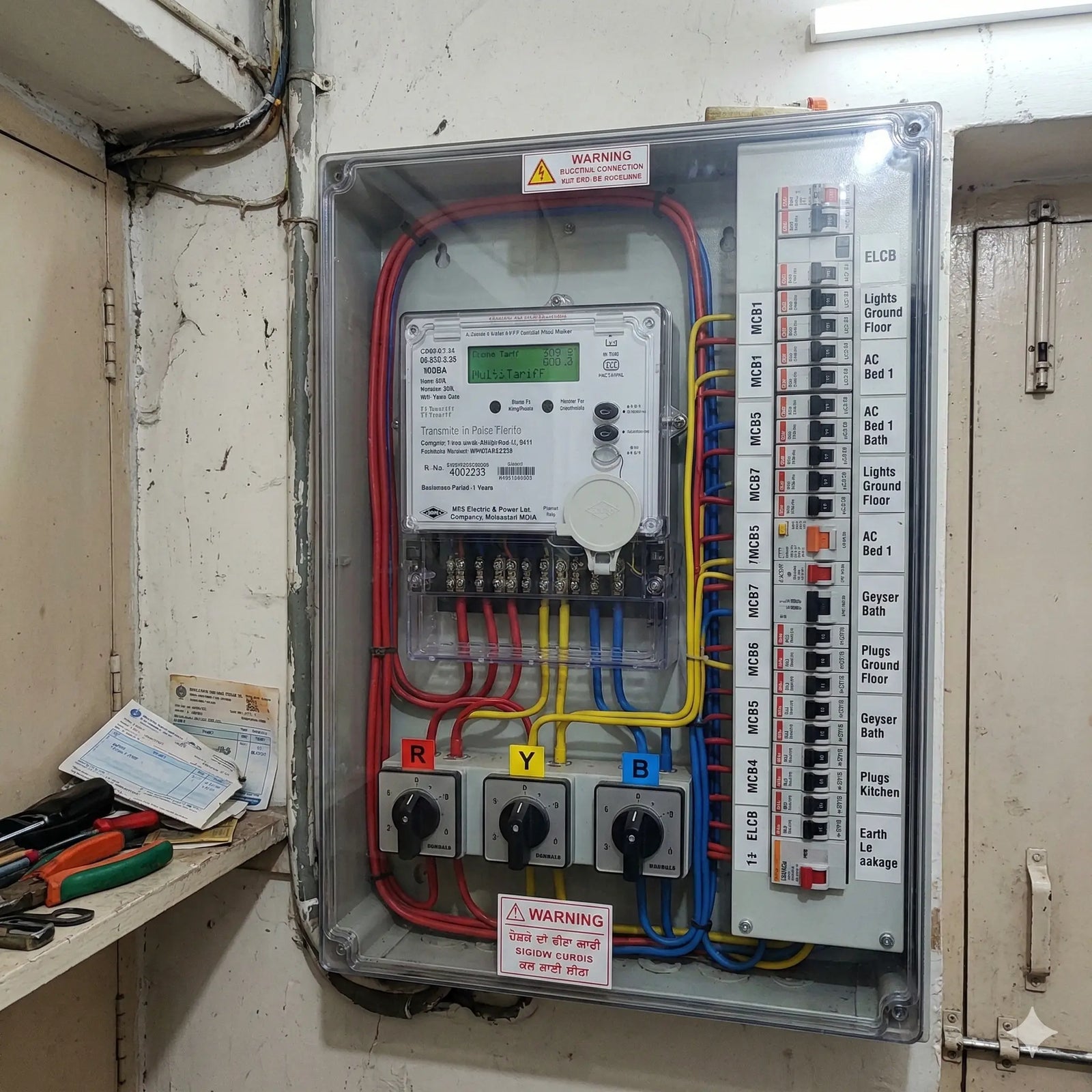

Yes, most EVs in India charge perfectly well on single-phase power. But here's the practical reality that many EV charger guides skip: most Indian homes come with a 5 kW sanctioned load. The moment you add a 7 kW charger on top of your existing appliances, you're likely exceeding that limit — and in most states, once your load crosses 5 kW, the DISCOM pushes you to a three-phase connection. That sounds like a hassle, but it's actually a good thing for you. Here's why, and everything else you need to know about phase and EV charging.
What's the Difference Between Single Phase and Three Phase?
Without getting too deep into electrical engineering, here's what matters for EV charging:
Single-phase power comes into your home through one live wire and one neutral wire, delivering 230 volts. This is the standard power supply in most Indian homes — flats, apartments, smaller independent houses. It powers your lights, fans, AC, geyser, washing machine, and everything else in a typical household. For EV charging, single-phase can theoretically support chargers up to about 7.4 kW, drawing around 32 amps on a dedicated circuit.
Three-phase power comes through three live wires and one neutral wire, delivering 415 volts. It's more common in larger homes, villas, independent houses, commercial buildings, and newer apartment complexes. Think of it as three independent single-phase lines bundled into one connection. Each phase can carry its own load, and together they support much higher total power — which is why three-phase is needed for 11 kW and 22 kW EV chargers.
The 5 kW Sanctioned Load Reality
This is something most online EV charging guides don't talk about because they're written for international audiences. In India, the typical domestic electricity connection comes with a sanctioned load of 5 kW. That's the maximum power your DISCOM has approved for your home. Your AC, geyser, microwave, washing machine — all of that runs within this 5 kW limit (not all at once, but the DISCOM expects your peak demand to stay within this range).
Now add a 7 kW EV charger. Your total potential load jumps to 12 kW — well beyond the 5 kW sanctioned limit. Even if you charge at night when the AC and geyser are off, the DISCOM looks at the connected load, not what you actually use simultaneously. In most states, once your sanctioned load needs to exceed 5 kW, the DISCOM mandates a three-phase connection.
So here's the practical situation: if you want a 7 kW home charger (which is the sweet spot for most Indian EVs), you'll very likely need to upgrade to a three-phase connection anyway — not because the charger needs three phases to run, but because your total home load now requires it.
Why Three Phase Is Actually Better for You
Many people see "three-phase upgrade" and think it's an unnecessary expense. But once you have three-phase at home, your electrical life actually gets easier — not just for EV charging, but for everything.
The biggest advantage is load distribution. With three-phase, you can dedicate one phase entirely to your EV charger and distribute your home's appliances across the other two phases. Your AC on one phase, geyser and kitchen appliances on another, and the EV charger on the third. This means your car charging doesn't compete with your home appliances for power. No tripping, no overloads, no worrying about running the AC while the car charges.
It also gives you headroom for the future. As homes get more electrical — induction cooktops, heat pumps, multiple ACs, bigger geysers — three-phase accommodates all of it without constantly bumping against your sanctioned load limit. The EV charger might be the trigger for the upgrade, but the benefits extend far beyond just car charging.
And if you eventually want a faster charger — 11 kW or 22 kW — you're already set. No second upgrade needed.
Your Car's Onboard Charger: The Speed Ceiling
Before choosing a charger, you need to know one number: your car's onboard charger rating. This is the built-in converter inside your EV that turns AC power from the wall into DC power for the battery. No matter how powerful the wall charger is, your car will only accept power up to this onboard limit.
To understand the range, here are three examples that cover the spectrum of Indian EVs:
The Citroen eC3 has a 3.3 kW onboard charger. It charges at a maximum of 3.3 kW on AC, regardless of what charger you plug in. Even a 7 kW or 22 kW charger will only deliver 3.3 kW to this car. A portable 3.6 kW charger on a 15A socket is a perfect match — fast enough, simple, no installation needed.
The MG Windsor (upper variants) has a 7.2 kW onboard charger. This is the most common tier for mass-market Indian EVs — the Tata Nexon, Punch, MG ZS, XUV400, and BYD Atto 3 all fall in this 7-7.4 kW range. A 7 kW wall-mounted charger on single-phase runs this at full speed. This is the sweet spot for most Indian EV owners.
The Mahindra XEV 9e has an 11 kW onboard charger. This is the newer premium tier — the BE 6, Hyundai Creta EV, Ioniq 5, and BMW iX1 are also here. To charge at the full 11 kW, you need a three-phase charger on a three-phase supply. On single-phase, these cars still charge fine — just capped at 7 kW or lower.
How to Check What You Have at Home
There are a few easy ways to check whether your home has single-phase or three-phase power:
Look at your electricity meter. A single-phase meter will have two thick wires coming in (one live, one neutral). A three-phase meter will have four thick wires (three live, one neutral). Most digital meters also display the phase type on the faceplate or nameplate — look for "1Φ" (single phase) or "3Φ" (three phase).
Check your distribution board (DB). Open your main electrical panel. If you see one main MCB (miniature circuit breaker) with a single toggle, that's likely single-phase. If you see a triple-pole MCB (three toggles linked together) at the main position, you have three-phase.
Check your electricity bill. Many DISCOMs mention the connection type on the bill — look for "LT-1" or "single phase" vs "LT-2" or "three phase" in the tariff category. Your sanctioned load (in kW) is usually mentioned too.
Ask your electrician. If none of the above is conclusive, any local electrician can tell you in 30 seconds by looking at your meter and DB.
Single Phase: What You Can Do Today
If you have single-phase at home and don't want to upgrade right away, you still have practical options:
A 15A socket with a portable charger delivers about 2.5-3 kW. This works within your existing 5 kW sanctioned load without any changes. Every EV comes with a basic portable charger, but a smart portable charger like the ZEVpoint Aveo Plus gives you app-based control, scheduling, and current adjustment — even at this power level. For someone driving 30-40 km a day, that's about 2-3 hours of charging to top up your daily use. Plug in at night when other appliances are off, and you're sorted.
A 7 kW wall-mounted charger is the ideal match for most Indian EVs. It runs on single-phase electrically, but as discussed, you'll likely need to increase your sanctioned load — and most DISCOMs will push you to three-phase at that point. If your DISCOM allows it and your existing wiring supports it, you can try running a 7 kW charger on single-phase within an upgraded sanctioned load. But in practice, most people end up going three-phase for the reasons covered above.
A charger like the ZEVpoint Dash AIO is versatile here — it can run at both 3 kW and 7 kW, so it adapts to your situation. Use it at 3 kW on your existing setup today, and when you upgrade to three-phase or a higher load, switch it to 7 kW for full speed.
Three Phase: The Practical Choice for 7 kW and Above
If you're going for a 7 kW charger (and you should, if your car supports it), a three-phase connection is the practical path in India. Here's what you get:
For a 7 kW charger on a car like the MG Windsor (7.2 kW onboard) — you run the charger on one of the three phases. The other two handle your home. Clean, no conflicts, no load issues. Full charge overnight, about an hour for a daily 30-40 km top-up.
For an 11 kW charger on a car like the Mahindra XEV 9e (11 kW onboard) — the charger draws about 16 amps per phase across all three phases. You're using your car's full AC capability, charging a 60 kWh battery in about 5.5 hours versus 9+ hours at 7 kW. The difference matters for larger batteries.
For future-proofing with 22 kW — onboard charger capacities have been moving up steadily, from 3.3 to 7 to 11 kW in just a few years. If you're setting up three-phase infrastructure anyway, going for a 22 kW charger is a smart long-term play. Your current car will charge at whatever its onboard charger allows, and your next car will likely support higher speeds. For more on this, read our 7kW vs 11kW vs 22kW guide.
ZEVpoint Three-Phase Chargers Work on Single Phase Too
One thing worth knowing about ZEVpoint's three-phase chargers: they don't go dead if you only have single-phase power. The 11 kW three-phase charger can operate on single-phase and delivers up to 3.5 kW. The 22 kW three-phase charger on single-phase delivers up to 7 kW.
Why does this matter? It means you can buy a charger for the future without worrying about it being useless today. If you're planning to upgrade to three-phase but haven't done it yet, the charger still works — just at a lower speed. Once you get three-phase, the charger automatically runs at its full rated power. No hardware swap, no configuration change. You buy once, and the charger grows with your electrical setup.
This is also useful if you travel with a portable setup or install the charger at a second location that might have different power availability. The charger adapts to whatever supply it's connected to.
Upgrading from Single Phase to Three Phase
The upgrade process is straightforward in most urban and semi-urban areas:
Apply to your local DISCOM for a connection upgrade and load enhancement. This is BSES or Tata Power in Delhi, Adani in Mumbai, BESCOM in Bengaluru, MSEDCL in the rest of Maharashtra, and so on. Most DISCOMs now allow online applications.
In most urban areas, three-phase supply lines already run to your building or street — the upgrade is mostly about changing the meter and your main incoming connection, not laying new cables from the transformer.
You'll need to upgrade your home's distribution board (DB) and main MCB to a triple-pole unit. Your electrician will also check if the incoming cable gauge is adequate. This is standard electrical work — any competent electrician handles it.
Timeline: typically 2-6 weeks depending on your area and DISCOM workload. Cost: expect ₹5,000-15,000 for the DISCOM charges and another ₹10,000-25,000 for internal wiring work (depending on the extent of upgrades needed). Some states also charge a per-kW security deposit.
One thing to check before upgrading: some states categorise three-phase domestic connections slightly differently for tariff purposes. In most states, the per-unit rate stays similar, but the fixed charges or demand charges may change marginally. Check your DISCOM's tariff schedule or ask your electrician — they deal with this regularly.
The Bottom Line
Here's the practical reality for Indian homes: if you're going for a 3-3.6 kW portable charger (like the ZEVpoint Aveo Plus), single-phase with your existing 5 kW sanctioned load works perfectly — no upgrades needed. If you want a 7 kW charger (which most EV owners eventually do), you'll likely need to increase your sanctioned load, and most DISCOMs will move you to three-phase at that point. That's not a problem — it's actually an upgrade that benefits your entire home's electrical setup.
And if you're thinking ahead to 11 kW or 22 kW, three-phase is simply the way. ZEVpoint's three-phase chargers work on single-phase too (at 3.5 kW for the 11 kW unit, 7 kW for the 22 kW unit), so you can buy the charger today and upgrade your supply whenever you're ready.
Browse ZEVpoint chargers to find one that matches your car and your home's current — and future — power supply. For a complete walkthrough on setting up home charging, check our home charging guide. And for a detailed look at charging costs by state, see our EV charging cost breakdown.


