
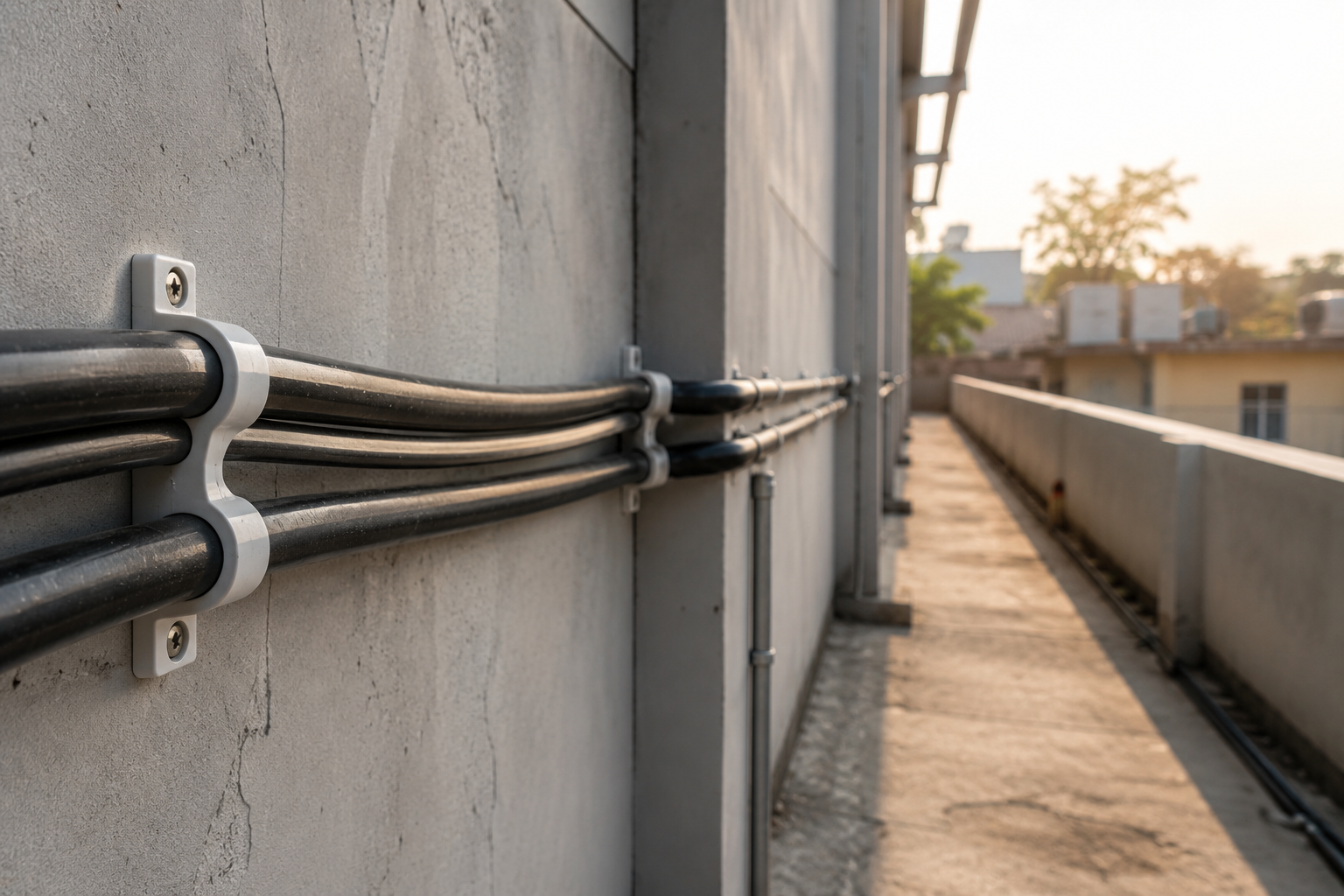

You've just bought an EV, and the convenience of home charging is a big part of the appeal. But then you look at your parking spot, then at your electricity meter box, and realise they're kilometres apart — well, maybe not kilometres, but certainly 65 meters or more. Suddenly, that convenience starts to look like a complicated, expensive wiring job.
When your EV charger is installed far from your meter, say 65 meters, 107 meters, or even more, a common concern pops up: electricity loss. It's not just about the cost of the extra-long cable; it's about the power that literally gets 'lost' as heat in the wire, meaning less power reaches your car and your electricity bill goes up. This guide will help you understand why this happens and how to choose the right cable to minimise those losses for long-distance home EV charging in India.
Why Long-Distance Wiring is a Big Deal for EVs
For a standard home appliance like a TV or a fan, a long wire might not cause much trouble. But an EV charger draws a significant, continuous current for several hours. This makes voltage drop and power loss critical issues. Think of it like a water pipe: if the pipe is too narrow or too long, the water pressure at the end will be much lower than at the source.
The Science of Power Loss: Voltage Drop and I²R Loss
- Voltage Drop: As electricity travels through a wire, it encounters resistance. The longer the wire and the thinner its cross-section (gauge), the more resistance it offers. This resistance causes the voltage to 'drop' along the length of the cable. If the voltage drop is too high, your EV charger might not operate efficiently, or in some cases, might even shut down.
- I²R Loss (Power Loss): This is the actual electricity wasted as heat in the cable. 'I' stands for current (in Amperes), and 'R' stands for resistance (in Ohms). The formula I²R shows that power loss increases exponentially with current. So, a high-power EV charger (drawing high current) on a long, thin cable will generate a lot of heat, wasting electricity and potentially damaging the cable over time.
For a 7.2 kW single-phase charger, you're looking at drawing around 32 Amperes (A). Over 65+ meters, this is a substantial load, and selecting the wrong cable can lead to significant energy wastage – and higher electricity bills.
Choosing the Right Cable: Copper vs. Aluminium and Gauge
When it comes to long cable runs for EV charging, two main factors dominate: the material of the cable and its cross-sectional area, or 'gauge' (measured in square millimetres, or sq.mm).
Copper vs. Aluminium: The Indian Reality
In India, you'll often hear discussions about copper versus aluminium wires. While aluminium is cheaper, it has higher resistance and is more prone to oxidation, especially at connection points. For a crucial, high-current application like EV charging, especially over long distances, copper cable is almost always the superior choice.
- Copper: Better conductivity, less resistance, more durable, and less prone to heating. It's the standard for reliable, high-power home wiring.
- Aluminium: Cheaper, but has higher resistance. If an electrician suggests aluminium for a long EV charger run, be very cautious. The cost savings upfront will likely be negated by higher electricity bills and potential safety issues down the line.
Understanding Cable Gauge (sq.mm) for Long Runs
The cable's cross-sectional area (e.g., 6 sq.mm, 10 sq.mm) directly impacts its resistance. A thicker cable has lower resistance, which means less voltage drop and less power loss. For long distances, you absolutely need to upsize your cable gauge.
Here's a general guideline for single-phase 7.2 kW (32A) EV chargers, assuming a reasonable voltage drop (typically <5% is desirable):
- Up to 20 meters: 6 sq.mm copper cable might suffice, but 10 sq.mm is safer and better for future-proofing.
- 20 to 50 meters: 10 sq.mm copper cable is generally recommended.
- 50 to 80 meters: You should seriously consider 16 sq.mm copper cable.
- 80 to 100+ meters: 16 sq.mm or even 25 sq.mm copper cable might be necessary, depending on the exact distance and desired voltage drop. This is where professional calculation becomes crucial.
Why upsizing is important: If you use a 10 sq.mm copper wire for a 65-meter run for a 7.2 kW charger, the losses could be significant. Switching to a 16 sq.mm cable, while more expensive initially, will drastically reduce those losses, saving you money on electricity in the long run and ensuring your charger operates optimally.
Calculating Voltage Drop and Power Loss (Simplified)
While a qualified electrician should do the precise calculations, here's a simplified way to understand the impact:
- Find Cable Resistance: Good quality copper cables have a resistance of about 0.018 to 0.021 Ohms per square millimetre per meter (Ω/sq.mm/m). You'll need to look up the exact resistance per kilometre for your chosen cable size from the manufacturer's datasheet.
- Calculate Total Resistance: Multiply the resistance per meter by the total length (remembering current travels both ways, so double the distance for a single-phase circuit if calculating for a loop). For example, a 65-meter run means a 130-meter loop.
- Calculate Voltage Drop: Voltage Drop = Current (A) × Total Resistance (Ω).
- Calculate Power Loss: Power Loss (Watts) = Current (A)² × Total Resistance (Ω).
Let's take an example: For a 7.2 kW (32A) charger, a 65-meter run (130m loop) with a 10 sq.mm copper cable (approx. 0.0019 Ω/m/sq.mm for a specific brand):
- Resistance of 10 sq.mm cable per meter (approx): 0.0019 Ω/m
- Total Resistance for 130m loop: 0.0019 Ω/m * 130m = 0.247 Ω
- Voltage Drop: 32A * 0.247 Ω = 7.9 V
- Percentage Voltage Drop (assuming 230V supply): (7.9V / 230V) * 100 = 3.4% (acceptable, but on the higher side)
- Power Loss: 32A² * 0.247 Ω = 1024 * 0.247 = 252.9 Watts
This means for every hour of charging, you lose about 0.25 units (kWh) of electricity. Over an 8-hour charge, that's 2 units lost. If electricity costs ₹8/unit, that's ₹16 per charge just in cable loss. Over a year, this can add up to ₹5,000-₹6,000! Now imagine using a thinner cable, and these losses climb even higher.
Installation Considerations for Long Runs
- Conduit: All cables, especially long runs, must be protected in proper conduits, whether it's through walls, under the ground, or along ceilings. This protects against physical damage, pests, and environmental factors like monsoon rains.
- Joints: Minimise joints in the cable. Every joint is a potential point of failure, resistance, and heat generation. If joints are unavoidable, they must be properly crimped, soldered, and insulated.
- Earthing: A dedicated and robust earthing system is non-negotiable, especially for long runs where faults might be harder to detect. Ensure your electrician provides a proper earth connection throughout the cable length.
- Safety Devices: Beyond the cable, ensure proper safety devices are installed near your meter box and near the charger. This includes a dedicated MCB (Miniature Circuit Breaker), an RCCB (Residual Current Circuit Breaker) – preferably Type A for EV charging – and a Surge Protection Device (SPD).
- Future-Proofing: If you're going through the effort of laying a long cable, consider if you might upgrade to a higher-power charger (e.g., from 7.2 kW to 11 kW) in the future. Upsizing the cable slightly now could save you from re-wiring later.
Getting it Right: Talk to Your Electrician
Given the complexities, this is not a DIY job. Always engage a certified electrician who has experience with EV charger installations. Here's what to discuss:
- Cable Sizing: Ask them to calculate the exact cable gauge required based on the charger's power (e.g., 7.2 kW), the actual distance, and the acceptable voltage drop (aim for less than 3-4%).
- Material: Insist on 100% copper cable from a reputable brand. Do not compromise on quality for long runs.
- Routing: Discuss the safest and most efficient cable routing, considering obstacles, protection, and future maintenance.
- Quotation Breakdown: Get a detailed quote for the cable cost (per meter), installation charges, and the cost of all safety devices (MCB, RCCB, SPD).
Choosing the right cable for long-distance home EV charging is one of the most critical decisions you'll make for your setup. It impacts efficiency, safety, and your long-term electricity bills. Invest wisely in a thicker, high-quality copper cable and a professional installation to ensure a smooth, worry-free EV charging experience for years to come.


