
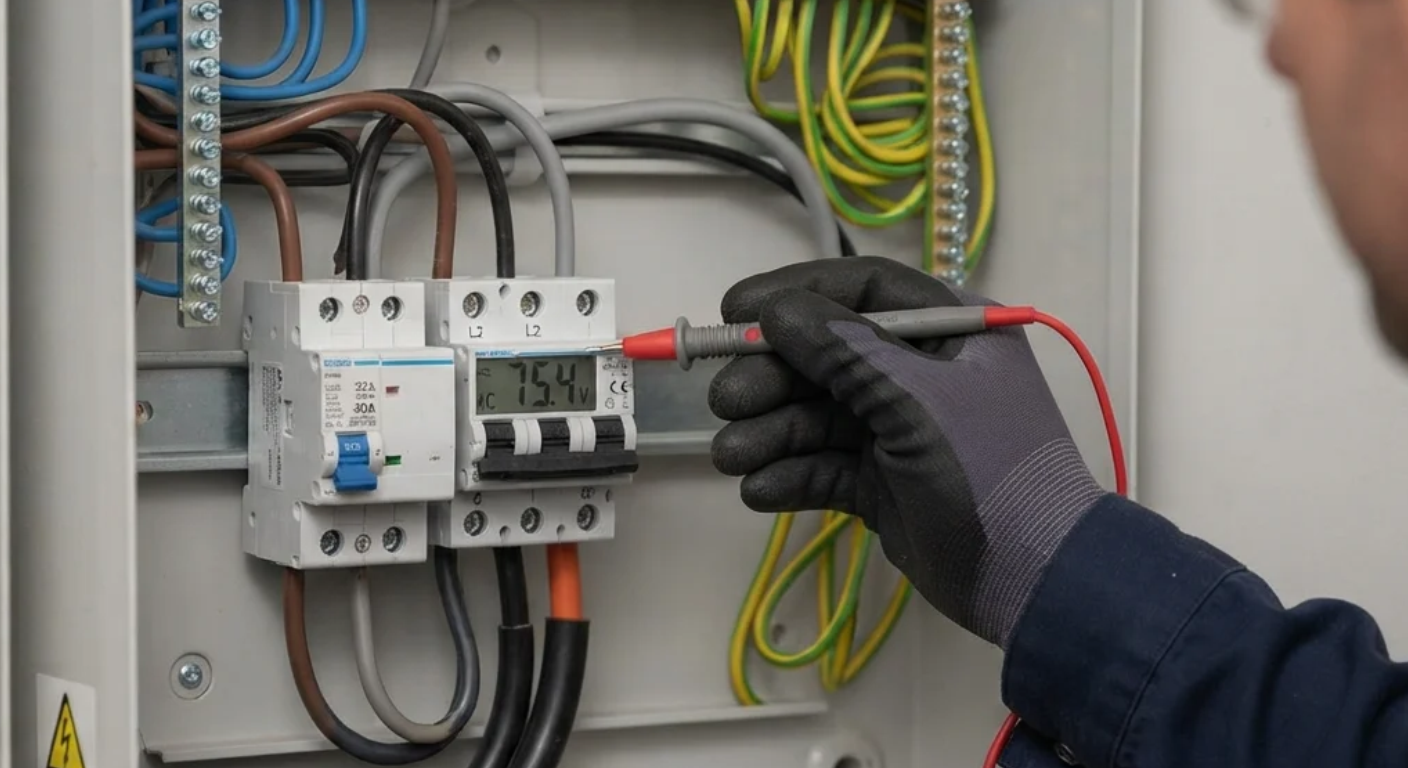

You shelled out a good chunk of money for a 22kW AC home EV charger, expecting super-fast charging. You plugged in your EV, saw the lights come on, and then, after an hour, realised your car barely gained any charge. Instead of the impressive 22kW, your charger is crawling along at a mere 2kW. This isn't just an inconvenience; it's a huge waste of time and money. What could be going wrong?
Understanding Your 22kW Charger
First, let's clear up a common misconception. A 22kW AC charger is a powerful beast, designed to deliver a significant amount of electricity to your EV. However, it's typically a three-phase charger. This means it needs three separate live wires, along with a neutral and an earth, to operate at its full capacity. Many Indian homes, especially older apartments or individual houses, are set up with a single-phase electricity connection. Even if you have a 22kW charger, if your home only has a single-phase supply, it will automatically derate to the maximum it can deliver on one phase, which is usually around 7.4kW (32 Amps x 230 Volts).
So, if you have a single-phase connection, and your 22kW charger is delivering 2kW, something is still very wrong. Even on a single phase, it should be pushing closer to 7kW, not just 2kW.
The Role of Three-Phase vs. Single-Phase Power
- Single-Phase: Common in homes, delivers power through one live wire and one neutral. Max capacity for EV charging is typically 7.4kW (32A).
- Three-Phase: Used in larger homes, commercial spaces, and for high-power appliances. Delivers power through three live wires, allowing for much higher capacities like 11kW or 22kW for EV charging.
Why Your 22kW Charger Might Be Stuck at 2kW
When a 22kW charger delivers only 2kW, it's a clear sign of a significant underlying electrical problem, not just a simple derating. Here are the most common culprits:
1. Incorrect Wiring Configuration (The Most Likely Culprit)
This is by far the biggest reason for such drastic underperformance. A 22kW charger needs all three phases to be correctly wired and detected. If one or two phases are missing or incorrectly connected, the charger will either not work at all, or it will try to operate on the single phase it detects, but at a severely reduced capacity if there's a further issue.
- Missing Phase: An electrician might have only connected one live wire to your charger, even though your home has a three-phase connection.
- Loose Connection: A loose wire for one or two phases at the charger terminal, MCB, or even in the meter box can prevent the full power delivery.
- Incorrect Wiring Sequence: Sometimes, the phases might be connected but in the wrong order, confusing the charger's internal electronics.
2. Faulty MCB or RCCB/RCBO
Your Miniature Circuit Breaker (MCB) or Residual Current Circuit Breaker (RCCB/RCBO) is a critical safety device. If it's undersized, faulty, or has tripped on one of the phases, it will limit the power. An MCB rated for, say, 10 Amps on a single phase will only allow a maximum of 2.3kW (10A x 230V). For a 22kW charger, you need a robust three-phase MCB/RCCB, typically rated for 32 Amps or 40 Amps per phase.
3. Weak or Unbalanced Grid Supply
While less common for such a consistent 2kW output, a severely unbalanced or weak grid supply can also cause issues. If one or two of your incoming phases from the electricity board are consistently low on voltage or frequently dropping out, your charger won't be able to draw full power. This is something your local electricity board (e.g., BESCOM, TPDDL, MSEDCL) would need to address. You can check this with a multimeter at your meter box.
4. Charger Internal Fault
Though less frequent in new installations, the charger unit itself could have an internal fault preventing it from utilising all its phases. This would typically require a technician from the charger manufacturer to diagnose and repair.
5. EV's On-Board Charger (OBC) Limitation
While your home charger might be 22kW, your EV's on-board charger (OBC) might have a lower limit. For example, many popular EVs in India, even with a 22kW AC home charger, can only accept up to 7.4kW (single-phase) or 11kW (three-phase) AC charging. However, if your 22kW charger is only delivering 2kW, it's likely an issue with the charger or installation, not just the car's OBC. An EV with an 11kW OBC would still pull ~11kW if the supply is adequate.
Troubleshooting Steps: What to Do
Don't just live with a 2kW charge! Here's a systematic approach to finding and fixing the problem:
Check Your Electricity Bill & Meter Box
- Confirm if your home connection is single-phase or three-phase. Your electricity bill will usually state this. If it's single-phase, your 22kW charger will never deliver more than 7.4kW. If it's three-phase, then the 2kW output is definitely an anomaly.
Inspect the MCB/RCCB
- Locate the dedicated MCB/RCCB for your EV charger. Ensure it's rated appropriately (e.g., 32A or 40A three-phase for a 22kW charger). Check if it's fully 'ON' and hasn't partially tripped (some three-phase breakers can trip on one phase).
Call a Certified Electrician (Crucial Step)
- This isn't a DIY job. You need a qualified electrician who understands EV charging installations. Ask them to:
- Verify Phase Presence: Using a multimeter, check if all three phases are present and live at the charger's input terminals, and if the voltage between phases (400-415V) and phase-to-neutral (220-240V) is correct.
- Check Wiring Integrity: Ensure all connections are tight and correctly wired, from the meter box to the MCB and then to the charger. Look for any loose wires, especially at the charger's input terminals.
- Cable Sizing: While less likely to cause a consistent 2kW output from a 22kW charger, ensure the cable running to your charger is adequately sized (e.g., 10 sq mm or 16 sq mm copper for a 22kW charger, depending on length). Undersized cables can lead to voltage drop and heat, but usually not such a dramatic, consistent derate.
Consult Your EV Charger Manufacturer
- If the electrician confirms the electrical supply and wiring are perfect, the issue might be with the charger itself. Contact the manufacturer's customer support. They can guide you through specific diagnostic steps or send a technician to inspect the unit.
Check Your EV's Charging Settings
- Though rare, some EVs or their companion apps allow you to limit the charging current. Double-check your car's settings and its app to ensure there isn't an accidental limit set to a very low amperage.
The Bottom Line
A 22kW home EV charger delivering only 2kW is a significant underperformance that almost always points to an electrical installation issue, most likely incorrect or incomplete wiring of the three-phase supply. Don't delay in getting it checked by a professional. You paid for the speed, and you deserve to get it.
When talking to your electrician, specifically mention that your 22kW charger is only pulling about 3.2 Amps per phase (which works out to roughly 2kW in a three-phase system). This detail can help them narrow down the problem quickly. They should be looking for why each phase isn't pulling its intended current (e.g., 32 Amps per phase for full 22kW).


