
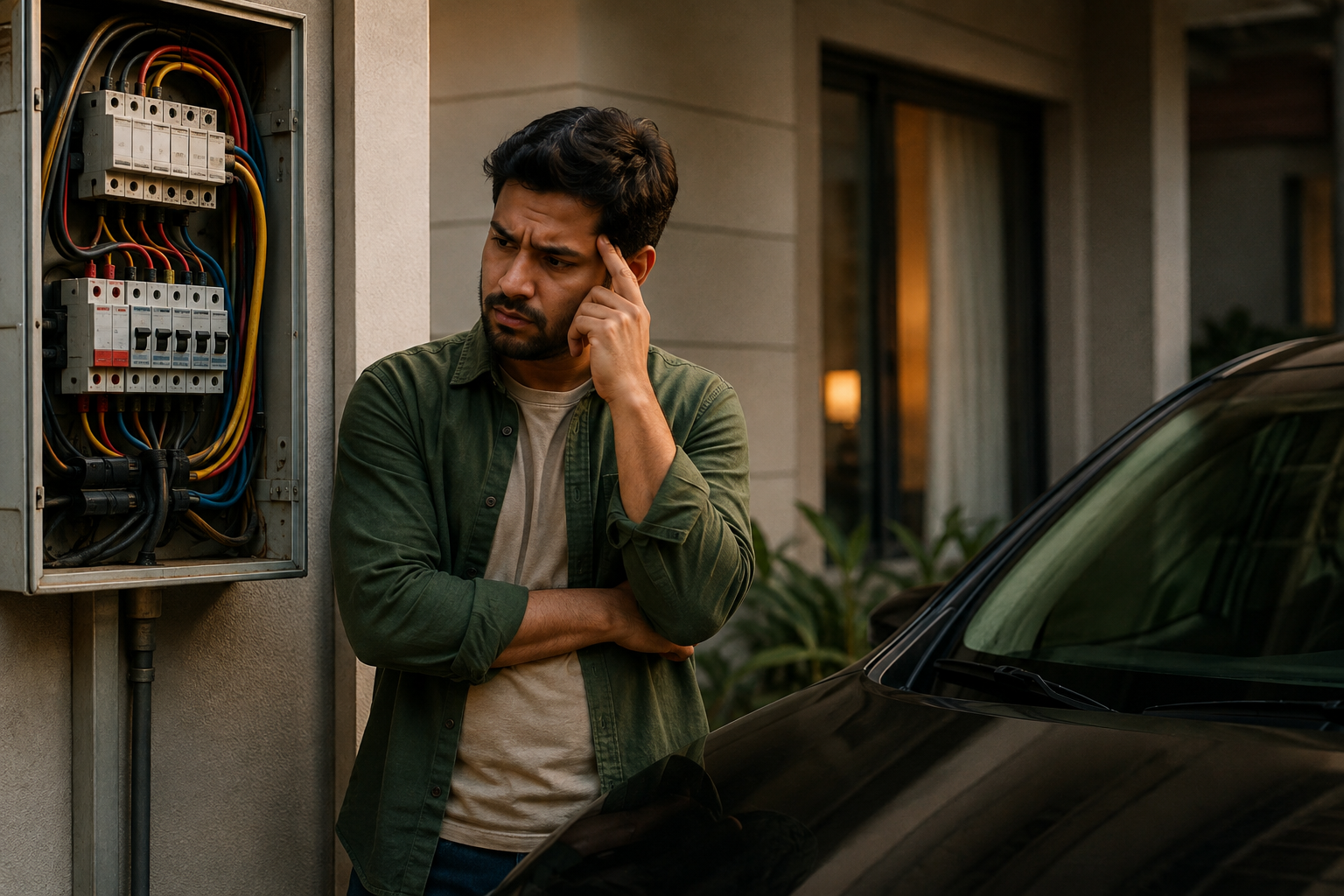

You've invested in a powerful 32A home EV charger, expecting quick top-ups for your electric vehicle. But instead of the promised 7kW (or roughly 32A) output, you consistently see it stuck at a lower current, perhaps 20A or 25A. It's not tripping completely, but it's not delivering full power either. This common issue can be frustrating, especially when you're trying to maximise charging speed. Let's break down why your charger might be derating and how to troubleshoot it.
Understanding Your Charger's 'Derating' Behaviour
When your 32A charger consistently operates at 20-25A, it's 'derating'. This means the charger, or your EV, is intentionally reducing the current draw. It's not necessarily a fault; often, it's a safety mechanism or a response to suboptimal electrical conditions. Think of it like your car's engine automatically reducing power when it detects an issue – it's trying to protect itself or the system it's connected to.
Why Does Derating Happen?
Unlike a complete shutdown, derating suggests the system is detecting a limit or a potential problem, but not one severe enough to stop charging entirely. The charger or the car's onboard charger (OBC) is smart enough to say, "I can't safely draw 32A here, but 20-25A seems fine."
Common Culprits Behind Consistent Power Drops
There are several reasons why your 32A charger might be consistently underperforming. We'll look at the most frequent ones in an Indian home context.
1. Insufficient Sanctioned Load from the DISCOM
This is perhaps the most common reason. Your home's electricity connection has a sanctioned load, which is the maximum power you're allowed to draw from the grid. If your sanctioned load is, say, 5kW or 6kW, and you try to draw 7kW for your EV charger (32A at 230V is roughly 7.36kW), your main MCB might trip. However, some systems are designed to derate rather than trip instantly, especially if the overload is marginal or intermittent.
- The Reality: Many Indian homes have sanctioned loads of 3-5kW for lights, fans, ACs, and geysers. Adding a 7kW EV charger without upgrading your sanctioned load is like trying to fit a truck through a scooter lane.
- What to Check: Look at your electricity bill to confirm your sanctioned load.
2. Undersized Wiring or Loose Connections
Even if your sanctioned load is adequate, the wiring from your meter box to your EV charger point plays a crucial role. Thin, low-gauge wires or old, corroded connections introduce resistance. This resistance causes a voltage drop, especially under high current draw. When the voltage drops significantly, your EV charger or car's OBC will automatically reduce the current to compensate and protect itself.
- The Impact: A 32A charger needs thick, dedicated wiring (typically 6 sq. mm copper cable for runs up to 15-20 metres, or even 10 sq. mm for longer distances) to carry the current without excessive voltage drop. If your electrician used 4 sq. mm wire for a 32A charger, or if there are loose joints, you'll likely see derating.
- What to Check: Have a qualified electrician inspect the entire wiring path from your main meter to the charger. Look for proper cable gauge, secure terminations, and any signs of overheating.
3. Weak or Fluctuating Grid Voltage
The Indian electricity grid, while improving, can sometimes have voltage fluctuations, especially in certain areas or during peak demand hours. Your EV charger is designed to operate within a specific voltage range (usually 220-240V). If the incoming voltage consistently drops below this range (e.g., to 200V or 210V), the charger will reduce the current to maintain the power output, or the car will request less current.
- How to Detect: Use a multimeter to measure the voltage at your charger's input during charging. Do this at different times of the day to see if there's a pattern.
- Solution: While you can't fix the grid, understanding this helps diagnose. Sometimes, a good quality automatic voltage stabiliser could help, but it's a costly solution for a charger and usually better to address the root cause if it's internal.
4. Earthing Issues
Proper earthing (grounding) is not just for safety; it also provides a stable reference point for electrical systems. Poor or absent earthing can sometimes lead to erratic behaviour in sensitive electronics like EV chargers, including derating. While it's more likely to cause tripping or complete shutdown, a subtle earthing issue could contribute to instability that prompts derating.
- What to Check: Ensure your home has a robust earthing system, and the charger is properly connected to it. An electrician can measure earth resistance.
5. Charger or EV Onboard Charger (OBC) Limitations
Less common, but possible, is an internal limitation within your EV charger itself or your car's OBC. Some chargers have settings that can be adjusted, or they might have an internal fault that prevents them from drawing full power. Similarly, if your car's OBC has an issue, it might consistently request a lower current from the charger.
- Troubleshooting: Try charging a different EV with your charger (if possible) or try charging your EV with a different 32A charger (e.g., at a friend's place or a public AC charger). This helps isolate whether the issue is with your charger, your car, or your home's electrical supply.
6. Shared Circuit with Other High-Load Appliances
If your EV charger is not on a dedicated circuit and shares wiring with other heavy appliances like air conditioners, geysers, or induction cooktops, the combined load can cause voltage drops or exceed the circuit breaker's capacity, leading to derating. Even if it doesn't trip the MCB, the system might sense the instability.
- Best Practice: A 32A EV charger should always have a dedicated circuit with its own MCB, directly from your main distribution board.
Steps to Troubleshoot Your Derating Charger
- Verify Sanctioned Load: Check your latest electricity bill. If it's less than 7kW, initiate a load extension request.
- Inspect Wiring: Call a certified electrician. Ask them to check the cable gauge from your meter to the charger, look for loose connections, and measure voltage drop under load. They should also verify the MCB rating (it should be a C-curve 32A or 40A MCB for a 32A charger).
- Monitor Grid Voltage: Ask your electrician to use a multimeter to check the voltage at the charger's input terminals before and during charging, especially during peak hours.
- Test with Another EV/Charger: If possible, try charging a different EV with your charger, or try charging your EV with another 32A charger. This is a quick way to narrow down the problem to either your car, your charger, or your home's electrical setup.
- Check Charger Settings: Some smart chargers have apps or interfaces where you can set the maximum charging current. Ensure it's not inadvertently set to a lower value.
- Professional Diagnostic: If all else fails, contact your EV charger manufacturer's service centre or a specialised EV electrician. They have advanced diagnostic tools to pinpoint internal faults.
The Bottom Line
A 32A charger consistently working at 20-25A isn't just an inconvenience; it means you're not getting the full value or speed you paid for. Most often, the issue lies with your home's electrical infrastructure – either the sanctioned load, the wiring, or the incoming voltage. Address these foundational elements first, and you'll likely resolve your derating problem, ensuring your EV charges efficiently and safely every time.


