
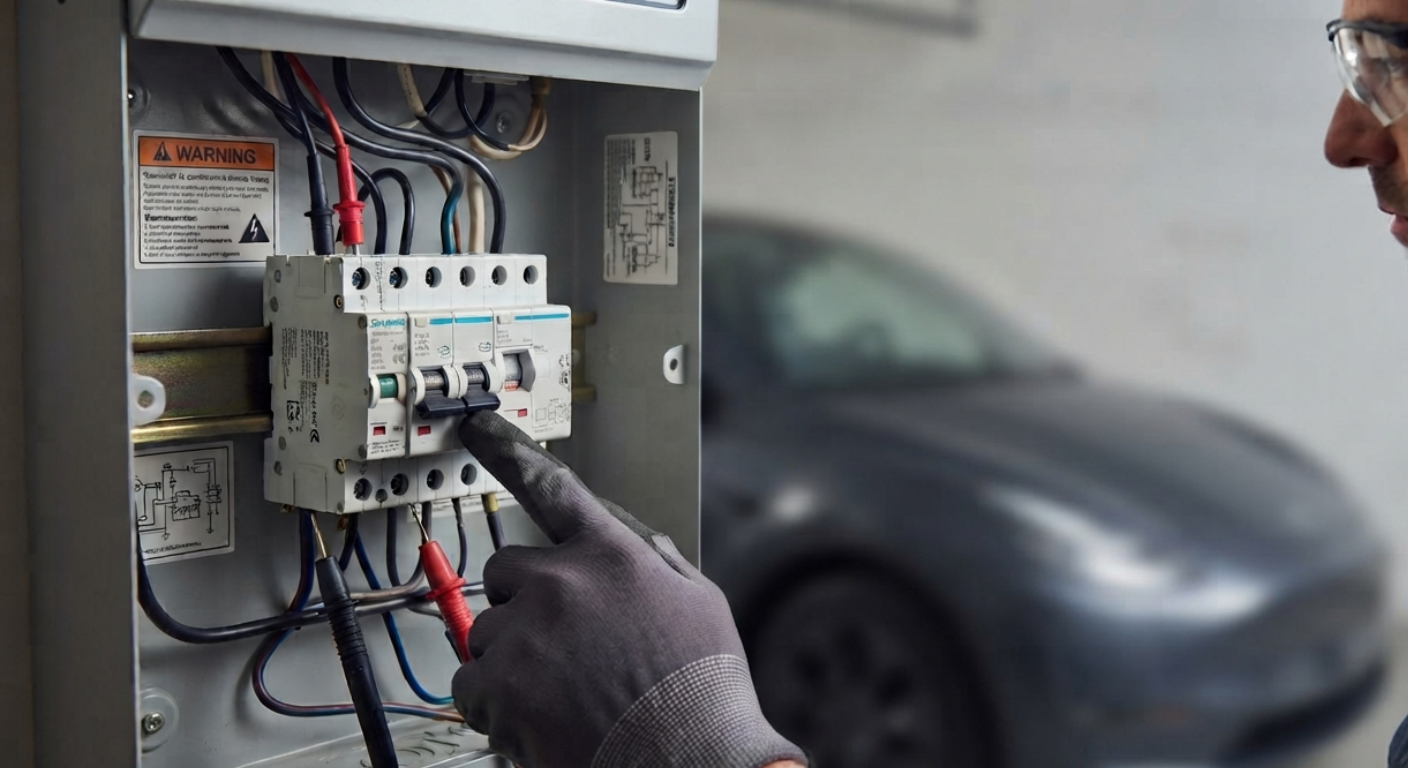

You just got a shiny new EV and a 7kW home charger, expecting smooth, fast charging. You plug it in, and it works, but then you notice something unsettling: the lights in your home flicker, the AC unit struggles, or perhaps other appliances briefly trip. This isn't just an inconvenience; it's a clear sign that your home's electrical system might be struggling to handle the load, often because your sanctioned load limit is 5kW, not enough for a 7kW charger.
Understanding Sanctioned Load: Your Home's Electrical Speed Limit
Every home in India has a 'sanctioned load' – this is the maximum amount of electricity, measured in kilowatts (kW), that your electricity provider has officially approved for your connection. Think of it as the speed limit for your home's electrical highway. If you have a sanctioned load of 5kW, it means your entire home, including all appliances running simultaneously, should ideally not draw more than 5,000 watts at any given moment.
Most residential connections in India, especially in older apartments or smaller homes, come with sanctioned loads in the range of 2kW to 5kW. A 7kW EV charger, when running at full power, draws approximately 7,000 watts (or around 32 Amperes on a single phase). If your home's sanctioned load is only 5kW, trying to run a 7kW charger alongside your AC, refrigerator, and geyser is like trying to fit a truck through a scooter lane – it's going to cause a jam, or in this case, a power fluctuation.
Why Fluctuations Happen
When your EV charger tries to pull more power than your sanctioned load, your home's electrical system gets overloaded. This can manifest in several ways:
- Voltage drops: The overall voltage supplied to your home temporarily dips, causing lights to dim or flicker.
- Tripping MCBs: Your main Miniature Circuit Breaker (MCB) or the MCB for the specific circuit might trip, cutting off power to prevent damage.
- Appliance malfunctions: Sensitive electronics might behave erratically or even get damaged over time due to inconsistent power supply.
- Meter issues: Your electricity meter might register an overload, potentially leading to penalties from your service provider.
Checking Your Home's Electrical Capacity: More Than Just the Meter
While the sanctioned load is the official limit, your home's actual electrical capacity involves several other factors:
- Main supply cable: The thick cable coming into your meter box from the main supply line. If this cable is too thin for a 7kW load, it will heat up and restrict power flow.
- Meter box wiring: The internal wiring within your meter box and distribution board. Older wiring might not be rated for high currents.
- MCBs and RCCBs: Your main MCB and Residual Current Circuit Breaker (RCCB) must be rated appropriately (e.g., 40A or 63A for a 7kW charger, depending on your setup) to handle the load safely.
- Internal house wiring: The wiring running from your distribution board to the point where your EV charger is installed. For a 7kW charger, you typically need a dedicated 6 sq. mm copper cable.
- Earthing: A robust earthing system is crucial for safety, especially with high-power appliances like EV chargers.
It's not just about the numbers on your electricity bill; it's about the physical infrastructure. Many electricians in India might simply connect a charger without a thorough assessment, leading to these very issues.
The Solution: Upgrading Your Sanctioned Load and Electrical Infrastructure
If your 7kW charger is causing fluctuations, the most direct and safest solution is to increase your sanctioned load. Here's how the process typically works in India:
Assess Your Needs:
- Calculate your total home load. Add up the wattage of all major appliances (ACs, geysers, refrigerator, washing machine, microwave) and then add 7kW for your EV charger. For example, if your existing home load is 3kW and you add a 7kW charger, you'll need at least a 10kW sanctioned load.
Contact Your Electricity Provider:
- Reach out to your local electricity board to apply for a load enhancement. You'll typically need documents like your latest electricity bill, identity proof, and property documents.
Site Inspection and Quotation:
- The electricity board will likely send an engineer to inspect your premises. They will provide a quotation for the load enhancement, which includes charges for the increased load and any necessary upgrades to their infrastructure (like a larger transformer if many residents in your area are upgrading).
Internal Wiring Upgrades:
- While the electricity board handles the main supply, you'll need a qualified electrician to upgrade your internal wiring. This includes installing a dedicated circuit for the EV charger with appropriate gauge cables (e.g., 6 sq. mm copper for single-phase 7kW), a suitable MCB (e.g., 32A or 40A), and an RCCB (e.g., 40A, 30mA). They might also need to upgrade your main MCB and distribution board if they are old or undersized.
Installation and Testing:
- Once the load is enhanced and internal wiring is upgraded, your EV charger can be safely installed and tested. Ensure your electrician provides a proper earthing connection.
What if Increasing Sanctioned Load isn't Possible?
In some cases, especially in older apartment societies, increasing the sanctioned load might be difficult or face RWA resistance due to overall building capacity limitations. In such scenarios, consider these alternatives:
- Load Management Features: Some advanced EV chargers come with dynamic load management features. These chargers can monitor your home's total electricity consumption and automatically reduce the charging speed of your EV when other heavy appliances are in use, preventing overloads.
- Lower Power Charger: If load management isn't an option and upgrading your sanctioned load is impossible, you might have to opt for a lower-power charger, perhaps a 3.3kW (15A) charger, which is less demanding on your existing electrical system.
- Scheduled Charging: Charge your EV during off-peak hours (e.g., late at night) when other household appliances are typically not in heavy use. This reduces the overall load on your system.
Final Thoughts: Don't Compromise on Safety
Ignoring power fluctuations from your EV charger is not just an inconvenience; it's a safety hazard. Overloaded electrical systems can lead to overheating, short circuits, and even fires. Always prioritise a safe and compliant installation. Before installing any high-power EV charger, it's wise to:
- Consult a qualified electrician to assess your home's existing electrical infrastructure.
- Check your latest electricity bill for your current sanctioned load.
- Plan for potential load enhancement and associated wiring upgrades.
A little planning and investment upfront will ensure a safe, reliable, and hassle-free EV charging experience for years to come.


