
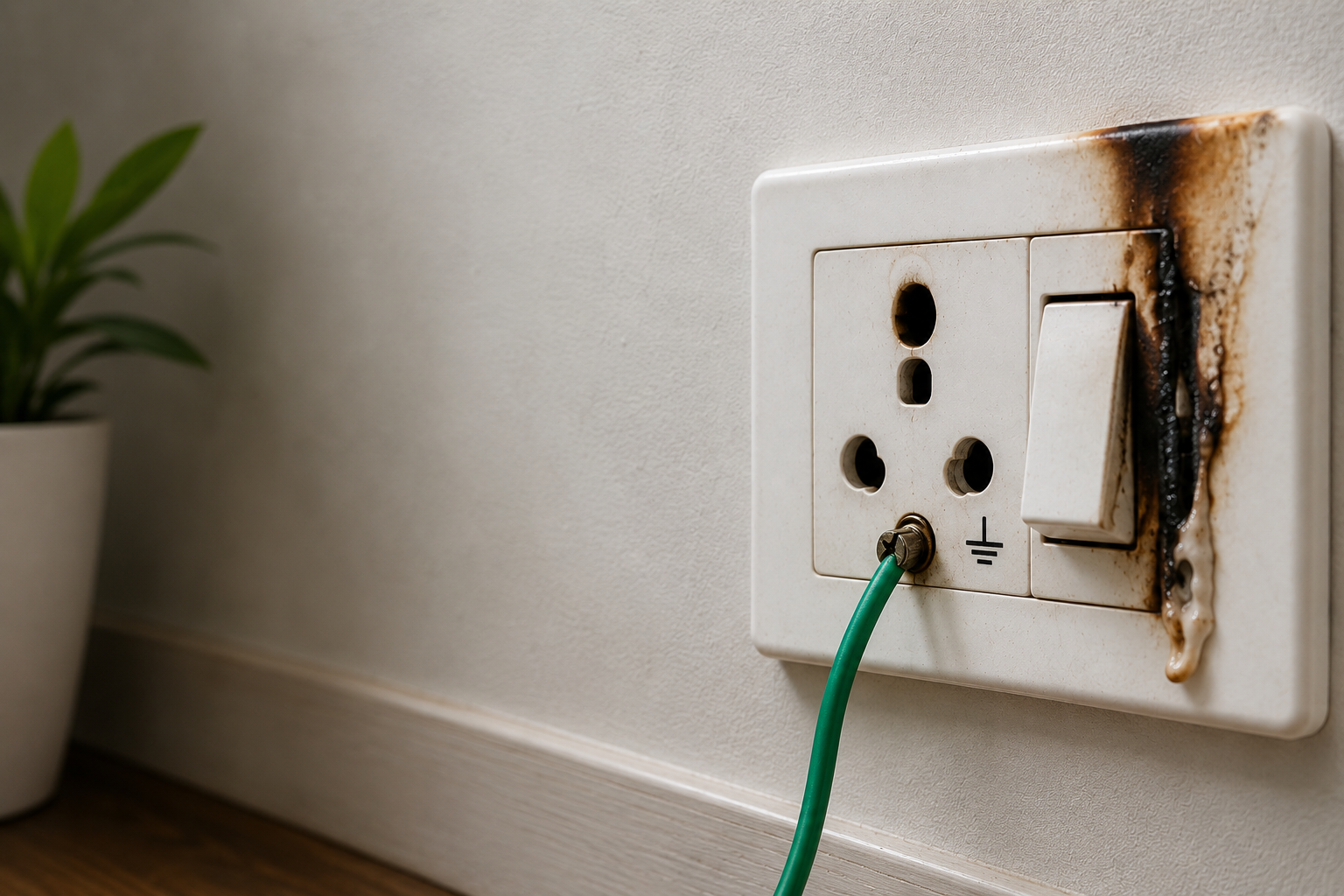

Walk into any Indian home, and you'll find a small, often overlooked detail: the third, slightly fatter pin on every plug. That's the earthing pin, and it's there for a crucial reason – your safety. Now, imagine you've just bought a shiny new electric vehicle. You're excited, but then comes the question of charging at home. Maybe you're trying to save a few bucks, or perhaps your electrician isn't fully clued into EV requirements. So, you try to charge your car without proper earthing. The car charges, yes, but then you notice something unsettling: the extension board switch starts to melt, or a strange burning smell fills the air. This isn't just an inconvenience; it's a ticking time bomb. This guide explains why proper earthing isn't just a suggestion for EV charging; it's a non-negotiable safety requirement to prevent melting switches, fire risks, and serious electrical hazards.
The Danger of 'Jugaad' EV Charging Setups
In India, we're masters of 'jugaad' – finding an innovative, often makeshift, solution to a problem. While 'jugaad' can be resourceful in many situations, it has no place when it comes to high-power electrical appliances like EV chargers. An EV charger, even a standard 3.3kW one, draws significant current. If your home's electrical system, especially its earthing, isn't up to the mark, you're inviting trouble.
We often hear stories of people trying to make do with existing, old wiring, or bypassing earthing altogether because their car 'seems to charge fine' without it. But what you don't see is the stress this puts on your entire electrical system. The melting switch you observed is a clear warning sign that the circuit is overheating, struggling to handle the load, and desperately trying to find a safe path for fault currents – a path that only proper earthing can provide.
What Exactly is Earthing and Why is it So Important for EVs?
Think of earthing (or grounding) as a safety net for your electrical system. In simple terms, it's a wire connecting the metallic parts of your appliances (like your EV charger's body) to a deep metal rod or plate buried in the earth. If there's an electrical fault – say, a live wire accidentally touches the charger's metal casing – the earthing provides a low-resistance path for that excess current to flow safely into the ground, instead of through you or your car.
For an EV charger, which handles high power, this safety net is critical. Without proper earthing, a fault could:
- Turn the entire metallic body of your charger (and potentially your car) into a live conductor, leading to a severe electric shock.
- Cause excessive heat build-up in wires and switches, leading to insulation breakdown, short circuits, and eventually, fire.
- Damage sensitive electronics in your EV or the charger itself, leading to costly repairs.
Common Earthing Issues and Their Consequences
Many older Indian homes, or those with poorly maintained electrical systems, might have inadequate or non-existent earthing. Here are some common scenarios and what can go wrong:
1. No Earthing Connection at All
This is the most dangerous scenario. If your charging point doesn't have an earthing wire connected, any fault current has no safe path. Imagine touching a faulty charger; the current would pass through your body to find a path to the ground, resulting in a potentially fatal electric shock. The melting switch you're seeing is a sign that the current is trying to find any path, often through unintended components, causing them to overheat and fail.
2. High Earth Resistance
Even if an earthing wire is present, its effectiveness depends on the resistance of the earth pit. If the earth resistance is too high (above recommended limits, typically 1-5 ohms for residential), the fault current won't dissipate quickly enough. This can still lead to dangerous voltage build-up on appliance bodies and insufficient tripping of protective devices like MCBs (Miniature Circuit Breakers) or RCCBs (Residual Current Circuit Breakers).
3. Faulty or Loose Earthing Connections
Over time, connections can corrode, loosen, or be poorly installed. A loose earthing connection is as good as no earthing at all. It might work intermittently, but when a fault occurs, it won't provide the reliable path needed, leading to the same risks as having no earthing.
The Role of MCBs and RCCBs (ELCBs)
Your home's electrical panel has protective devices like MCBs and RCCBs (sometimes called ELCBs, or Earth Leakage Circuit Breakers). While these are vital, they work hand-in-hand with proper earthing.
- MCBs protect against overcurrents (too much current flowing) and short circuits. They trip when the current exceeds a safe limit.
- RCCBs/ELCBs are designed to detect small leakage currents to the earth – precisely what happens during an electrical fault where current is trying to escape to the ground. They trip much faster than MCBs, often within milliseconds, to prevent electric shock.
Without proper earthing, an RCCB might not even detect a fault current until it's flowing through a person, making it less effective. An MCB, on the other hand, might only trip after significant overheating and damage has already occurred, as it's not designed specifically for leakage current detection.
What a Safe EV Charging Installation Looks Like
For safe and reliable EV charging at home, here's what you need:
- Dedicated Circuit: Your EV charger should ideally have its own dedicated electrical circuit from your main meter box, not just share an existing power socket. This ensures it doesn't overload other appliances.
- Appropriate Wiring: The wiring (phase, neutral, and earthing) must be of adequate gauge to handle the charger's current (e.g., 4 sq mm or 6 sq mm for a 7kW charger).
- Proper Earthing: This is non-negotiable. A dedicated earth pit for your home, or at least a robust connection to an existing, verified earth electrode, is essential. The earth resistance should be tested by a qualified electrician.
- Protection Devices: Install a dedicated MCB and an RCCB (Type A or Type B, as recommended by your charger manufacturer) for your EV charging circuit. These should be housed in a weather-proof enclosure if installed outdoors.
- Professional Installation: Always get your EV charger installed by a certified electrician who understands EV charging requirements. They will assess your existing electrical infrastructure, check the earthing, and ensure all safety standards are met.
The Cost of Safety vs. The Cost of 'Jugaad'
You might think getting a professional installation with proper earthing is an added expense. A basic earth pit installation can cost anywhere from INR 5,000 to INR 15,000, depending on the location and complexity. Add to that the cost of proper wiring, MCBs, and RCCBs. However, compare this to the potential costs of 'jugaad':
- Replacing melted switches and damaged appliances.
- Repairing fire damage to your home or vehicle, which could run into lakhs of rupees.
- Hospital bills from electric shock.
- The ultimate, irreversible cost of a life lost.
The choice is clear: investing in proper earthing and professional installation is a small price to pay for peace of mind and the safety of your family and property.
Final Rule of Thumb: Always Prioritise Safety
Never compromise on electrical safety, especially when dealing with high-power equipment like EV chargers. If you see any signs of overheating – a burning smell, discoloured switches, flickering lights when charging – disconnect your charger immediately and call a qualified electrician. Ask them to check your earthing system thoroughly. A safe EV charging experience begins with a robust and reliable electrical foundation, and earthing is the bedrock of that foundation.


