
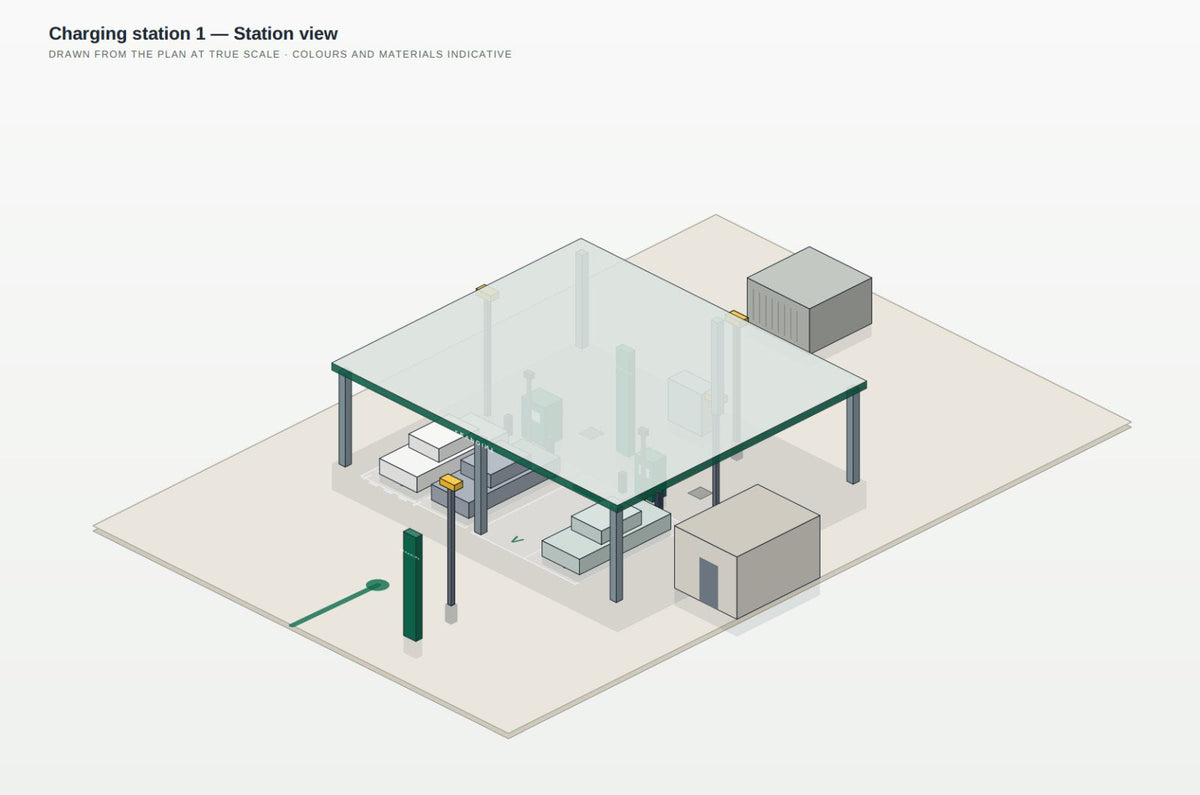

Short answer: a DC charger is the largest electrical load most sites will ever ask for, and the utility decides how it arrives. Up to a ceiling, your DISCOM supplies it at 415 volts on an ordinary low-tension connection, the kind a shop or a small workshop has. Above that ceiling the connection becomes high tension: your own transformer, a metering cubicle, an inspection, a yard to put it all in, and months instead of weeks. The general ceiling is not a national number. Each state's regulator sets it in its supply code, and between the strictest state and the most generous it varies about four-fold. But for a charging station there is a national rule on top: the Ministry of Power's 2024 guidelines tell every DISCOM to give an LT connection up to 150 kW, if you apply for a separate connection for the station. The table in this guide lists every state ceiling we have verified from the regulation itself, with the document it comes from and the largest Zevpoint charger that fits under it, and the section below it explains how to use the national rule where your state is stricter.
Sanctioned load is a contract, not a setting
Every connection carries a sanctioned load, printed on the bill: the power you have agreed to draw. Draw more and the meter records it, a penalty follows, and in most states a repeat earns a letter asking you to regularise. Raising it is an application with a fee, a feasibility check and sometimes a wait for the local transformer to have room. For a house this is paperwork. For a DC station it is the project.
So the first question for a site is not "which charger" but "how much can this plot be given, and at what voltage". Everything else, the charger included, follows from the answer.
LT or HT: the one number that decides the budget
Low tension is 415 V three-phase, straight off the DISCOM's transformer, through a meter and into your panel. High tension means the DISCOM hands you 11 kV and the transformer is yours. You buy it, house it, protect it, have it inspected by the electrical inspectorate, and maintain it for the life of the site. The charger costs the same either way. The difference between the two connections is a transformer, an HT panel, a metering cubicle, civil work, an inspection and the time all of that takes, and on a small site that difference can cost more than the charger.
The LT ceiling is therefore the single figure that decides whether a site is a four-week job or a four-month one. That is why we hold it as data with a source, and never as a round number someone remembers.
The ceiling is a state rule
Each state's electricity regulator writes a supply code, and somewhere inside it is the load above which supply must be at HT. Some codes say it in kW, some in kVA, one in horsepower. A few states carve out a category for EV charging; most do not. The pattern on the ground: the big northern states are strict, and a dual-gun charger for mass-market cars is already over the line in Haryana, Uttar Pradesh and Rajasthan. Punjab sits in the middle. Delhi, Maharashtra and Karnataka are generous enough that a dual-gun charger in the 120 kW class stays on LT.
A single flat assumption is wrong in both directions. It sends you to HT where LT would have done, and it designs an LT site where the utility will refuse to connect it.
The national rule for charging stations: LT up to 150 kW
The state ceilings above are the general rule for any consumer. Charging stations have one more rule, from the centre. The Ministry of Power's Guidelines for Installation and Operation of Electric Vehicle Charging Infrastructure, 2024 (17 September 2024), clause 5(3), says: "Distribution Licensee must provide Low Tension (LT) connection up to 150 kW for charging stations provided, application for a separate LT electricity connection is made for EV charging station."
In practice that changes the advice in the strict states. A dual-gun charger in the 60 to 120 kW class is over the general ceiling in Haryana, Uttar Pradesh and Rajasthan, but under the 150 kW the guidelines allow for a station on its own connection. Three things make it work:
- Apply for a separate connection for the station. The rule applies to a dedicated EV charging connection, not to adding load to the shop or hotel next to it. The guidelines also require separate metering for every station.
- Cite the clause in the application. State supply codes have not all been amended to match, and a DISCOM office may quote its own code first. The guideline, the clause and its date belong in the covering letter.
- Keep the state ceiling as the fallback. If the DISCOM still refuses LT, the state code in the table is what it will apply, and the site is planned for HT.
Above 150 kW, the national rule does not help, and the state ceiling decides. The same guidelines set the time the DISCOM has to release the connection: three days in a metro, seven in other towns, fifteen in rural areas and thirty in hilly rural areas, or ninety where new mains or a substation are needed.
Traps we found reading the rules
We read the regulations rather than summaries of them, and the reading turned up things no summary mentions. Each one sits in the note under its DISCOM in the table above.
- Haryana's old sales manuals still show a higher band. It protects connections that already existed when the code changed. A new connection gets the lower ceiling.
- Karnataka's regulator still hosts a consolidated PDF from 2013. It prints a ceiling three times lower than the one in force since the 2020 amendment. Design against the PDF and you build HT for nothing.
- Uttar Pradesh's code prints two different figures on two pages, the original text and the amended one. The regulator's cost data book settles it. UP is also the one state with a real relaxation: an EV connection above the ceiling may be released on LT on request, at your cost, if the DISCOM finds it feasible. It is discretionary, so plan for HT and ask.
- Maharashtra caps the whole premises, not just you. Inside a mall, a plaza or a housing society the limit is cumulative. A charger that would be LT on its own plot can tip a shared building over.
- Delhi lets you choose between LT and HT across its middle band, which is an option to weigh, not a verdict. But an LT connection in the upper part of that band must still provide space for a transformer.
- Karnataka asks for HT-class metering on LT connections well below its ceiling. Still LT, but not the simple job the headline figure suggests.
kW, kVA and the number on the form
A charger is sold by its output in kW. The DISCOM sanctions load at the input, in kW or kVA, and the two are not the same: once losses and power factor are counted, a charger draws more from the grid than it delivers to the car. Some states also key the ceiling to recorded maximum demand rather than sanctioned load, which matters on a site with load management, where two guns never draw their full sum at once. Each charger's product page states the supply it needs. The table above uses that figure, not the output, to say what fits.
What we would do
Buy to the ceiling, not through it. Up to 150 kW, apply for a separate EV connection and ask for LT under the national guideline, whatever your state's general ceiling. If the DISCOM refuses, a single-gun charger under the state ceiling can be live in weeks while the dual-gun unit you wanted waits on a transformer, so put the first one in and let it earn while the HT application runs. In a generous state, use the room: a dual-gun charger on LT serves two mass-market cars at full rate with no transformer at all. Go HT without regret where the traffic justifies two or more big guns, on a highway or at a depot, and have the load for the second phase sanctioned at the same time.
Whatever the state, do not design from a number someone remembers. Read the code, or let us: the site study checks the connection on day one, and the proposal names the voltage, the load and the DISCOM paperwork before anyone orders steel. If you are still deciding which charger class the cars in your area can use, start with what each car takes from a DC charger.
Frequently asked questions
Is there a national LT limit for EV chargers in India?
For a charging station on its own connection, yes: the Ministry of Power's 2024 guidelines tell DISCOMs to provide LT up to 150 kW. For everything else, each state regulator sets the LT ceiling in its supply code, and those differ about four-fold between states.
Does a 120 kW DC charger always need an HT connection?
Not if you apply for a separate connection for the station. The Ministry of Power's 2024 guidelines tell DISCOMs to give an LT connection up to 150 kW for a charging station on its own connection. Without that, it depends on the state: Delhi, Maharashtra and Karnataka allow it on LT, while Haryana, Uttar Pradesh and Rajasthan have lower general ceilings.
What does the Ministry of Power say about LT connections for charging stations?
Clause 5(3) of its 2024 guidelines says the DISCOM must provide an LT connection up to 150 kW for a charging station, provided a separate LT connection is applied for. Cite the clause in the application, because not every state supply code has been amended to match.
What does an HT connection add to a charging station?
A transformer you own, an HT panel, a metering cubicle, civil work, an inspection by the electrical inspectorate, and the space for all of it. Weeks become months. The site proposal costs it for your plot.
Can I run two DC chargers on one LT connection?
Yes, if their combined supply need stays under the ceiling. Some states count the recorded maximum demand rather than the sum of the nameplates, which load management can keep down.
Who applies to the DISCOM for the connection?
The site owner, as the consumer. We prepare the load calculation, the single-line diagram and the forms as part of the proposal, and our engineers handle the DISCOM's feasibility visit.
Why does the table not show my DISCOM?
We publish a ceiling only after reading the regulation it comes from. Ask us for yours and we will verify it and add it to the table.


