

Updated on 1 November 2026.
Installing a DC fast charger is nothing like putting a home charger on a garage wall. It's a small electrical project: a power connection sized for the charger, thick armoured cables, proper earthing, a concrete plinth, and in bigger setups a transformer of your own. The good news is that none of it is mysterious. Once you know the steps, you can plan the timeline, budget for it, and avoid the delays that catch most first-time owners.
Here's how a DC charger installation actually goes in India, from the first site visit to the first car charging.
Quick summary
- Most of the time goes into getting the power connection from your DISCOM, not into fixing the charger.
- Up to 150 kW, a charging station that applies for its own connection is entitled to LT supply. Above that you need HT supply and your own transformer, which takes longer and costs more.
- Every charger needs a sized supply cable, its own protection at the supply end, tested earthing, a concrete plinth and an internet connection.
- Start the DISCOM application early, and make sure the land papers are sorted before you apply.
Step 1: The site survey
An engineer visits and looks at four things: where the power will come from and how much is available, where the chargers and parking bays will go, the route and length of the cable from the meter to the chargers, and how cars will enter, park and leave. Cable length matters more than people expect. A long run needs thicker cable, which costs more.
When we survey a site, you get a layout, the electrical design and a project report within 24 hours of the visit, so you know exactly what to apply for.
Step 2: The power connection
This is the step that decides your timeline. You'll either need a new connection or an increase in the load already sanctioned on your premises. A separate connection just for the chargers is usually the better route. The Ministry of Power's guidelines make separate metering mandatory for charging stations anyway, a separate connection can come under your state's EV tariff, and it keeps the charging load off your shop or hotel's main supply.
The Ministry of Power's 2024 guidelines help here in two ways. If you apply for a separate LT connection for the charging station, the DISCOM has to provide LT supply up to 150 kW. And DISCOMs have time limits for giving the connection. The connection should be given within 3 days in a metropolitan area, 7 days in other municipal areas, 15 days in rural areas and 30 days in hilly rural areas. Where the DISCOM has to extend its mains or build a new substation, the limit is 90 days. The regulator can penalise a DISCOM that misses these, but delays still happen, so apply as early as you can and keep copies of everything.
Above 150 kW, or if your DISCOM's rules need it, the connection is HT. That means your own transformer, HT metering and an electrical safety inspection, which adds weeks and a good chunk of cost.
For more detail, read LT or HT: how much power a DC station can get.
Step 3: The electrical work

Between the meter and each charger, you'll need:
- A supply cable sized for the charger and the length of the run, usually armoured copper or aluminium laid in a trench or tray.
- Protection at the supply end, meaning a breaker and isolator just for that charger.
- Earthing with tested earth pits. DC chargers need low earth resistance, and it should be tested before the charger is switched on.
- Surge protection on the panel, especially in areas with frequent lightning or voltage swings.
To give you a real example, our Nova 60 product sheet asks for about 67 kVA of supply, a 125 A breaker with a DC isolator, and two to three earth pits under 1 ohm. Each charger's product page lists its own requirements, so your electrician can quote against them.
The Central Electricity Authority's 2023 safety regulations set the ground rules for any charging station: a dedicated, protected circuit for each charge point, residual current protection, monitoring of the earth connection, lightning protection and a fire-retardant charger enclosure. The car has to park within 5 metres of the charger, with no extension leads or adaptors, and the station has to keep its records for 7 years. Have a licensed electrical contractor do the work and test it.
Step 4: The civil work
- A plinth. A raised concrete (RCC) base for each charger keeps it above rainwater. For the Nova 60, that's about 1 m × 1 m.
- Protection from cars. Bollards or wheel stops so a reversing car can't hit the charger.
- A canopy. Not always required, but it protects the charger and the driver from rain and sun, and makes the station easy to spot.
- Markings, lighting and signs. Clear EV-only bays, good lighting for night charging, and a sign visible from the road.
- Drainage, so the bays and cable trenches don't flood in the monsoon.
Step 5: Installing and commissioning the charger
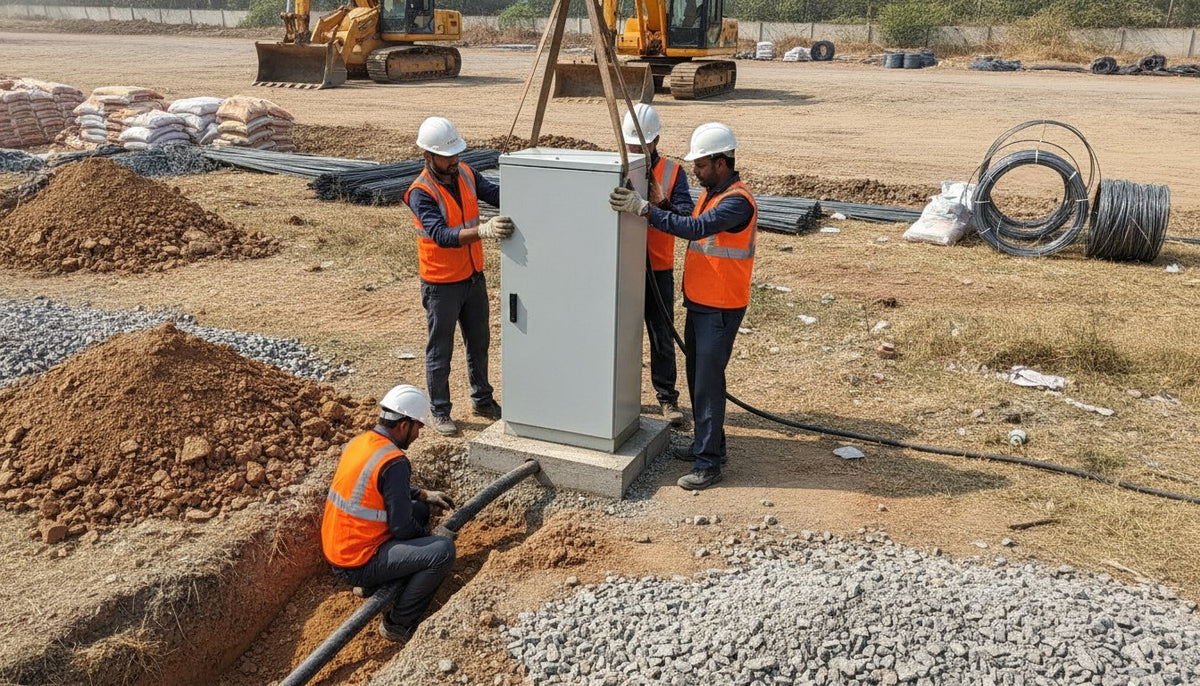
With the power and civil work done, the charger itself goes in fast. It's placed on the plinth, connected, and then tested: earth resistance, insulation, and the protections. After that it's brought online. The charger connects to its software over Wi-Fi or a 4G SIM using OCPP, your price per unit is set, and payments are tested. The last check is a real car charging from start to finish, including a UPI payment.
Before you open to the public, double-check the approvals you need for your site. Our approvals checklist covers them all.
Common delays, and how to avoid them
- Land papers not in order. The DISCOM and the bank will both want proof that you own or have leased the site. Sort this out first.
- Applying for too little load. If you might add a second charger later, ask for the load now. Going back for an increase means starting over.
- Underestimating the cable run. A longer route than planned means thicker cable and more trenching. Measure it during the survey.
- Weak earthing. If the earth pits don't test well, the charger can't be switched on. Dry or rocky soil can need extra pits.
- No internet at the spot. Check mobile signal where the charger will stand. Without a connection, drivers can't start or pay.
What does installation cost?
It depends almost entirely on the site: the length of the cable run, whether you need HT supply and a transformer, and how much civil work there is. Our cost and earnings calculator gives a range for a whole station on your type of site, and our DC charger price page shows the chargers themselves. If you're borrowing for the project, see our loans guide.
What we'd do
Get the survey done before you buy anything, and file the DISCOM application as soon as you know the load. Everything else can run alongside it. If you'd like us to handle it, book a site survey or see how we plan and build DC stations.
Frequently asked questions
How long does it take to get a power connection for an EV charging station?
Under the Ministry of Power's 2024 guidelines, DISCOMs should connect a charging station within 3 days in metropolitan areas, 7 days in other municipal areas, 15 days in rural areas and 30 days in hilly rural areas, or 90 days where mains have to be extended or a new substation built.
Do I need an HT connection for a DC charger?
Not always. If you apply for a separate LT connection for the charging station, the DISCOM must provide LT supply up to 150 kW under the Ministry of Power's 2024 guidelines. Above that, you need HT supply with your own transformer.
Should EV charging be on a separate electricity connection?
Usually yes. The Ministry of Power's guidelines make separate metering mandatory for charging stations, a separate connection can come under your state's EV tariff, and it keeps the charging load off your main supply.
What earthing does a DC charger need?
Tested earth pits with low resistance, checked before the charger is switched on, plus an earth-continuity monitor in the charger as required by the CEA safety regulations. For example, our Nova 60 product sheet asks for two to three earth pits under 1 ohm.
What civil work does a DC charger need?
A raised concrete plinth, bollards or wheel stops, bay markings, lighting, signs, drainage, and a canopy if you want one.
What usually delays a DC charger installation?
Land papers not in order, applying for too little load, a longer cable run than planned, earth pits that don't test well, and no mobile signal at the charger spot.


