
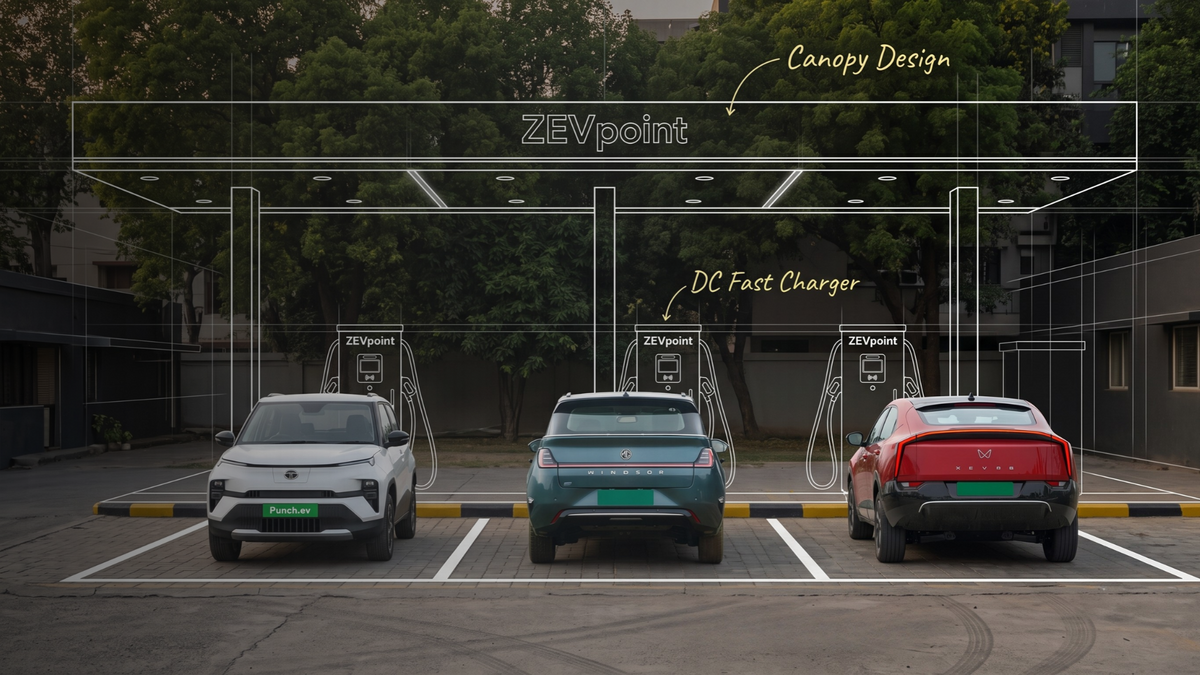

Short answer: a highway DC station sells time, not electricity. A driver stops for twenty to forty minutes, and the site wins or loses on whether the charger works, whether it is free, and whether there is somewhere decent to wait. The equipment decisions follow from that: at least two guns from day one, a charger that serves the middle band of cars in full, a canopy, payment that needs no app, and a power connection planned for the second phase before the first is built. The best highway sites in India today are dhabas, fuel stations and hotels that already have the driver's attention.
What a highway driver actually wants
Ask anyone who has driven an EV from Delhi to Chandigarh and the list is short. A charger that is working, shown as working before they leave the expressway. A bay that is free, or will be soon. A clean toilet, tea and shade. And a session that starts without a new app, a new account or a call to a helpline. Speed comes after all of that, and only up to what the car can take.
So the site is the product. The charger is what gets it on the map.
Which charger, and how many guns
Look at what drives past. Most of the EVs on Indian highways today take 60 kW or less, and the newer mid-market SUVs take up to about 120. A Nova 120 serves every one of them in full, two at a time when neither asks for more than half, which is why it is our default for a highway stop. A Nova 180 or 240 makes sense where premium cars are a real share of the traffic: the expressways around the metros, the routes to hill stations, the corridors with high-end hotels. Our live table of what each car takes is in what each car takes from a DC charger.
Two guns is the minimum. One gun means one car in the bay and the next one leaving. Two guns, or better two chargers, means a fault or a slow driver does not close the site. We set out the trade-off in one dual-gun charger or two single ones.
Power is the long pole
A highway plot is usually on a rural or semi-urban feeder, and a DC station is often the largest load the DISCOM has been asked for on that line. Up to 150 kW, apply for a separate connection for the station: the Ministry of Power's 2024 guidelines tell DISCOMs to supply that at LT, even in states whose general ceiling is lower. Above 150 kW, or if the DISCOM refuses, your state's ceiling below decides, and the site needs HT and its own transformer. Whatever it says, apply for the load you will need in two years, not the load for the first charger: a second HT application on the same site costs the same paperwork and the same wait again.
The site around the charger
- Bays a car can enter and leave forwards. A highway driver will not reverse into a bay in the dark between trucks. Drive-through layouts beat parking-lot layouts.
- A canopy. Our chargers are rated IP54 and work from minus 25 to plus 70 °C, but the driver standing at the screen in May is not. Every Nova plinth is specified with a canopy.
- Light and a camera. A charger that is lit at night is a charger people stop at.
- A clear walk to the food and the toilet. The driver will spend most of the session there, and that is where a dhaba or a fuel station earns from the stop.
Getting found, getting paid
A highway charger nobody knows about earns nothing. Drivers find chargers in apps and maps, so the site needs to be listed where they look. Our software can publish the charger's live status to maps and partner networks as an add-on. Payment must be as simple as a toll plaza: drivers scan and pay from any UPI app already on their phone, with no download and no sign-up, and the money settles to the owner's account. See how the software works.
What we would not do
We would not build one 240 kW gun on a two-lane state highway where the traffic is mass-market cars, and call it future-proof. Two guns that work beat one fast gun that is busy or broken. We would not plan the site around the first charger and discover the transformer has no room for the second. And we would not open without listing the site and testing a payment from three different UPI apps.
Have a plot on a highway? Book a site study. We will check the feeder, the plot and the traffic, and draw the station on your land.
Frequently asked questions
What is the best DC charger for a highway charging station in India?
For most highways, a 120 kW dual-gun charger. It serves the cars on Indian roads today at their full rate, two at a time. Routes with many premium cars justify 180 or 240 kW.
How many chargers does a highway station need?
At least two guns from day one, and ideally two chargers, so a fault or a long session does not close the site.
Does a highway charging station need an HT connection?
Not up to 150 kW, if the station has its own connection: the Ministry of Power's 2024 guidelines tell DISCOMs to supply that at LT. Above 150 kW the state's ceiling decides, and most highway sites that grow past two chargers go HT. Apply for the load you will need in two years, not just for the first charger.
How do drivers pay at a highway charger?
By scanning and paying from any UPI app on their phone, with no app to download and no sign-up. The money settles to the owner's account.
Are dhabas and fuel stations good sites for DC chargers?
Often the best ones, because they already offer what a driver needs during a 20 to 40 minute stop: food, toilets, shade and a known location.


