
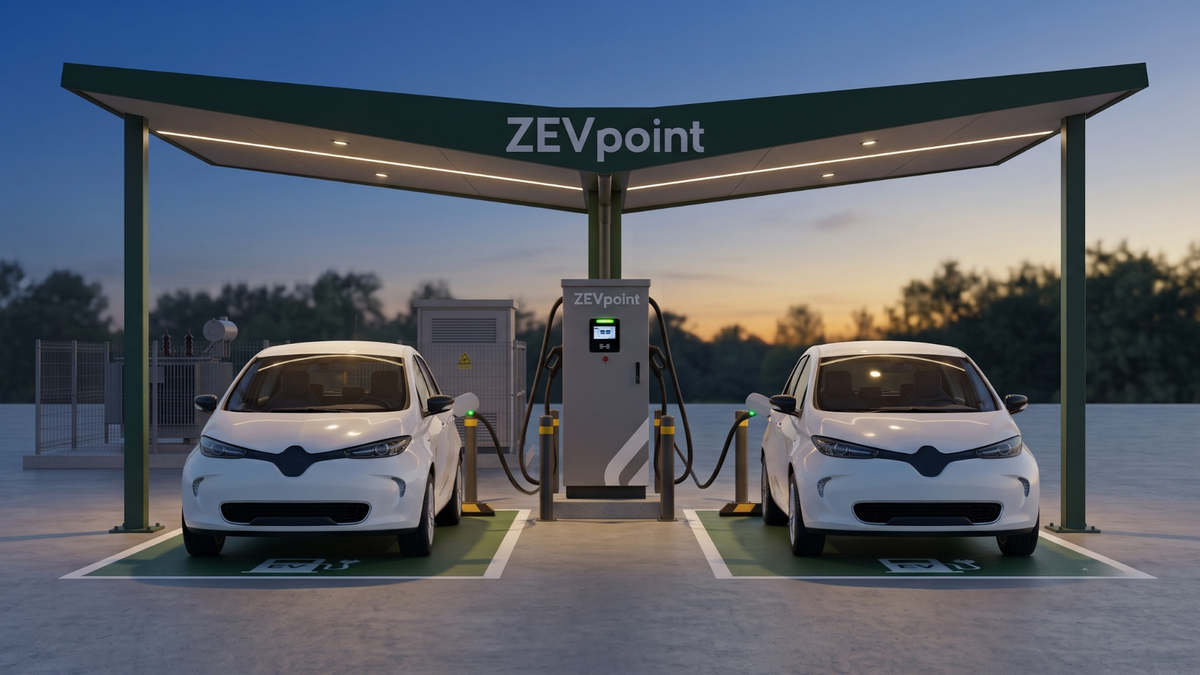

Short answer: a car dealership needs a DC charger for three moments, not for the public: the delivery bay, where a new owner should drive away with a full battery; the workshop, where cars arrive low and must leave charged; and the test drive, where a flat demo car loses a sale. Size it to the fastest car the brand sells, because that is the car the customer is about to pay the most for. Today almost every mainstream brand has at least one car that takes more than 60 kW, so for most showrooms the answer has moved from a Nova 60 to a Nova 120.
Why a showroom is not a public station
A public station earns per session and lives or dies by traffic. A dealership's charger earns nothing directly. It protects margins that are already won: a delivery that does not slip, a service car that goes back on time, a demo car that is ready when a family walks in on a Sunday. The question is not utilisation. It is how many hours a car sits at the dealership waiting for charge, and what each of those hours costs.
That changes the sizing. A public site can buy for the average car on the road. A dealership must buy for the best car on its own floor, because that is the car whose delivery day cannot go wrong.
The three jobs
- Delivery. Cars often reach the dealership with a low state of charge after transport and storage, and a new owner expects a full battery and a long first drive. Overnight AC can do it if the car comes in a day early. It rarely does.
- Workshop. A car in for service often comes in near empty, and diagnostics and software updates drain it further. Each car that goes back at 30% is a call to the service manager.
- Test drives. Two demo cars on a busy weekend can drive a hundred kilometres between them by noon. A demo car that cannot leave the showroom is a lost conversation.
Sizing to the brand
Find your brand's fastest car in the table below and read across. The charger in the last column is the smallest one that gives that car everything it can take. It is the same table we use when we plan a showroom, and it updates when a maker changes a figure.
Two things stand out. First, the mass-market brands have moved: Tata, MG, Hyundai, Kia and Maruti each sell at least one car in the middle band now, so a dealer who bought a 60 kW charger two years ago is already charging the newest cars on the floor below their rate. Second, the premium band is where the brands are going. A Mahindra dealer with the BE 6 and XEV 9e has cars that can use a Nova 180.
One charger or two
Most showrooms need one dual-gun unit, placed between the delivery bay and the workshop door so both can reach it. Cars come in one at a time, the second gun covers the overlap, and a single car alone can take the full rating. A large multi-brand or high-volume dealership is different: deliveries cluster at month end, and that is when a second unit stops the queue. We cover the trade-off in one dual-gun charger or two single ones.
Open it to the public, or not
A showroom on a main road has something a public operator pays for: a visible forecourt and opening hours. Listing the charger publicly brings strangers onto the forecourt, which some dealers want and some do not. It can be both. Our software lets each charger be public, private or member-only, with a different tariff per group, so the charger can serve your own cars at no charge in the morning and earn from passing drivers in the evening. Drivers pay from any UPI app on their phone, with no app to download. See how the software works.
What we would not do
We would not put a dealership's DC charger at the far end of the yard where the cable run is cheapest. It goes where the delivery bay can reach it, because that is the bay that pays for it. We would not size it for the car that sells most, if the brand's top car takes more. And we would not skip the power check: a showroom's existing connection is often already near its limit with lights and air-conditioning, and the charger may need a load increase before it can be switched on. See how much power a DC charging station can get.
Ready to plan one? Book a site study. We will measure the yard, check the connection and put the charger where your delivery bay can use it.
Frequently asked questions
Does a car dealership need a DC charger or is AC enough?
AC is enough for cars that sit overnight. A dealership needs DC for the moments it cannot wait: deliveries that must leave full, service cars that must go back on time, and demo cars on a busy weekend.
What size DC charger should a dealership install?
The smallest charger that gives the fastest car the brand sells its full rate. For most mainstream brands today that is a Nova 120; for brands with cars that take over 150 kW, a Nova 180 or 240.
Can a dealership charger be open to the public?
Yes. Each charger can be public, private or member-only, with a different tariff for each group, so it can serve your own cars free and charge passing drivers.
Where should the charger go in a showroom?
Where the delivery bay and the workshop door can both reach it. That is the bay that pays for the charger, even if a longer cable run costs more.
Will the showroom's existing electricity connection be enough?
Often not. Lights and air-conditioning already use much of it, so a DC charger may need a load increase from the DISCOM. A site study checks this on day one.


